
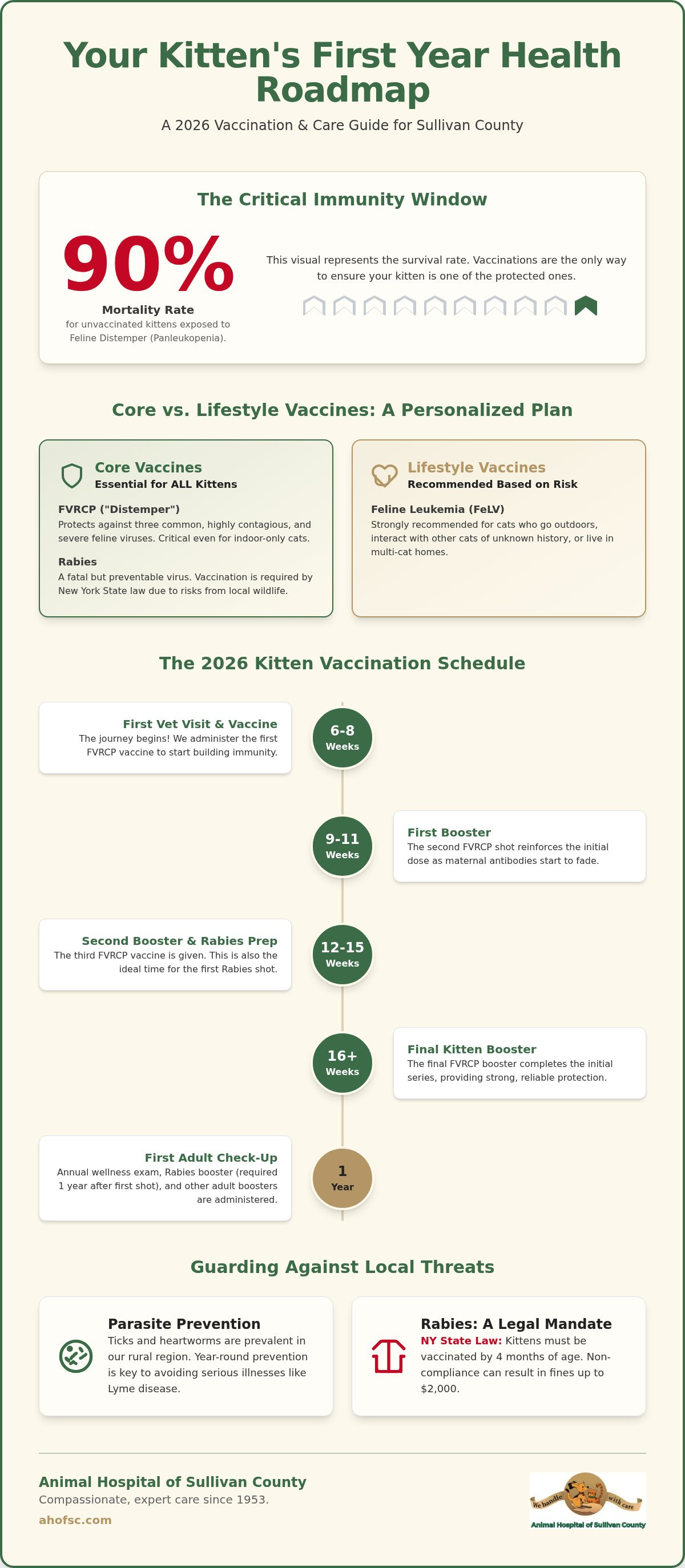
Did you know that unvaccinated kittens exposed to feline distemper face a heartbreaking mortality rate of up to 90%? Bringing a tiny, purring new family member into your home is one of life's greatest joys, yet it often brings a heavy sense of responsibility. You want to do everything right to protect this sacred bond, but the local wildlife and rural landscape of the Catskills can make the world feel a bit unpredictable for a small pet. It is completely normal to feel anxious about timing your vet visits or choosing the right level of protection.
We believe that keeping your pet safe should be a stress-free experience rooted in compassion and expert care. By following a clear kitten vaccination schedule Sullivan County parents can trust, you'll ensure your kitten grows up healthy and strong. This 2026 checklist provides a comprehensive roadmap for your kitten's first year of life. We will walk you through New York State's rabies requirements, the difference between core and non-core vaccines, and how to schedule your visits using tools like the PetDesk app for a seamless journey toward lifelong health.
Key Takeaways
- Learn how to protect your kitten from the unique wildlife risks and environmental challenges found right here in the Catskills.
- Master the kitten vaccination schedule Sullivan County requirements to ensure your pet is protected against life-threatening diseases and meets New York State legal standards.
- Gain clarity on the difference between essential core vaccines and lifestyle-based options to create a personalized health roadmap for your pet.
- Discover how to safeguard your kitten from local "silent threats" like ticks and heartworms that are prevalent in our rural region.
- See how our compassionate team uses modern tools like the PetDesk app to make managing your new kitten's first year of care simple and stress-free.
Why Your Kitten Needs a Sullivan County-Specific Health Plan
A kitten's first 16 weeks represent a fleeting but vital window for their long-term health. During this time, their immune systems are essentially under construction. While they receive initial protection through maternal antibodies in their mother's milk, this natural shield eventually fades. This creates a dangerous gap where they are highly vulnerable to local diseases. Following a consistent kitten vaccination schedule Sullivan County provides is the only way to bridge this gap safely. Boosters are non-negotiable because they ensure the immune system responds correctly as those maternal antibodies disappear. We view this roadmap as more than just a medical requirement; it's the foundation for a lifetime of happiness and shared memories with your new companion.
The Catskills Wildlife Factor
Our rural landscape brings specific risks that urban pets rarely face. Raccoons, foxes, and bats are common neighbors in Sullivan County; each can carry diseases like rabies. Even indoor-only kittens face risks from stray visitors or bats entering the home. Core vaccines are the essential shield for all New York cats regardless of their lifestyle. When Understanding Core vs. Lifestyle Vaccines for Cats, it's clear that our local environment dictates your pet's safety. Protecting your kitten means acknowledging these local threats with a proactive plan that leaves nothing to chance.
A Legacy of Protection in Ferndale
Since 1953, our hospital has served as a steady guide for local families. We know a kitten's first vet visit sets the tone for their entire life. Led by Dr. Barbara Bodolosky, our team uses a heart-first approach to make your new family member feel safe. We combine medical expertise with neighborly empathy to help you manage the kitten vaccination schedule Sullivan County families rely on for peace of mind. Our goal is to build a relationship of trust that lasts through every stage of your cat's life, starting with these first gentle appointments. We are here to ensure your kitten's medical journey is as comforting for you as it is for them.
Understanding Core vs. Lifestyle Vaccines for Cats
Choosing the right vaccinations is one of the most important decisions you'll make for your new family member. It is a sacred bond of protection that we take very seriously. We don't believe in a one-size-fits-all approach. Instead, we use the 2020 AAHA/AAFP Feline Vaccination Guidelines to separate essential core vaccines from lifestyle-based options. This ensures your kitten receives exactly what they need to stay safe in our unique Catskills environment without over-vaccinating. Our goal is to provide medical authority wrapped in neighborly empathy, making the process clear and stress-free for both you and your pet.
FVRCP: The Feline "Distemper" Shield
The FVRCP vaccine is a vital combination that protects against three major threats: Feline Viral Rhinotracheitis, Calicivirus, and Panleukopenia. This "distemper" shot is critical because these viruses are incredibly hardy. They can even be brought into your home on your shoes or clothes, making them a threat to indoor-only cats. Panleukopenia is particularly devastating. Research shows that unvaccinated kittens face a mortality rate between 70% and 90% when exposed to this virus. To build strong immunity, we typically start this series between 6 and 8 weeks of age. Boosters are then administered every three to four weeks until the kitten reaches 16 weeks old. Following this precise kitten vaccination schedule Sullivan County parents can ensure their pets are fully shielded during their most vulnerable months.
Rabies: Sullivan County Legal Mandates
Rabies is not just a health concern; it is a legal requirement. New York State law mandates that every kitten receives their first rabies vaccination by four months of age. In our rural area, the risk is real. Our local wildlife, including bats and raccoons, are frequent carriers of the virus. A second rabies shot is required one year after the first, followed by boosters every one to three years depending on the vaccine type. Protecting your pet from rabies is also a matter of human safety, as the virus is fatal to people. Failure to comply with these laws can result in fines of up to $2,000, but the peace of mind you gain from a protected home is the true reward.
Feline Leukemia (FeLV) for the Adventurous Kitten
Feline Leukemia is considered a "lifestyle" or non-core vaccine. We strongly recommend it for kittens who may eventually spend time outdoors or live in multi-cat households where exposure is more likely. Before we begin the FeLV series, we always perform a blood test to ensure the kitten is currently negative. This tailored approach allows us to provide protection only where it is truly needed. If you aren't sure about your pet's future habits, our team can provide a personalized preventive care consultation to help you decide. We focus on a gentle "bedside manner" and use stress-reduction techniques during every injection, ensuring your kitten's experience is as calm and comforting as possible.
The 2026 Kitten Vaccination Schedule: A Week-by-Week Roadmap
Understanding the timing of your kitten's medical visits is the first step toward a worry-free first year. We follow a specific 3-4 week interval between appointments. This timing is essential because it ensures that as maternal antibodies naturally fade, the vaccines can effectively stimulate your kitten's own immune system. By adhering to this kitten vaccination schedule Sullivan County parents can rest easy knowing there are no gaps in their pet's protection. We treat these visits as milestones in a growing relationship, focusing on both physical health and emotional comfort.
Your First Visit Checklist (6-8 Weeks)
At six to eight weeks, your kitten's journey truly begins. This first visit is about more than just shots; it's a comprehensive health assessment. We perform a gentle physical exam to ensure their heart, lungs, and tiny joints are developing perfectly. This is also when we administer the first FVRCP dose. Since kittens are curious and often arrive with unwanted guests, we conduct a fecal exam to identify intestinal parasites. You can learn more about these risks in the Cornell Feline Health Center guide to parasites. We also recommend discussing pet microchipping Sullivan County to provide a permanent safety net if your explorer ever wanders too far.
The Middle Milestone (10-12 Weeks)
Between 10 and 12 weeks, your kitten enters a critical growth phase. We provide the FVRCP booster and the first dose of the Feline Leukemia (FeLV) vaccine for those who need it. This visit is a great time to evaluate their nutritional needs to support their high energy levels. We also introduce flea and tick prevention during this window. Because our Catskills region is a high-risk area for ticks, starting this early is essential for their comfort and safety. We'll help you choose the right products from our pet store to keep your home and kitten pest-free.
Completing the Foundation (14-16 Weeks)
By 14 to 16 weeks, we complete the primary series. This includes the final FVRCP and FeLV boosters. Most importantly, this is when your kitten receives their legally required Rabies vaccine. Completing this kitten vaccination schedule Sullivan County roadmap provides the immune system with the memory it needs to fight off future infections. We will also begin discussing veterinary surgery Sullivan County options for spaying or neutering, which is a key part of long-term wellness. Don't forget that a one-year booster is required 12 months after this final visit to solidify adult immunity and ensure lifelong safety.
Beyond Vaccines: Protecting Your Kitten from Local Parasites
Protecting your kitten requires a multi-layered approach that goes beyond the needle. While following the kitten vaccination schedule Sullivan County experts recommend is vital, vaccines don't shield against every local threat. Parasites are silent invaders that can compromise a young cat's health before you even notice a problem. In our lush Catskills region, these pests are more than just a nuisance; they are a year-round reality. We advocate for continuous prevention rather than seasonal treatment because our local weather patterns can be unpredictable. Our onsite lab provides immediate results for parasite screenings, ensuring we catch any issues early while you are still in the exam room with us.
Ticks and the Catskills Environment
Sullivan County is a known hot zone for tick-borne illnesses like Lyme disease. Even if your kitten never steps paw outside, they still need a safety net. Ticks frequently hitchhike into homes on our own clothing or on other family pets. We only recommend safe, veterinarian-approved products that are specifically formulated for a kitten's developing system. You can find these trusted options among our pet store products. Using the right prevention early on prevents the stress of treating a complex illness later. We want your home to be a sanctuary where you don't have to worry about these tiny, dangerous intruders.
Heartworm and Intestinal Health
There is a common myth that cats are immune to heartworm. The reality in Sullivan County is quite different. While heartworm is more frequently discussed for dogs, it can be fatal for cats and has no approved treatment for them. Prevention is the only cure. Similarly, routine deworming is essential for every new pet. Many kittens are born with intestinal parasites like roundworms. Treating these early protects your kitten and your human family, as some of these parasites can be transmitted to people. Remember that senior pet care Sullivan County residents value actually begins with these healthy choices in kittenhood. Establishing a strong foundation now ensures your companion enjoys their golden years with vitality and comfort.
If you are ready to start your new family member on the right path, book your kitten's first preventive care appointment today.
Compassionate Care at Animal Hospital of Sullivan County
At the Animal Hospital of Sullivan County, we believe that medical care is about more than just clinical science; it is about the sacred bond between you and your animal companion. Our "heart-first" philosophy means we treat every kitten as if they were a member of our own family. Led by Dr. Barbara Bodolosky, affectionately known as Dr. B, our team brings decades of experience and a gentle bedside manner to every exam table. Since 1953, we've served the Ferndale community with a unique blend of professional medical authority and neighborly empathy. We understand that the first few visits can be an emotional time for new pet parents. We're dedicated to being your steady, calming guide through every milestone of your kitten's growth.
A Welcoming Environment for New Kittens
Entering a clinic can be a scary experience for a tiny kitten. We use gentle, stress-free handling techniques to ensure your pet feels safe and cherished from the moment they arrive. Our staff is trained to move at a pace that feels supportive, never rushed or frantic. To help you stay organized during this busy year, we encourage using the PetDesk app. This tool makes it simple to track your kitten vaccination schedule Sullivan County requirements and receive helpful reminders for upcoming boosters. We take immense pride in maintaining high animal hospital Sullivan County standards, ensuring your pet receives the quality care they deserve in a warm, welcoming setting.
Ready to Start Your Journey?
Booking your first kitten wellness exam is the first step in a lifelong journey of health and happiness. When you're preparing for your visit, we recommend making the car ride as comfortable as possible. Place a familiar blanket or a calming pheromone spray in a secure carrier to help your kitten feel at ease during the trip to Ferndale. During the visit, we'll review the kitten vaccination schedule Sullivan County families rely on and answer any questions you have about nutrition, behavior, or local safety risks. We're honored to join the generations of local families who have trusted us with their pets' lives for over 70 years. Your peace of mind is our priority, and we look forward to welcoming your new family member into our care with open arms and expert hands.
Starting Your Journey Together with Confidence
Navigating your kitten's first year is a beautiful responsibility that sets the stage for a lifetime of purrs and companionship. By following the kitten vaccination schedule Sullivan County parents trust, you've ensured your pet is protected from both local wildlife threats and legal complications. We've explored the essential nature of core boosters and the vital need for year-round parasite prevention in our unique rural environment. These proactive steps are the greatest gifts of safety you can give to your new family member during their most vulnerable months.
Since 1953, our team has been a steady partner for families in Ferndale and beyond. Led by Dr. Barbara Bodolosky, we provide the medical expertise and gentle bedside manner your kitten deserves. We want to make this process as easy as possible for you! You can even use the PetDesk app to manage your records and receive helpful reminders right on your phone. It's time to turn this checklist into action and secure your pet's future health.
Schedule Your Kittens First Wellness Exam Today and let us help you protect the sacred bond you share with your pet. We can't wait to meet your newest family member and welcome you into our community of care.
Frequently Asked Questions
At what age should I start my kittens vaccination schedule?
Your kitten should begin their medical journey between six and eight weeks of age. This initial visit is vital because it establishes a foundation of health just as their mother's natural protection begins to fade. We'll perform a gentle physical exam and administer the first FVRCP dose. Starting this early ensures your pet is shielded during their most vulnerable stage of development. We want your first experience with us to be as warm and welcoming as possible!
Does my indoor kitten really need a rabies vaccine in Sullivan County?
Yes, New York State law requires all cats to be vaccinated against rabies by four months of age, regardless of their indoor status. Bats or other small wildlife can occasionally enter homes, posing a significant risk to unprotected pets. Rabies is a fatal disease for animals and humans alike; therefore, this requirement is about community safety. Following the kitten vaccination schedule Sullivan County mandates provides you with essential legal protection and total peace of mind for your household.
What are the most common side effects of vaccines in kittens?
Most kittens experience only mild, temporary side effects after their injections. You might notice your pet is a bit sleepy or less interested in play for about 24 hours. Some experience slight soreness at the injection site or a very mild fever. These are normal signs that the immune system is working! If you notice any swelling, vomiting, or breathing difficulties, please contact us immediately. We're here to support you and ensure your kitten feels loved throughout the process.
How much time should I leave between kitten vaccine boosters?
We recommend leaving exactly three to four weeks between each booster appointment. This specific interval is crucial for building a strong, lasting immune response as maternal antibodies decrease. If you wait too long, the immune system might forget the previous dose, and we may need to restart the series. Using the PetDesk app can help you track these visits easily! We want to keep your kitten's health journey steady and methodical to ensure maximum protection.
Can my kitten get all their shots in one single visit?
No, a single visit cannot provide the lifelong immunity your kitten needs. Their developing immune system requires a series of doses over several months to learn how to fight off diseases effectively. While we can often combine certain vaccines like the FVRCP combo shot, the legal and biological requirements for boosters mean you'll visit us three or four times. This paced approach is much safer and more effective for your pet's long-term health and comfort.
What happens if I miss a scheduled booster for my kitten?
If you miss an appointment, please reach out to us as soon as possible to get back on track. Depending on how much time has passed, your kitten might need to restart a specific series to ensure they are fully protected. Gaps in the kitten vaccination schedule Sullivan County parents follow can leave pets vulnerable to local threats like distemper. We'll work with you with kindness and patience to adjust the roadmap and keep your pet safe.
Are there any specific vaccines required for kittens in the Catskills?
In our rural Catskills environment, the Rabies and FVRCP vaccines are considered essential core protections for every kitten. Because we share our landscape with abundant wildlife, the Rabies vaccine is a strict legal requirement in New York. We also strongly recommend the Feline Leukemia (FeLV) vaccine for any kitten that might spend time outdoors. We'll help you tailor a plan that fits your pet's specific lifestyle while addressing the unique biological risks found in our region.
How do I prepare my kitten for their first visit to Animal Hospital of Sullivan County?
Preparing for your first visit starts with making the car ride a soothing experience. Use a secure carrier and place a familiar, soft blanket inside to provide comfort. You can also use calming pheromone sprays to help reduce any travel anxiety. When you arrive at our Ferndale clinic, our compassionate team will use gentle handling techniques to make the exam feel safe. We're dedicated partners in your journey of care and can't wait to welcome your new family member!


