
A clinic’s location and hours are more than map details: they help you plan care for your pet. If you’re looking for a Monticello, NY vet clinic, start with where it’s located, when it’s open, and whether it provides routine care and urgent treatment.
It’s reassuring to know what to expect before a wellness visit or when your pet needs attention. This guide covers the clinic’s location and weekly hours, emergency and critical care options, and the medical and surgical services available. You’ll also find information about the practice’s history and staff, offering a clearer picture of the people and care behind the clinic. With these practical details in one place, you can better understand which services fit your pet’s needs and plan your next step.
Key Takeaways
- Use the clinic’s location and weekly schedule to plan routine visits and understand when the practice is open.
- Learn how medical assessments and diagnostic services can help guide care when your pet is unwell.
- Get a clearer picture of the surgical care discussed and how it fits into a pet’s treatment plan.
- Understand what to consider when your pet needs urgent attention, including the difference between emergency treatment and round-the-clock care.
- Explore the practice’s history and staff information to help you feel more informed about your pet’s care.
Medical and surgical services
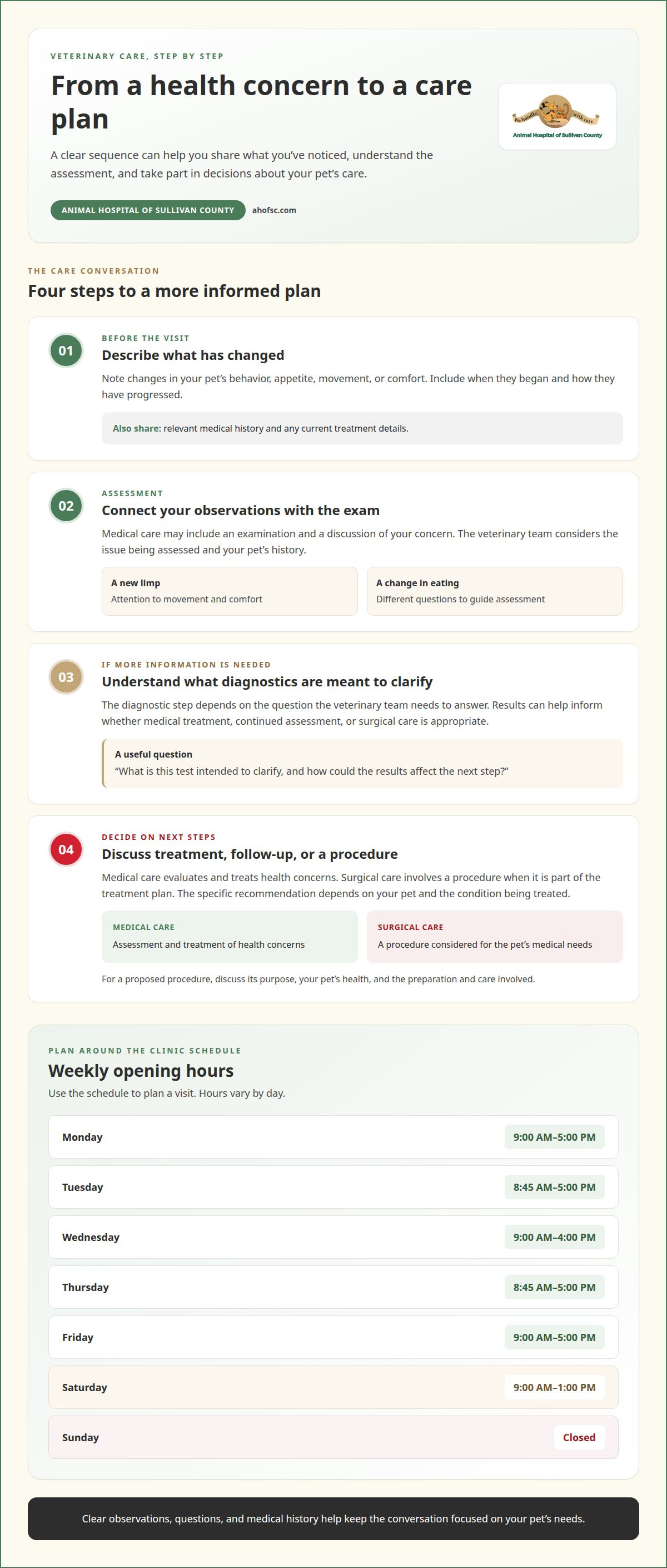
Medical care helps assess illness, injury, and changes in a pet’s health. At a Monticello, NY veterinary clinic, the visit starts with understanding what has changed. Note any differences in your pet’s behavior, appetite, movement, or comfort, along with when they began and how they have progressed. These details give the veterinary team a clearer starting point for evaluating your companion.
Medical care may involve an examination, a discussion of your concern, and decisions about next steps. The approach depends on what the team is assessing. A new limp, for example, calls for attention to movement and comfort, while a change in eating raises different questions. Sharing your pet’s history helps connect what you have observed with the examination and shape a plan around the individual animal.
Diagnostics can support medical decisions by adding information about a pet’s condition. The choice of diagnostic step depends on the question the veterinary team needs to answer. Results can help inform whether medical treatment, continued assessment, or surgical care is appropriate. A useful conversation covers what the test is intended to clarify and how its results may affect the next step. This keeps the plan focused on the pet’s health rather than assumptions.
Surgical care may be considered when a procedure is appropriate for a pet’s medical needs. Before surgery, the veterinary team considers the reason for the procedure, your pet’s health, and the information gathered during assessment. Discuss the purpose of the procedure and what preparation and care it involves. The specific plan depends on your pet and the condition being treated.
- Describe the concern clearly, including when it began and what has changed.
- Share relevant medical history and any current treatment details.
- Ask what a proposed diagnostic step is meant to determine.
- Discuss the purpose of a recommended procedure and the care plan around it.
These steps make conversations about veterinary services more useful and support informed decisions about follow-up, medical treatment, or surgery. Bring questions about how a recommendation relates to your pet’s comfort and health. Clear communication at each stage helps keep the plan focused on your companion’s needs.
For a Monticello-area family, medical and surgical care serve different purposes. Medical care evaluates and treats health concerns; surgical care involves a procedure when it is part of the treatment plan. The veterinary team can explain the reasoning behind a recommendation and how diagnostic testing may contribute. Understanding the distinction helps you take part in decisions for your companion.
Practice history and staff
A practice’s history can help explain how its approach to veterinary care developed. For families in Monticello, New York, the useful details are specific: when a hospital began, how its services changed, and what staff members do today. Those details help distinguish a current practice profile from a similarly named clinic elsewhere. A name alone does not establish a connection between practices or confirm shared history.
Staff information is most helpful when it describes professional roles in clear terms. A veterinarian assesses a pet’s health concerns and discusses possible care. Other team members may help coordinate appointments or support care during a visit. Specific responsibilities vary by practice, so a reader should rely on the roles actually described for that hospital. Clear role descriptions make it easier to understand who is involved at each step.
If your pet may need surgery, an assessment and a discussion of the procedure help clarify the plan. Dr. Barbara Bodolosky and the veterinary team can discuss your pet’s needs and the care being considered. Staff experience offers context, but no biography can guarantee a particular outcome. Focus the conversation on how the proposed care relates to your companion.
History can offer context, but it does not replace current information. A long-standing name alone cannot show which services are available today or who currently provides them. A practical way to read a practice history is to separate past milestones from present-day details. Look for the current staff roster, role descriptions, and information about the care offered. This keeps an older date from being mistaken for a current service or staffing fact.
- Read the practice history for named milestones and distinguish them from present details.
- Use staff profiles to understand each person’s stated role and professional focus.
- For a planned procedure, identify who explains the surgery and care plan.
- Keep a pet’s medical records and questions together for a more focused discussion.
A concise question list can help you discuss your companion’s needs with the veterinary team. For instance, note a new health concern, the changes you have observed, and what you hope to understand during the visit. These details help keep the conversation specific to your pet, rather than relying on general claims about a hospital’s history. They also give staff a clearer picture of what matters to your family.
For practical context on care for your companion, browse the veterinary care information and consider how its stated services relate to your pet’s needs. History and staff details are most useful when they help you understand the people involved and the care being discussed. A healthy relationship with a veterinary team starts with clear information, attentive questions, and a shared focus on your pet.
Weekly opening hours
The weekly schedule gives pet owners clear windows for planning veterinary visits in Monticello. Monday hours are 9:00 AM to 5:00 PM. Tuesday and Thursday hours begin earlier, at 8:45 AM, and end at 5:00 PM. Wednesday closes earlier, at 4:00 PM. Friday hours are 9:00 AM to 5:00 PM, while Saturday hours are 9:00 AM to 1:00 PM. The clinic is closed on Sunday.
- Monday: 9:00 AM to 5:00 PM
- Tuesday: 8:45 AM to 5:00 PM
- Wednesday: 9:00 AM to 4:00 PM
- Thursday: 8:45 AM to 5:00 PM
- Friday: 9:00 AM to 5:00 PM
- Saturday: 9:00 AM to 1:00 PM
- Sunday: Closed
Those weekday differences can shape a pet owner’s visit plan. For example, Tuesday and Thursday offer the earliest weekday opening. Wednesday’s earlier closing makes the afternoon window shorter than Monday, Tuesday, Thursday, or Friday. Saturday provides a morning option, with service hours ending at 1:00 PM. Sunday has no open hours in this schedule.
For routine pet care, consider the purpose of the visit alongside the clinic’s hours. A wellness exam, vaccination visit, or follow-up may call for different discussion and preparation than an urgent concern. Organize your questions and relevant medical details beforehand. The posted hours can guide your planning, while the appointment time determines when you’ll be seen.
Hours also matter when a pet becomes unwell during the day. If a concern arises close to closing, note the time and the changes you’ve observed. For instance, a pet owner who notices a sudden change late Wednesday should keep in mind that Wednesday hours end at 4:00 PM. The same concern on Saturday arises within a shorter opening window, which ends at 1:00 PM. These examples show why the day and time matter when arranging pet care.
The posted schedule shows when the clinic is open, but it does not indicate appointment availability or the length of an individual visit. If your pet has ongoing needs, keep a record of recent symptoms and questions to make the next conversation more useful. Note when a concern began and whether it has changed.
Use the weekly hours as a planning guide: identify the day that fits, account for Wednesday’s earlier closing or Saturday’s morning schedule, and prepare the details that matter for your pet. Sunday is closed, so it isn’t an option for a scheduled visit under this timetable.
What services do vet clinics in Monticello, NY provide?
Veterinary services support pets through preventive visits, illness, injury, and changing needs over time. Animal Hospital of Sullivan County offers preventive wellness exams, essential vaccinations, medical care, diagnostics, and surgery. If you’re arranging routine care, you might need an exam or vaccinations; a new health concern calls for an assessment.
Preventive care helps keep a pet’s health needs visible before a concern prompts a visit. Animal Hospital of Sullivan County offers nose-to-tail wellness exams, annual wellness exams, senior-pet exams twice yearly, and essential vaccinations, including PUREVAX for feline patients. During a visit, discuss changes in appetite, movement, behavior, or comfort. A specific example, such as reluctance to climb stairs, helps focus the conversation.
Medical care addresses a current concern. A visit may begin with your pet’s history and symptoms observed at home. The veterinary team assesses the situation and discusses suitable next steps. Blood, urine, or fecal testing can help answer health questions. Notes about when symptoms began and how they have changed can help explain the pattern. The right approach depends on the pet and the concern.
Surgical care may be discussed as part of a treatment plan, with the reason for surgery and your pet’s health informing the conversation. Animal Hospital of Sullivan County offers spay and neuter surgeries and other surgical care. Ask what a recommended procedure is intended to address and what care surrounds it. These questions help clarify how surgery fits into your pet’s overall plan.
A pet’s needs can change with age. Young, adult, and senior pets may have different concerns to discuss during visits. Animal Hospital of Sullivan County offers preventive wellness exams, senior-pet exams twice yearly, diagnostics, dental care, medical care, and surgery. The appropriate plan depends on the individual pet.
- For a routine visit, note the topics you want to discuss, such as vaccinations or a change in daily behavior.
- For illness, record the symptom and when you first noticed it.
- For diagnostics, ask what health question a test is intended to clarify.
- For surgery, discuss the procedure’s purpose and how it relates to the treatment plan.
Understanding how preventive, medical, diagnostic, and surgical services relate to your pet’s needs can help you plan care. A clear description of the concern gives the veterinary team a useful starting point. For families in Monticello, Animal Hospital of Sullivan County offers these services in one local practice.
Which veterinarians in Monticello, NY accept new patients?
Starting care with a veterinarian begins with an initial appointment to discuss your pet’s health, history, and current needs. For families in Monticello, Animal Hospital of Sullivan County provides preventive, medical, diagnostic, and surgical care. The first visit is a practical opportunity to share the information that helps the team understand your companion.
A first appointment is more than a name on the calendar. Explain why you’re seeking care, whether your pet has an immediate concern, and what medical information you have. A newly adopted dog may need a wellness visit, while a cat with a recent change in appetite may need an appointment focused on that concern. Describe the reason for the visit plainly.
Prepare a concise history before the initial appointment. Include your pet’s age, known health conditions, current medications, and recent changes you have noticed. Bring or share previous veterinary records if you have them. A clear timeline helps the veterinarian understand whether a symptom is new, recurring, or changing.
- Write down the main reason for the visit and when the concern began.
- Gather available medical records and current medication details.
- Note changes in appetite, activity, behavior, or comfort.
- Bring questions about preventive visits, ongoing treatment, or diagnostics.
If your pet has no current health concern, an initial appointment can establish a baseline and provide time to discuss routine care. If your pet is already receiving treatment, summarize the diagnosis, care so far, and questions about next steps. This context helps make the visit specific to your animal.
Acceptance and scheduling are practical parts of starting care. The appointment process connects the pet’s needs with the right visit type and timing. Describe whether you’re seeking preventive care or help with an active concern, and share any time-sensitive changes. If your pet needs emergency attention, use the appropriate emergency-care option rather than treating a routine new-patient visit as urgent care.
Once an appointment is arranged, keep your notes and records together so details are easy to share. A short list of questions can help you cover the concerns that matter most, such as a new symptom or an ongoing treatment plan. Start planning your pet’s veterinary care with a clear summary of your companion’s needs and history.
Animal Hospital of Sullivan County
Animal Hospital of Sullivan County provides veterinary care for routine health needs and medical concerns. Its services include Preventive Care, Medical Care, Diagnostics, and Surgical Care. These offerings support wellness visits, assessment of health concerns, and treatment planning when surgery is considered.
Families can discuss preventive care, bring forward a medical concern, or learn how diagnostic testing may inform a care plan. If surgery is part of the plan, the veterinary team can explain the procedure and its purpose. Sharing your pet’s history and the reason for your visit helps focus the conversation on your companion.
Contact Animal Hospital of Sullivan County to discuss your pet’s veterinary care and next steps.
Take the next step with confidence
Choosing a Monticello NY vet clinic is a chance to build a relationship around your pet’s changing needs, not just arrange a single visit. Keep a note of questions as they arise, and bring your pet’s health history into the conversation. A thoughtful first discussion can help you decide what care makes sense now and what to plan for later.
Animal Hospital of Sullivan County offers Preventive Care, Medical Care, Diagnostics, and Surgical Care. These services support different stages of a pet’s care, from routine needs to treatment planning. Share what matters most to your family to keep the conversation centered on your companion.
Contact Animal Hospital of Sullivan County to discuss your pet’s care. A clear next step can make planning feel more manageable, and your companion deserves attentive support at every stage.
Frequently Asked Questions
Where are you located?
Animal Hospital of Sullivan County is at 667 Harris Rd, Ferndale, NY 12734. Ferndale is the practice’s physical location, while Monticello is among the communities it serves. The practice also serves the Catskills, Hudson Valley, New York City, and surrounding communities. Its local reach includes New York, Connecticut, New Jersey, and Pennsylvania, so families can consider the Ferndale location when planning veterinary care.
Which veterinary clinics are located in Monticello, NY?
Animal Hospital of Sullivan County is located in Ferndale, not within Monticello, and serves Monticello pet owners. Its address is 667 Harris Rd, Ferndale, NY 12734. The distinction matters when planning a visit: use the Ferndale address for directions, and consider the practice for your pet’s care from Monticello or nearby communities. The practice supports pets through preventive, medical, and surgical care.
What are the addresses, phone numbers, and hours of Monticello NY vet clinics?
For Animal Hospital of Sullivan County, the address is 667 Harris Rd, Ferndale, NY 12734, and the phone number is (845) 292-6711. Hours are Monday through Thursday, 7:30 AM to 6:00 PM; Friday, 8:00 AM to 1:00 PM; Saturday by appointment; and Sunday closed. Use these details when planning a visit from Monticello, and note the Saturday appointment arrangement.
Which Monticello veterinary clinics offer emergency or after-hours care?
Animal Hospital of Sullivan County provides urgent care and rapid-response emergency surgery during regular office hours. It does not provide 24/7 emergency care or after-hours care. If your pet has an urgent concern, call (845) 292-6711 during the practice’s posted hours to discuss the situation. For a pet owner in Monticello, knowing this distinction helps separate urgent daytime care from a need arising outside office hours.
Do Monticello NY vet clinics offer pet vaccinations, spay and neuter, or dental care?
Animal Hospital of Sullivan County offers essential vaccinations, spay and neuter surgeries, and dental care, including exams and professional cleanings. Vaccinations are part of preventive care, while spay and neuter procedures are surgical services. Dental exams and cleanings focus on oral health. Share your pet’s age, health history, and reason for the visit to guide the care discussion.
Which Monticello veterinary clinics accept pet insurance or offer payment plans?
Monticello Animal Hospital accepts pet insurance for unexpected accidents and illnesses.


