

A retiring veterinarian doesn’t have to mean a sudden break in your pet’s care. If my vet is retiring, finding a new one starts with learning who will continue seeing patients and how the clinic will handle the transition.
It’s natural to feel attached to a veterinary team that knows your pet’s history and personality. A thoughtful handover can help preserve that familiar approach: practice owners can choose a successor whose values align with the clinic’s and gradually transfer responsibilities while remaining available to guide them.
This article explains how to find a veterinarian who suits your pet’s needs, what to learn about an incoming vet and the clinic, and how a gradual transition can support continuity of care. You’ll also see how a clinic can keep its culture present as responsibilities shift, so you can make your next decision with greater confidence and care for the bond you share with your pet.
Key Takeaways
- Look for a veterinarian whose experience and approach fit your pet’s health needs and your family’s priorities.
- Compare clinics by the care they provide, appointment access, and hours that work for your household.
- Arrange for your pet’s medical records to reach the new veterinary team so important history can guide ongoing care.
- A meet-and-greet can help you understand the clinic’s communication style and how your pet responds to the team.
- A gradual handover, guided by shared values, can help a retiring veterinarian preserve the practice’s culture and continuity of care.
3. How to find a reputable new veterinarian near me
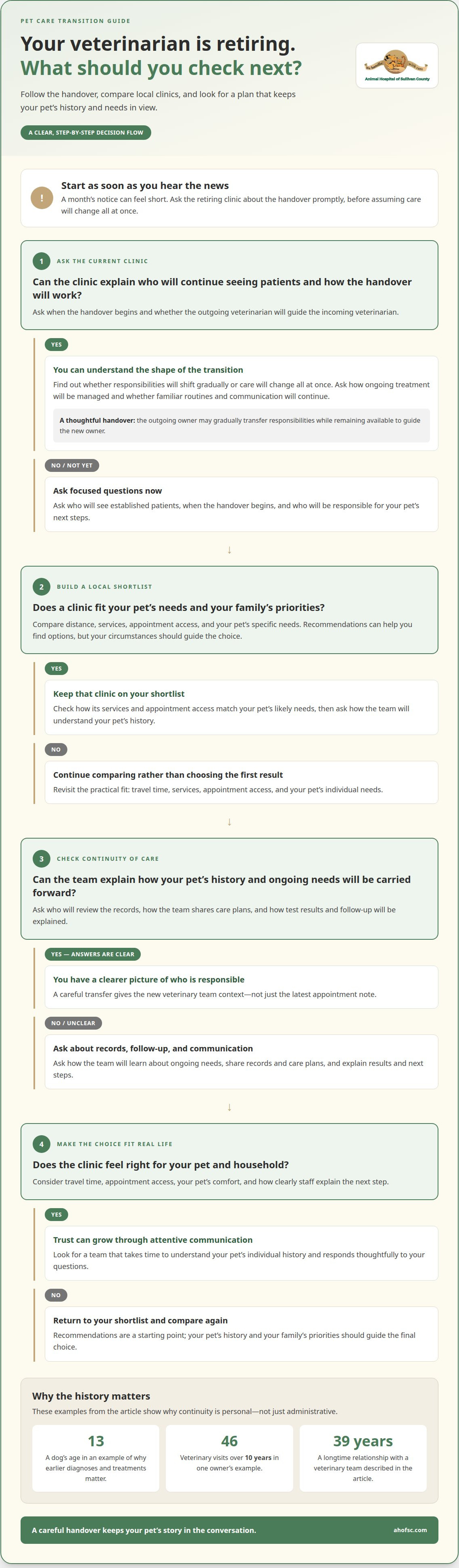
Start with the clinic that’s retiring your veterinarian. Ask who will continue seeing patients, when the handover begins, and whether the outgoing vet will guide the transition. Those details help you understand whether care will shift gradually or change all at once. A month’s notice can feel short, so ask about the transition as soon as you receive it.
Next, make a shortlist of local clinics rather than choosing the first search result. Consider distance, services, appointment access, and your pet’s specific needs. Recommendations can help you discover a practice, but your pet’s history and your family’s priorities should guide the final choice.
Look for continuity, not just convenience. A dog who is 13 may benefit from a new veterinarian taking time to understand earlier diagnoses, treatments, and changes over time. In one owner’s example, their dog had 46 veterinary visits over 10 years. That history shows why a careful transfer matters: a new team needs context, not just the latest appointment note.
When you contact a clinic, ask focused questions about records, follow-up, and communication. Who will review your pet’s history? How will the team learn about ongoing needs? How are test results and care plans explained? Clear, specific answers help you understand who will be responsible for your pet’s next steps.
- Ask whether the retiring veterinarian will introduce the incoming veterinarian to established patients.
- Find out how the clinic will manage ongoing treatment during the handover.
- Ask how the team shares records and care plans among staff.
- Check whether the clinic’s approach fits your pet’s needs and your expectations.
A practice’s culture also affects the experience you and your pet receive. Veterinary practice owners planning a handover should consider a successor’s values and vision, because these can help preserve the clinic’s character and continuity of care. An outgoing owner can gradually transfer responsibilities while remaining available to guide the new owner. Ask how the clinic plans to carry familiar routines and communication forward.
Finally, compare the shortlist against your real circumstances. Consider travel time, appointment access, your pet’s comfort, and how clearly staff explain the next step. If your longtime team has served your family for 39 years, it’s understandable to value that relationship. A new clinic earns trust through attentive communication and a thoughtful understanding of your pet’s individual history.
4. What credentials and experience should I look for in a veterinarian?
Start with the veterinarian’s education and professional focus. Ask where they studied veterinary medicine and whether they have additional training relevant to your pet’s needs. A dog with recurring skin problems, for example, may benefit from a veterinarian who regularly manages dermatological concerns. An older cat with several ongoing conditions may need a clinician comfortable coordinating care across those concerns.
Credentials can help explain a veterinarian’s training, but they don’t tell the whole story. Ask what kinds of cases they commonly see, how they approach unfamiliar symptoms, and when they collaborate with another veterinary professional. Clear answers help you understand how their experience relates to your pet, rather than relying on a title alone.
For each veterinarian you’re considering, ask which training and experience are most relevant to your companion. A clinician may have a particular interest in surgery, for example, while another may often manage ongoing medical concerns. Find out who would see your pet and how that veterinarian’s background fits the care your animal needs. Education offers useful context, but it doesn’t reveal every clinician’s strengths.
Experience matters most when it fits the situation. If your pet takes ongoing medication, ask how the veterinarian reviews treatment and explains changes. If your companion gets anxious during examinations, ask how the team helps make visits calmer. For a pet needing surgery, ask who evaluates the case and explains the procedure and follow-up.
- Ask about veterinary education and any training related to your pet’s health needs.
- Find out which veterinarian is likely to provide your pet’s regular care.
- Discuss experience with conditions, life stages, or procedures relevant to your companion.
- Notice whether explanations are clear, patient, and responsive to your questions.
Communication is an important part of care. A veterinarian should explain what an examination or diagnostic test may clarify and outline the next steps in language you can follow. If your pet has a persistent cough, for example, ask how the clinician would assess the concern and discuss care options. Look for thoughtful reasoning, not a rushed answer or a string of unfamiliar terms.
Consider whether the veterinarian’s approach suits your family’s priorities. You may value detailed explanations at every visit, or a consistent plan for a pet with ongoing needs. Share what matters to you and notice how the veterinarian responds. A respectful conversation can show whether your expectations and their care style fit.
For care that includes examinations, treatment, or diagnostic evaluation, explore veterinary medical care as you consider the qualities that matter to your pet.
5. How to compare veterinary clinics, services, and hours
Compare clinics by matching their services to your pet’s likely needs. A healthy young dog may mainly need preventive visits, while an older cat with ongoing concerns may need medical care and diagnostics. If your pet might need surgery, ask how the clinic handles surgical care and follow-up. This helps you compare practical fit, not just location.
Appointment access matters too. One pet owner reported waiting weeks for an appointment at their clinic. Ask how routine visits are scheduled and what happens when your pet needs attention sooner. For example, if your dog’s recurring ear problem worsens, learn how the clinic handles the concern and arranges care.
Hours should work for your household and your pet’s needs. Ask which days and times the clinic sees patients, and how appointments fit around those hours. One nearby animal hospital in an example offered emergency veterinary care 24 hours a day, 365 days a year. That describes that hospital, not every practice. Know where you would seek urgent care outside your regular veterinarian’s hours.
- Compare the clinic’s preventive, medical, diagnostic, and surgical services with your pet’s needs.
- Ask how routine appointments are scheduled and urgent concerns are handled.
- Note the clinic’s hours and consider how they fit your family’s routines.
- Understand where your pet could receive emergency care outside regular hours.
If my vet is retiring, how do I find a new one who fits my schedule? Compare how clinics explain test results, discuss treatment choices, and arrange follow-up. If a blood test leads to another diagnostic step, clear communication can help you understand its purpose and what happens next.
Consider travel as part of your decision. A nearby clinic can simplify routine visits, while a longer drive may be harder when your pet feels unwell. Picture carrying a nervous cat across town in a carrier. That practical example can help you decide whether the clinic’s location and hours suit your family.
When my vet is retiring, how can I find a clinic that works for both my pet and household? Compare your notes side by side. One clinic may offer suitable services but have appointment times that conflict with your schedule. Another may be convenient but less clear about follow-up. Weigh these factors together for routine care, ongoing needs, and urgent situations.
Long-term relationships can matter, but confirm that a clinic can still meet your needs as staffing changes. A commenter had used a veterinarian for 38 years before that veterinarian reduced their hours, illustrating why it is worth asking about continuity and who will handle visits when a familiar clinician is unavailable. Staffing can also shift substantially: one clinic in Portland had 8 veterinarians at the end of 2019 and was down to four veterinarians by June 2023. Ask whether the clinic’s current team and appointment availability can support ongoing care, and how records and treatment plans are shared if you see different veterinarians. This helps you assess the practical service the clinic can provide now.
4. How to transfer pet medical records to a new veterinarian
Tell the retiring clinic which veterinarian or practice should receive your pet’s records. Ask what release form or written authorization is needed, and provide the new clinic’s correct contact details. If you have more than one pet, identify each animal by name and species. Clear instructions help the former team send the right history to the right place.
Request a complete record, not just the latest visit summary. Your pet’s file may include examination notes, diagnoses, medications, vaccination history, laboratory results, imaging reports, and surgery details. For a recurring skin problem, earlier treatments and your pet’s response can help the new veterinarian understand what has already been tried.
Ask whether diagnostic images can be transferred with their reports. A written X-ray interpretation explains the findings, while the image may provide further context. If your pet has ongoing medical needs, include current medication names and instructions, along with recent test results. These details help the new team understand the existing care plan.
- Identify every pet whose records should be transferred.
- Include visit notes, diagnoses, medication details, and vaccination history.
- Request laboratory reports and imaging records alongside written interpretations.
- Tell the new clinic about pending test results or planned follow-up.
Keep a personal copy too. Store records in a folder or secure digital location, grouped by pet and date. If the files arrive separately, label them clearly, such as “blood test,” “medication,” or “visit summary.” An organized record makes it easier to find details during an appointment, especially if your pet has seen more than one veterinarian.
Follow up rather than assuming every document arrived. Ask the new clinic whether it received the records, then identify missing items with the former practice. If the new veterinarian has a recent blood test but no earlier results, for example, ask the previous clinic to send the comparison reports too.
Bring essential information to the first appointment even if the records are still being transferred. Note your pet’s current medications, known reactions, ongoing symptoms, and questions about treatment. If your cat takes daily medication, provide the instructions and routine. This summary helps the veterinarian review immediate needs while the full history is assembled.
Records support continuity, and your observations add useful context. Describe changes in appetite, mobility, or behavior, and when they began. Combining those details with past examination notes and test results gives the new veterinarian a fuller picture of your companion’s health.
5. Should I schedule a meet-and-greet before choosing a new vet?
A meet-and-greet can help you assess communication before your pet needs a full appointment. Use the opportunity to describe your companion’s routine, ask about the clinic’s approach, and notice how the team responds. For a nervous dog, the greeting and handling style can shape how comfortable future visits feel.
Discuss your pet’s needs, not just the clinic’s general approach. Give a relevant example, such as a cat who hides in a carrier or a dog who gets uneasy during examinations. Notice whether the veterinarian listens, asks useful follow-up questions, and explains how the team would make a visit more manageable.
Prepare a short list of topics to keep the conversation focused. Include your pet’s age, current health concerns, medications, and care priorities. If your older cat has a recurring problem, ask how the veterinarian approaches ongoing monitoring. You can also ask how the team communicates test results and follow-up plans.
- Describe one behavior or health concern that affects your pet’s visits.
- Ask how the veterinarian approaches examinations, treatment discussions, and follow-up.
- Observe whether staff speak gently and give your pet time to settle.
- Consider whether the clinic’s communication style suits your family.
Your pet’s response is useful, but it isn’t the only measure. A shy animal may need time to settle into a new room, while a confident dog may greet staff immediately. Watch how the veterinarian and team respond. Calm handling, patience, and attention to your pet’s signals can tell you more than a quick first impression.
Clarify what a meet-and-greet includes. An introduction can help you assess communication, but it isn’t a medical examination or diagnosis. If your pet has a current health concern, describe it clearly and arrange appropriate medical care rather than relying on an introductory visit to address it.
After the visit, write down what stood out while the details are fresh. Note whether the veterinarian answered clearly, respected your concerns, and explained next steps without rushing. Consider whether those qualities match your pet’s needs. A thoughtful first conversation can help you decide whether to begin a veterinary relationship with confidence.
Start a conversation about your pet’s care and share what would help your companion feel comfortable with a new veterinary team.
A practice transition may also shape your choice if a veterinary practice owner is preparing to retire. Veterinary practice owners should assess their savings, investment portfolio, and projected retirement income before retiring. Dr. Angie began preparing for retirement from her veterinary practice five years before retiring. Veterinary practice owners planning retirement should define whether they intend to leave the practice completely or continue in a part-time role. Those preparing to sell should work with valuation experts to assess the practice and identify areas for improvement, and consult attorneys and tax experts who specialize in business sales.
Separately, active-duty service members with an illness or injury they believe was caused or worsened by service need to file a Benefits Delivery at Discharge claim 180 to 90 days before separation.
Animal Hospital of Sullivan County
Animal Hospital of Sullivan County provides preventive, medical, diagnostic, and surgical care for pets. If your veterinarian is retiring, the hospital can help you establish a new veterinary relationship and continue your pet’s care.
The hospital provides Preventive Care, Medical Care, Diagnostics, and Surgical Care, with urgent care and emergency surgery during regular office hours. These services support routine wellness, evaluation of health concerns, and treatment needs. Sharing your pet’s records and your observations gives the veterinary team useful context.
Choosing a new veterinarian is personal, especially when your pet has known the same team for years. Contact Animal Hospital of Sullivan County to discuss your pet’s care and the transition to a new veterinary team.
Take the Next Step Toward Familiar, Thoughtful Care
Changing veterinarians can feel like a meaningful shift for you and your pet. You don’t have to settle every question at once. Start a conversation that helps you feel heard and gives the veterinary team a clearer picture of the companion in their care.
If you’re wondering, “My vet is retiring; how do I find a new one?” remember that trust can grow through open communication. Share what matters to you, bring your questions, and give your pet time to get comfortable with a new team. The next chapter of care can begin with a thoughtful first step.
Contact Animal Hospital of Sullivan County to talk about your pet’s care and what comes next. Your companion deserves attentive support, and your family can move forward one conversation at a time.


