

What if knowing when it's time to say goodbye to a pet isn’t about one difficult day, but about noticing a pattern? When familiar comforts fade, everyday tasks become harder, or pain seems to outweigh pleasure, it can be difficult to tell whether your pet needs a change in care or is nearing the end of life.
If you’re afraid of acting too soon or waiting until your cherished companion is suffering, you’re not alone. Changes in appetite, movement, sleep, or mood can have treatable causes, and guilt or differences of opinion at home can make an already tender decision feel even heavier. There may not be one perfect moment or a simple answer.
This guide will help you look for meaningful changes in comfort, daily function, and enjoyment rather than judging by a single sign. You’ll also find practical questions to bring to your veterinarian, who can help assess what may be treatable and discuss compassionate next steps. The goal isn’t to make the decision for you. It’s to help you feel supported as you consider what your pet needs.
Key Takeaways
- Assess quality of life through your pet’s comfort, daily function, engagement, and ability to enjoy familiar routines.
- Keep brief notes on appetite, movement, rest, comfort, and interest in everyday activities to spot patterns over time.
- Knowing when it's time to say goodbye to a pet involves weighing diagnosis, prognosis, symptom relief, and how your pet responds to care.
- Prepare for a veterinary discussion with your observations, medication list, diagnosis details, and questions about what may be treatable.
- A veterinary team can help you explore compassionate next steps. Animal Hospital of Sullivan County has cared for the community since 1953.
When to Say Goodbye to a Pet: What Changes Matter?
If you’re unsure what your pet’s changes mean, you’re not alone. This decision is deeply personal, and it’s rarely made clear by one sign. A pet may have a difficult day and then seem brighter, or continue to enjoy a favorite moment while struggling with other parts of daily life. Looking at the bigger pattern can help you prepare for a thoughtful conversation with your veterinarian.
Quality of life is how comfortably your pet can move through daily life, meet basic needs, connect with loved ones, and enjoy familiar routines. Comfort, function, and engagement all matter. For one pet, that might mean resting peacefully, eating with interest, and greeting family members. For another, it may mean getting outside or settling in a favorite spot. These observations can help you consider knowing when it's time to say goodbye to a pet, but they don’t provide a diagnosis or a single answer.
Which everyday changes may signal declining quality of life?
Notice changes in ordinary moments you know well. Is your pet eating or drinking less, struggling to stand or walk, having trouble staying clean, sleeping differently, or withdrawing from familiar activities? Persistent pain, breathing difficulty, restlessness, or an inability to settle are also concerns to discuss promptly with a veterinarian.
Signs vary with a pet’s health, age, and medical history. A change in mobility, for example, can have more than one cause, and a veterinarian can help assess what may be happening. Consider whether a change is new, how often it occurs, and how it affects your pet’s comfort or routine.
- Compare current appetite, drinking, and rest with what’s usual for your pet.
- Notice whether moving, staying clean, or settling down has become more difficult.
- Look for changes in interest in familiar people, places, play, or activities.
Why one symptom or one good day is not the whole story
A single difficult day doesn’t automatically mean your pet’s quality of life has declined beyond improvement. Equally, a brief return to eating, greeting you, or enjoying a favorite activity may not erase a broader pattern of worsening discomfort or reduced function. Consider how your pet has been doing over time and whether treatment is helping them feel better.
There’s no universal symptom count or threshold that can make this decision for every family. If a change is new, persistent, worsening, or troubling, share it with your veterinarian rather than trying to interpret it alone. Sudden distress, especially difficulty breathing or signs of severe pain, needs prompt veterinary attention.
For broader background on the ethical questions and approaches involved, the Animal euthanasia overview offers context, but it can’t replace guidance tailored to your pet. Your veterinarian can connect what you’re seeing with your pet’s medical history and discuss whether further assessment or changes in care may help.
How to Track Your Pet’s Comfort and Quality of Life Over Time
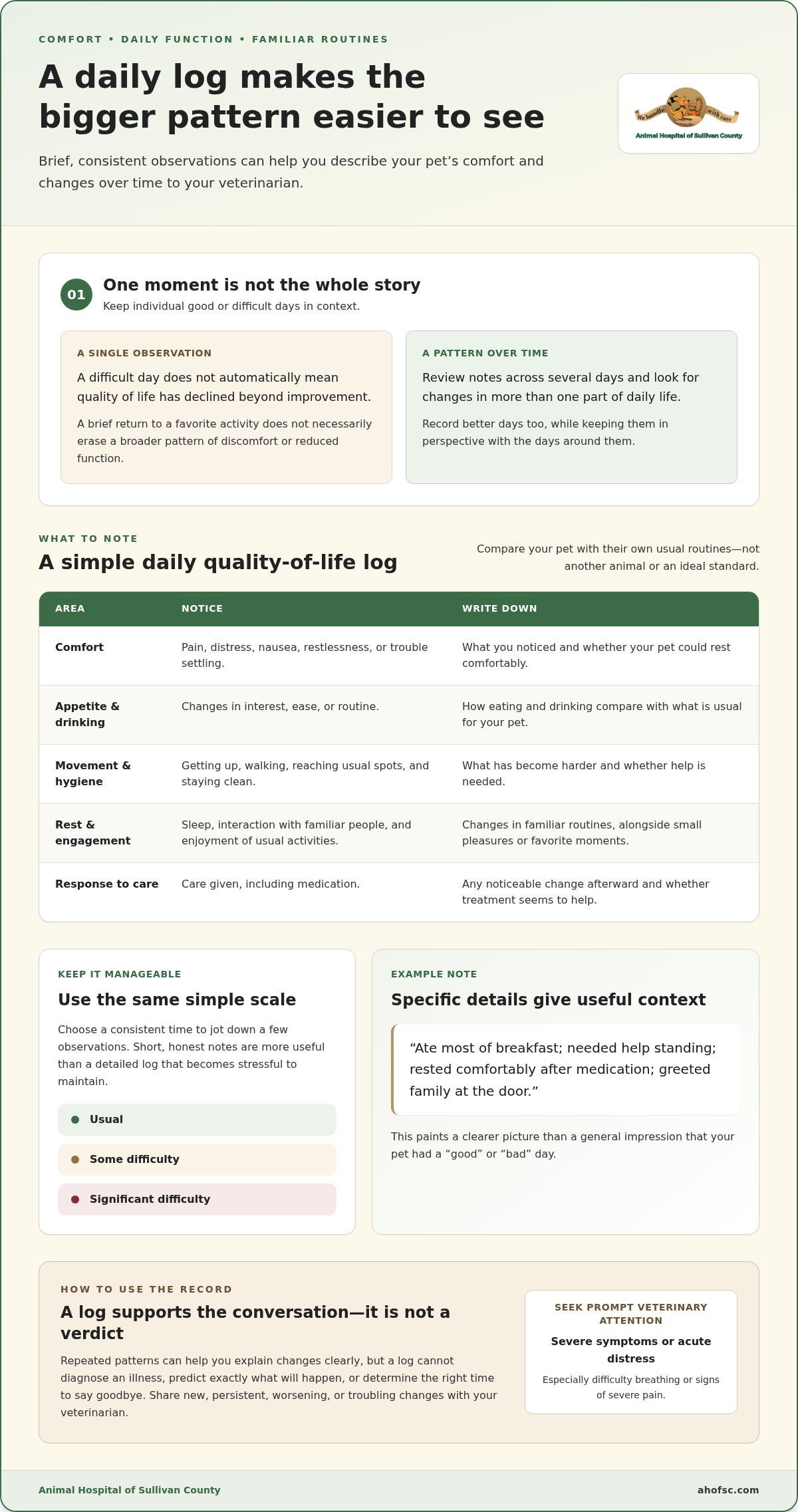
When days feel uncertain, a simple record can make changes easier to see. The goal isn’t to calculate a score or reach a decision on your own. It’s to capture what everyday life is like for your pet so you can describe changes clearly to your veterinarian. Keep the process manageable: a few honest notes are more useful than a detailed log that becomes stressful to maintain.
What to note in a simple daily quality-of-life log
Choose a consistent time to jot down a few observations. Use short descriptions or the same simple scale each day, such as “usual,” “some difficulty,” or “significant difficulty.” Compare your pet with their own normal routines, not with another animal or an ideal standard. Record challenging moments as well as small pleasures, such as a relaxed rest, a favorite greeting, or interest in a familiar activity.
- Comfort: Note signs of pain, distress, nausea, restlessness, or trouble settling.
- Appetite and drinking: Record changes in interest, ease, or routine.
- Movement and hygiene: Describe getting up, walking, reaching usual spots, and staying clean.
- Rest and engagement: Note sleep, interaction with familiar people, and enjoyment of usual activities.
- Response to care: Record care given and any noticeable change afterward.
A brief example might read, “Ate most of breakfast; needed help standing; rested comfortably after medication; greeted family at the door.” This gives your veterinarian more context than a general impression that your pet had a “good” or “bad” day. For additional end-of-life care context, see the AAHA End-of-Life and Euthanasia Guidelines.
How to recognize patterns without treating a score as a verdict
Review your notes across several days and look for changes in more than one part of daily life. For example, reduced appetite alongside difficulty moving and less interest in family routines may be more informative than any one observation on its own. A better day matters too. Record it, while keeping it in perspective with the days around it.
Repeated patterns tell you more than one isolated moment, but they don’t make the decision for you. A log can’t diagnose an illness, predict exactly what will happen, or determine the right time to say goodbye. It can help you notice changes and explain them clearly. If a symptom becomes severe or your pet appears acutely distressed, seek prompt veterinary attention rather than waiting to complete a log.
Bring your notes to an appointment and describe what has changed, when it happens, and how your pet responds to care. This can help your veterinarian consider the full picture and talk through possible next steps. The veterinary team at Animal Hospital of Sullivan County can discuss your pet’s comfort and daily function.
Is There a Perfect Time? Making Sense of Prognosis, Comfort, and Uncertainty
It’s natural to wish for a clear sign or a moment when the right choice becomes obvious. Often, there isn’t one. Considering whether your pet’s comfort can still be maintained doesn’t mean you’re abandoning them. It means you’re trying to understand what they’re experiencing and what care can realistically offer.
Knowing when it's time to say goodbye to a pet is not a decision you have to reach from one symptom, a brief improvement, or fear that you haven’t done enough. A veterinarian can help you consider your pet’s diagnosis, likely course of illness, current comfort, and response to treatment together. The aim is an informed conversation, not a perfect prediction.
How treatment response and prognosis can change the picture
Some changes in comfort or daily function may improve when an underlying problem is treated. Ask what the examination suggests, what further assessment could clarify, and what improvement might realistically look like. Discuss the likely benefits and burdens of available care, including how it may affect your pet’s comfort and routines.
Your veterinarian can help you set practical goals, such as resting more comfortably or showing renewed interest in familiar activities. They can also explain what signs might suggest treatment isn’t helping as hoped. An individual outcome can’t be predicted without considering your pet’s specific health and circumstances.
It can help to ask questions plainly, even if they’re hard to say aloud:
- What parts of my pet’s condition may be treatable?
- What could comfort look like with the care options available?
- How will we know if the current plan is helping, and what changes should prompt us to revisit it?
These questions can make room for more than an all-or-nothing choice. The next step might involve assessing a new concern, adjusting care, or talking about whether comfort can be maintained. You don’t need to know every answer before asking for help.
Working through guilt, hope, and fear of choosing too soon
Hope and worry can sit side by side. You may feel relief when your pet has a better day, then fear that you’re misreading what’s happening. Grief can also begin before a pet dies, as the family anticipates changes and loss. These feelings don’t mean you’re failing your companion.
Bring your concerns into the conversation rather than carrying them alone. You might say, “I’m afraid of waiting too long,” or “I’m worried this decision could be premature.” Your veterinarian can help focus the discussion on your pet’s needs, explain uncertainties, and consider what matters to your family. The decision is deeply personal, but you deserve support as you think it through.
If family members see your pet’s condition differently, sharing specific observations and asking the veterinarian to explain the medical picture can help everyone discuss the same concerns. You don’t have to force agreement in a single conversation. Keep the focus on comfort, realistic care options, and what your pet may be experiencing now.
How to Prepare for a Veterinary Conversation About Your Pet’s Quality of Life
A little preparation can make a hard conversation feel more manageable. You don’t need to arrive with a decision already made. Your role is to share what you’ve noticed and what you’re worried about; your veterinarian can help interpret those observations and discuss your pet’s care.
Before the appointment, gather a few practical details:
- Your quality-of-life notes, including difficult moments and activities your pet still enjoys.
- A current medication list, including doses and any changes you’ve noticed after treatment.
- Diagnosis details, test results you have available, and a timeline of recent changes.
- Examples of how those changes affect daily routines, such as eating, resting, moving, or greeting family.
- Questions or concerns you want to make sure you discuss.
If it’s difficult to organize your thoughts, choose the changes that concern you most and describe when they happen, how often, and what seems to help. This makes the conversation concrete without requiring you to interpret the cause. Knowing when it's time to say goodbye to a pet is deeply personal, and you can ask for help understanding the medical picture before considering next steps.
Questions to ask about comfort and care options
Use your questions to understand what may be causing each major change and whether further evaluation could clarify the situation. Ask what comfort-focused care might achieve, how you’ll recognize whether it’s helping, and what realistic goals make sense for your pet. Before you leave, ask which changes need prompt attention and how follow-up should be handled.
You can also ask your veterinarian to explain unfamiliar terms or repeat information. It’s all right to take notes, bring someone to listen with you, or ask for time to think through what you’ve heard.
Including family members in a difficult decision
Family members may notice different things because they share different parts of your pet’s routine. Invite each person to bring specific observations and concerns, while allowing space for disagreement and more discussion. If children are involved, use honest, age-appropriate language, explain what you know, and make room for their questions without asking them to carry the decision.
When perspectives differ, return to your pet’s daily comfort and needs. Sharing observations with the veterinarian can help the family understand the medical picture and identify what remains uncertain. No one has to feel exactly the same way for the conversation to be caring and constructive.
Bring your notes and questions to the veterinary team at Animal Hospital of Sullivan County to discuss your pet’s comfort and quality of life.
Finding Compassionate Pet End-of-Life Support in Sullivan County
When your pet’s needs are changing, a familiar veterinary team can help you make sense of what you’re seeing. The team can bring medical context to your observations, discuss what care may offer, and revisit the conversation as your pet’s condition changes. Support doesn’t require you to arrive with a decision. It can begin with a question, a concern, or a request to understand what your companion may be experiencing.
Animal Hospital of Sullivan County has served the community since 1953. The veterinary team provides medical care and diagnostics, and can talk with families about a pet’s comfort and changing needs. For pet families in New York, Connecticut, New Jersey, and Pennsylvania, knowing when it's time to say goodbye to a pet can remain uncertain even after a thoughtful conversation. A trusted relationship can help you consider your individual pet’s circumstances without pressure to reach certainty immediately.
What compassionate veterinary support can offer
A useful conversation makes room for the details that matter to your family: what has changed, what still brings your pet comfort, and what you’re most worried about. Your veterinarian can consider these observations alongside your pet’s medical history and discuss what may be treatable, what care could realistically achieve, and how to recognize if your pet’s needs are changing.
It’s okay to return with more questions or to need time to process what you’ve heard. Families may make decisions at different paces, and the right next step can depend on the pet’s condition. Veterinary guidance can help you understand the options and focus on your companion’s wellbeing without promising a particular outcome.
Aftercare and support for grieving families
Thinking about aftercare can feel difficult before you’re ready, but learning what support is available may help reduce uncertainty. Animal Hospital of Sullivan County has an onsite crematorium as part of its end-of-life support. The veterinary team can discuss aftercare as part of a broader conversation, at a pace that feels comfortable for you.
Grief can continue after a decision, and the bond you share with your pet deserves kindness. Families may find it helpful to talk together, remember familiar routines, or take time to honor their companion in a personal way. For additional local context, the companion guide to pet end-of-life care in Sullivan County can help you explore the subject further.
When you’re ready, contact Animal Hospital of Sullivan County to discuss your pet’s changing needs with the veterinary team. You don’t need to have every answer before starting the conversation.
Take the Next Step With Support
You don’t have to settle every question today. A gentle next step is to write down what worries you and what you hope your pet can still enjoy. Bring those thoughts to a conversation with your veterinarian, and give yourself permission to ask for time, clarification, or another discussion. Knowing when it's time to say goodbye to a pet isn’t about proving you’ve done enough. It’s about seeking thoughtful guidance centered on your companion’s needs.
Families deserve care that respects both the bond they share with their pet and the weight of the choices ahead. The team at Animal Hospital of Sullivan County can help you talk through your concerns and consider compassionate care for your companion.
Learn more about compassionate care at Animal Hospital of Sullivan County. Start a conversation about your pet’s needs with the veterinary team.
Frequently Asked Questions
Can a pet have good days and still have a declining quality of life?
Yes, a pet can enjoy certain moments even as their overall condition worsens. A dog might still wag at a familiar visitor but struggle to get comfortable afterward; a cat may seek a sunny spot while tiring quickly. Knowing when it's time to say goodbye to a pet means considering these moments in context, not dismissing them. Tell your veterinarian what your pet can still enjoy and what seems harder now.
Is refusing food by itself a sign that it is time to say goodbye?
No, refusing food alone doesn’t determine that it’s time to say goodbye. A change in appetite can have different causes, including discomfort or illness, and some may be treatable. Note when your pet last ate, whether they’re drinking, and whether they seem interested but unable to eat. Contact your veterinarian for guidance, especially if the refusal persists or comes with weakness, vomiting, or other concerning changes.
How can I tell whether my pet’s pain or distress is being controlled?
Look for whether your pet can rest, move, and respond to gentle interaction with less visible discomfort than before. Watch for changes such as guarding a body area, flinching, panting at rest, hiding, or repeatedly changing position. These signs don’t reveal the cause on their own, so share them with your veterinarian. Don’t change medication doses or give human pain medicine unless your veterinarian specifically directs you to.
Should I wait for my pet to pass naturally?
There isn’t one right answer for every pet. A natural death may occur peacefully, but the experience and timing can be difficult to predict, and illness may cause distress that needs medical attention. Ask your veterinarian what to expect with your pet’s specific condition, which signs could indicate suffering, and what care may ease discomfort. Understanding the likely course can help you consider options without assuming you must wait for a crisis.
What if my family disagrees about when it is time?
Disagreement can reflect different experiences with the same pet, not a lack of love. Invite each person to describe a specific concern, such as a change they’ve witnessed or a routine they think the pet still enjoys. Ask your veterinarian to explain the medical outlook in a shared conversation. If emotions run high, pause and return to the discussion after everyone has had time to absorb the information.
How soon should I speak with a veterinarian when my pet’s condition changes?
Contact a veterinarian promptly if a change is sudden, worsening, persistent, or worrying to you. Difficulty breathing, collapse, or severe distress needs urgent attention rather than watchful waiting. For less urgent changes, explain what you’ve noticed and ask how soon your pet should be assessed. Families in New York, Connecticut, New Jersey, and Pennsylvania can use their veterinary team’s guidance to distinguish a concerning change from one that can be monitored.
How can I explain a pet’s end-of-life situation to a child?
Use clear, gentle words that fit the child’s age, and avoid phrases like “going to sleep,” which can cause confusion or fear. You might explain that the pet is very ill, the veterinarian is helping the family understand what the pet needs, and the child can ask questions. Let them know their feelings are welcome. Offer a simple way to say goodbye or remember the pet, without pressuring them to take part.


