
It is a quiet afternoon in the Catskills when you notice your dog isn't just tired from a walk; he is pacing restlessly and his stomach looks unusually bloated. Your heart sinks as you wonder if this is something that can wait until tomorrow or if it is a "go now" situation. We know that pit-in-your-stomach feeling of uncertainty. You love your pet like family, and the fear of them suffering while you hesitate is truly overwhelming. It is completely natural to feel anxious when you aren't sure what constitutes a real medical emergency.
We are here to be your steady, calming guide during these high-pressure moments. Understanding exactly when to take a sick pet to the vet Sullivan County neighbors rely on is the best way to ensure your cherished companion stays safe. This guide will walk you through the critical warning signs that require immediate intervention, from respiratory distress to sudden neurological changes. We will provide you with a clear list of emergency symptoms and the immediate steps you should take to protect your pet. Our goal is to replace your worry with the confidence that comes from expert knowledge and neighborly support.
Key Takeaways
- Learn how to identify the "Golden Hour" in veterinary medicine to ensure your companion receives life-saving care when every minute counts.
- Recognize critical respiratory and cardiovascular red flags, such as labored breathing or persistent coughing, that signal a need for immediate intervention.
- Discover the specific abdominal and neurological symptoms that indicate when to take a sick pet to the vet Sullivan County families trust for urgent care.
- Gain practical skills for safely stabilizing and transporting a distressed animal, including how to use common household items as makeshift stretchers.
- Understand how AAHA-accredited standards and onsite diagnostics provide the fast, accurate answers required to protect your pet's long-term health.
Recognizing the Tipping Point: When a Symptom Becomes an Emergency
Your intuition as a pet parent is one of the most reliable diagnostic tools we have. You know your companion's daily rhythms better than anyone else. If your heart tells you that a behavior isn't just "off" but is actually dangerous, trust that feeling. Deciding when to take a sick pet to the vet Sullivan County residents count on often comes down to recognizing the "Golden Hour." This is the critical window where immediate medical intervention can stop a condition from spiraling into a life-threatening crisis. In our rural landscape, where mountain roads can add twenty minutes to any trip, making a quick decision is even more vital.
The Sullivan County Context: Local Environmental Risks
Living in the Catskills brings unique joys, but it also presents specific environmental hazards. A backyard scuffle with a raccoon or a stray mountain lion might look like a few scratches, but deep puncture wounds can quickly turn septic or carry rabies risks. We also see many cases of tick-borne emergencies. While Lyme is common, certain ticks can cause rapid-onset paralysis or dangerously high fevers that require immediate stabilization. Additionally, our mountain weather is unpredictable. Heatstroke can happen during a humid valley hike in July, while hypothermia is a real threat during our bitter winter nights. If your pet is shivering uncontrollably or panting without being able to catch their breath, they need help now.
The Five-Minute Observation Rule
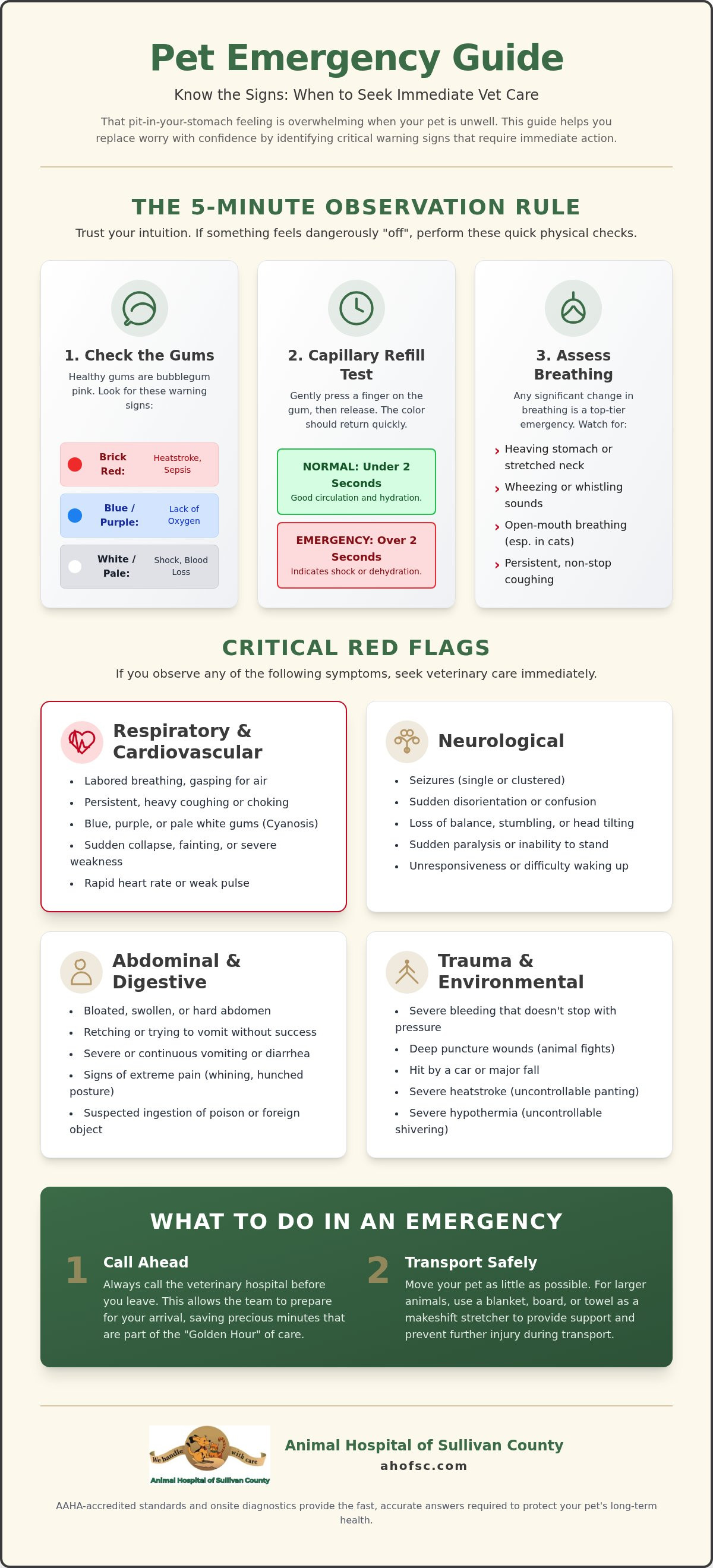
If you are unsure whether to load your pet into the car, perform a quick physical check. Start with the gums. Healthy gums should be a bubblegum pink. If they look white, blue, or a dark brick red, your pet is in trouble. Press your finger against the gum and release; the color should return in under two seconds. If it takes longer, or if the gums feel tacky and dry to the touch, your pet is likely suffering from severe dehydration or shock.
Monitoring their basic vitals is a key part of pet first aid that every owner should know. Watch the chest for respiratory effort. If the stomach is heaving or the neck is stretched out just to get air, don't wait. These physical markers are clear signals from your pet's body that they can no longer compensate for their illness on their own. Taking action during these early minutes can be the difference between a simple treatment and a complex recovery.
Critical Respiratory and Cardiovascular Red Flags
When your pet's heart or lungs are struggling, every second feels like an eternity. It is perhaps the most frightening experience a pet owner can face. Knowing when to take a sick pet to the vet Sullivan County families trust means recognizing that any change in breathing is a top-tier emergency. While a slight sneeze might wait, labored breathing or a blue tint to the gums requires immediate action. Our team is dedicated to being that steady presence you need when your companion is in distress.
Watch for open-mouth breathing, especially in cats, as this is never normal and usually indicates a crisis. If your dog is using their whole abdomen to pull in air, or if you hear a wheezing, whistling sound, they are struggling to get enough oxygen. Persistent coughing that won't stop can also signal fluid in the lungs or an underlying heart condition. If you see cyanosis, which is a blue or purple tint to the gums, your pet's body is starving for oxygen. This is a critical signal to seek emergency care immediately.
Sudden collapse or fainting is another non-negotiable emergency. Even if your pet stands back up a moment later, a fainting spell usually points to a significant cardiovascular or neurological event. It is always better to be safe and have a professional evaluation to rule out heart rhythm issues or internal bleeding. We treat every collapse with the urgency and deep compassion your family member deserves.
Choking and Obstructions
Choking often presents with frantic pawing at the mouth and excessive drooling. You might see your pet gagging or trying to clear their throat without success. If you suspect a foreign object is lodged, do not try to reach deep into the throat yourself, as you might accidentally push it further down. Respiratory distress is an immediate need for clinical intervention.
Heart-Related Emergencies
As our companions age, their hearts may begin to tire and require extra vigilance. Signs of congestive heart failure often include a soft, wet cough that worsens at night or a sudden inability to exercise. For our feline friends, be aware of a "Saddle Thrombus," which is a sudden blood clot that causes hind-limb weakness or paralysis and is extremely painful. If you notice these signs, our team is here to provide the specialized senior pet care Sullivan County owners can rely on during a crisis.
If you are worried about your pet's breathing or heart rate, please reach out to the Animal Hospital of Sullivan County during our business hours for urgent support and guidance.
Abdominal and Neurological Shifts That Demand Action
While some stomach upsets are minor, certain abdominal changes are life-threatening emergencies that cannot wait for a morning appointment. Gastric Dilatation-Volvulus, commonly known as Bloat or GDV, is one of the most time-sensitive crises we treat. If your dog's abdomen appears distended or hard to the touch, and they are pacing restlessly, their life may be at risk. A hallmark sign of this condition is unproductive retching, where the pet tries to vomit repeatedly but nothing comes up. This indicates the stomach may have twisted, cutting off blood supply and requiring the immediate intervention of a veterinary surgeon Sullivan County families trust for life-saving care.
Neurological shifts can be equally distressing to witness. If your pet suddenly begins circling, tilting their head to one side, or walking as if they are "drunk," they are experiencing a significant health event. Seizures and tremors also demand professional evaluation. During a seizure, keep your pet away from stairs or sharp furniture to prevent injury, but avoid placing your hands near their mouth. Knowing when to take a sick pet to the vet Sullivan County neighbors rely on is vital when these neurological signs appear, as they often point to underlying issues like toxins, infections, or metabolic imbalances.
Toxic Ingestion and Poisoning
Our beautiful Catskills environment holds hidden dangers that can lead to rapid poisoning. In the winter, a few licks of sweet-tasting antifreeze from a driveway can cause kidney failure. In the warmer months, poisonous local mushrooms or even certain garden mulch can be toxic. Signs of ingestion include excessive salivation, tremors, or sudden vomiting. The window for decontamination is often very small, so if you suspect your pet ate something dangerous, please bring them in immediately for medical care.
Pain Signals and Behavioral Changes
Pets are masters at hiding discomfort, so a sudden behavioral shift is often a cry for help. A normally docile dog who snaps when touched or a cat that suddenly retreats to a dark closet for hours is likely in acute pain. You might hear unusual vocalizing, such as low whining or howling, without an obvious cause. These subtle emergency signals are just as important as more visible injuries. We believe in a "heart-first" approach to care, and we are here to help you decode these signs to ensure your companion remains comfortable and safe.
Triage and Transport: What to Do Before You Reach Ferndale
The drive to our hospital in Ferndale can feel like the longest journey of your life when your cherished companion is in distress. While your instinct is to rush, taking a few moments to stabilize your pet ensures their safety and yours during the trip. Even the most gentle, sweet-natured dog or cat may snap or bite when they are in significant pain. If your pet is not having trouble breathing, a soft muzzle or even a loosely wrapped towel can prevent accidental injury as you lift them into the car. We want to ensure that both you and your pet arrive safely so we can begin care immediately.
For larger dogs that cannot walk, you can create a makeshift stretcher using a heavy blanket or a sturdy piece of plywood. Carefully slide the pet onto the center of the material, ensuring their spine remains as straight as possible. If you are dealing with active bleeding, apply firm, direct pressure with a clean cloth or sterile dressing. Do not remove the dressing if it becomes soaked; simply add another layer on top to avoid disturbing any clots that have begun to form. These first steps are a vital part of the "heart-first" care you provide before we take over.
One of the most important steps you can take is to call us while you are on your way. Notifying the hospital allows our medical team to prepare the necessary diagnostics and treatment area before you even pull into the parking lot. Triage is the prioritization of care based on the severity of the condition. By calling ahead, you help us determine when to take a sick pet to the vet Sullivan County residents can trust for the fastest possible response. It allows us to clear a path for life-saving intervention the moment you walk through our doors.
First Aid for Wounds and Fractures
If you suspect a fracture, the goal is to prevent further trauma rather than trying to set the bone. Keep the pet confined in a small carrier or a confined space in your vehicle to limit movement. For eye injuries, which are common in our wooded Catskills environment, prevent your pet from pawing at the area. A soft Elizabethan collar or even a gently wrapped scarf can serve as a temporary barrier. This prevents a simple scratch from turning into a permanent injury during the transit time.
Communicating with the Clinic
When you call, try to have a few key details ready: your pet's approximate weight, their age, and the exact time you noticed the symptoms. This information helps us prepare the right dosage of emergency medications. Many of our clients find the PetDesk app incredibly helpful for keeping medical records and vaccination history at their fingertips during a crisis. For more information on how we support our local community, visit our guide to the animal hospital Sullivan County families have relied on for generations.
If your pet is experiencing an urgent medical need during our business hours, please contact the Animal Hospital of Sullivan County immediately so we can guide you through the next steps.
Why AAHA-Accredited Urgent Care Matters for Your Family
Our roots in the Catskills run deep. Since 1953, the Animal Hospital of Sullivan County has stood as a pillar of support for local families and their beloved pets. Being the only AAHA-accredited facility in the county isn't just a point of pride; it is a promise of excellence. This accreditation means we voluntarily adhere to over 900 rigorous standards covering everything from pain management to surgical protocols. When you are deciding when to take a sick pet to the vet Sullivan County neighbors trust, knowing your hospital meets these elite benchmarks provides invaluable peace of mind.
In an emergency, every second counts. Our facility is equipped with advanced onsite diagnostics, including digital X-rays and a comprehensive laboratory. We don't have to send samples across the state and wait days for answers. We can see what is happening inside your pet's body right now. Dr. B and our dedicated team combine this technical precision with a calming bedside manner. We understand that you are scared. Our goal is to lower your anxiety while we focus on the physical health of your family member.
Full-Spectrum Compassion: From Urgent Care to End-of-Life
Sometimes, an urgent visit leads to the most difficult journey a pet owner can take. We believe in providing dignity at every stage of life. Our onsite crematorium allows us to maintain a circle of care that never leaves our hands. This "Neighborly Empathy" means we treat your pet with the same tenderness we would show our own. After an urgent visit, we don't just send you on your way. We provide clear instructions for home care and schedule follow-up exams to ensure the recovery is staying on track.
Finding Us in Sullivan County
Located conveniently in Ferndale, we are a short drive for residents in Monticello, Liberty, and the surrounding Catskills villages. While we are not a 24/7 emergency room, we provide high-level urgent care during our regular business hours. If your pet is in distress during the day, we are your first line of defense. For after-hours crises, we can help direct you to the nearest overnight resources to ensure your pet is never without a guardian. Our steady, methodical approach ensures that no detail is overlooked in your pet's treatment plan.
If you need immediate assistance or have questions about a sudden symptom, please Contact Animal Hospital of Sullivan County for Urgent Care and let us be your partner in your pet's health journey.
Protecting Your Companion's Future Today
Your bond with your pet is a sacred relationship that deserves the highest level of protection. By learning to recognize critical red flags like respiratory distress, unproductive retching, or sudden neurological changes, you are acting as their strongest advocate. Every minute counts during a medical crisis, and your quick response can lead to a much happier outcome! Knowing when to take a sick pet to the vet Sullivan County residents have trusted for generations is the most important tool in your caregiving kit.
As the oldest urgent care facility in the Catskills and Sullivan County’s only AAHA-accredited animal hospital, we are uniquely prepared to support you. Dr. B and our dedicated team have provided compassionate care since 1953, treating every patient like a cherished member of our own family. We don't want you to face these moments with uncertainty. We are here to offer a steady, calming presence and expert medical authority. If your pet is showing emergency signs, call our Ferndale clinic at (845) 292-6711 immediately. We look forward to helping your best friend get back to their happy, healthy self!
Frequently Asked Questions
What should I do if my pet is breathing fast but not coughing?
Tachypnea, or fast breathing, is a serious sign that your pet's body is struggling to compensate for pain, heat, or internal distress. If your pet is breathing rapidly without the presence of a cough, it is time to act. This is a key example of when to take a sick pet to the vet Sullivan County owners can depend on. We recommend checking their gum color and calling us immediately for triage guidance to ensure their safety.
Is a dog limping considered a veterinary emergency?
A limp becomes an emergency when your pet is completely non-weight-bearing or if the limb is dangling at an odd angle. While a slight gingerly walk might wait for a morning call, acute pain from a fracture or a ligament tear requires immediate stabilization. These injuries are distressing for your companion and can lead to permanent damage if left untreated. We prioritize these cases to ensure your pet's comfort and a faster recovery process.
What if my pet eats something toxic after your business hours?
Since we are not a 24/7 facility, you must seek immediate care at an overnight emergency hospital if a toxic ingestion occurs after our business hours. Toxins like antifreeze, chocolate, or certain local mushrooms require a rapid decontamination window to prevent organ failure. You can also call a pet poison control hotline for initial guidance. Don't wait until the next day; your pet's life depends on how quickly the toxin is removed from their system.
How can I tell if my cat is in pain if they aren’t crying?
Cats often express pain through silence and withdrawal rather than crying or howling. You might notice your cat hiding in the back of a closet, neglecting their grooming, or sitting in a hunched, "tucked-in" position. A sudden change in litter box habits or a refusal to eat their favorite treats are also red flags. These subtle shifts are their way of communicating that something is wrong. We are here to help you decode these quiet signals.
Can I give my pet human pain medication before we get to the vet?
You should never administer human pain relievers like Tylenol or Advil to your pet. These medications are extremely dangerous and can cause life-threatening stomach ulcers or liver failure in cats and dogs. Even common over-the-counter drugs can interfere with the safe medications we need to use once you arrive. If your companion is hurting, the safest thing you can do is keep them calm and bring them to our Ferndale clinic for professional help.
How long can a pet go without eating before it becomes an emergency?
While a healthy adult dog might skip a single meal due to a minor upset, any pet that refuses food for more than 24 hours needs a professional evaluation. Cats are especially vulnerable; prolonged fasting can lead to a fatal liver condition. For young puppies or senior companions, the window is even shorter. Understanding when to take a sick pet to the vet Sullivan County families rely on ensures that minor issues don't turn into major crises.
What is the Golden Hour in pet emergency medicine?
The Golden Hour refers to the critical first sixty minutes after a pet experiences a trauma or a sudden health crisis. Medical treatment provided during this specific window is statistically more likely to save a life or prevent long-term complications. Whether it is a mountain hiking accident or a sudden case of bloat, reaching an AAHA-accredited hospital quickly is vital. Our onsite diagnostics allow us to maximize this time to provide the fastest possible care for your pet.
Does a sudden change in gum color always mean an emergency?
A sudden change in gum color is a definitive emergency signal that should never be ignored. Healthy gums should be a vibrant pink. If they appear pale white, deep red, or blue, your pet's circulatory system is in trouble. These shifts can indicate anything from internal bleeding to heart failure or heatstroke. If you see an abnormal color, please call us immediately so we can prepare our medical team for your arrival and begin life-saving intervention.


