
What if your pet’s pain shows up as a changed routine, not a limp or a cry? Pets often hide discomfort, and the first clues can be easy to mistake for aging, stress, or a shift in mood. The five signs your pet is in pain may include small changes in how they move, eat, groom, play, or seek company.
It’s understandable to wonder whether a new behavior will pass or needs attention. Watching for patterns can help you make sense of what’s changed, and you don’t need to diagnose the cause at home. This article explains common and subtle signs to notice, how to keep useful notes or videos, and what details to share with your veterinary team. You’ll also learn when to call a vet, especially if a change persists, worsens, or concerns you. Your observations matter: at home, you may notice changes your pet doesn’t show during an appointment.
Key Takeaways
- The five signs your pet is in pain can include changes in movement, appetite, grooming, posture, or social behavior. Treat them as clues to discuss with a veterinarian, not proof of a specific condition.
- Notice whether a change is brief or persistent, worsening, or different from your pet’s usual routine.
- Seek urgent veterinary guidance for sudden, severe, rapidly worsening, or breathing-related changes.
- Before an appointment, note when the change began, how often it happens, and what was happening beforehand. A short video may help show what you’ve noticed at home.
- A veterinary assessment can help determine what’s causing the change and whether diagnostic testing is appropriate.
Five signs your pet may be in pain: changes owners can notice first
A change from your pet’s usual behavior is worth noticing, even if it seems small. You know how your dog or cat normally moves, plays, rests, and responds to family, so a departure from that familiar pattern can be a useful clue. Pain may develop gradually, too, making comparisons with your pet’s usual routines more helpful than looking for one dramatic symptom.
These five signs your pet is in pain are possible signals, not proof of a particular condition. A pet who slows down or seeks more solitude could be responding to discomfort, but other explanations are possible. A veterinary assessment can help make sense of the changes. For broader context, the Dog health overview discusses health conditions, including orthopedic issues, that can affect movement.
For a closer look at subtle behaviors owners may notice, watch this video:
A possible pain sign is a noticeable change from your individual pet’s normal behavior, movement, or routine. That change deserves attention, but it doesn’t tell you what’s causing it. Look for a pattern over time and consider whether it is becoming more frequent or interfering with everyday activities.
Sign 1: Slower movement or reluctance to do familiar activities
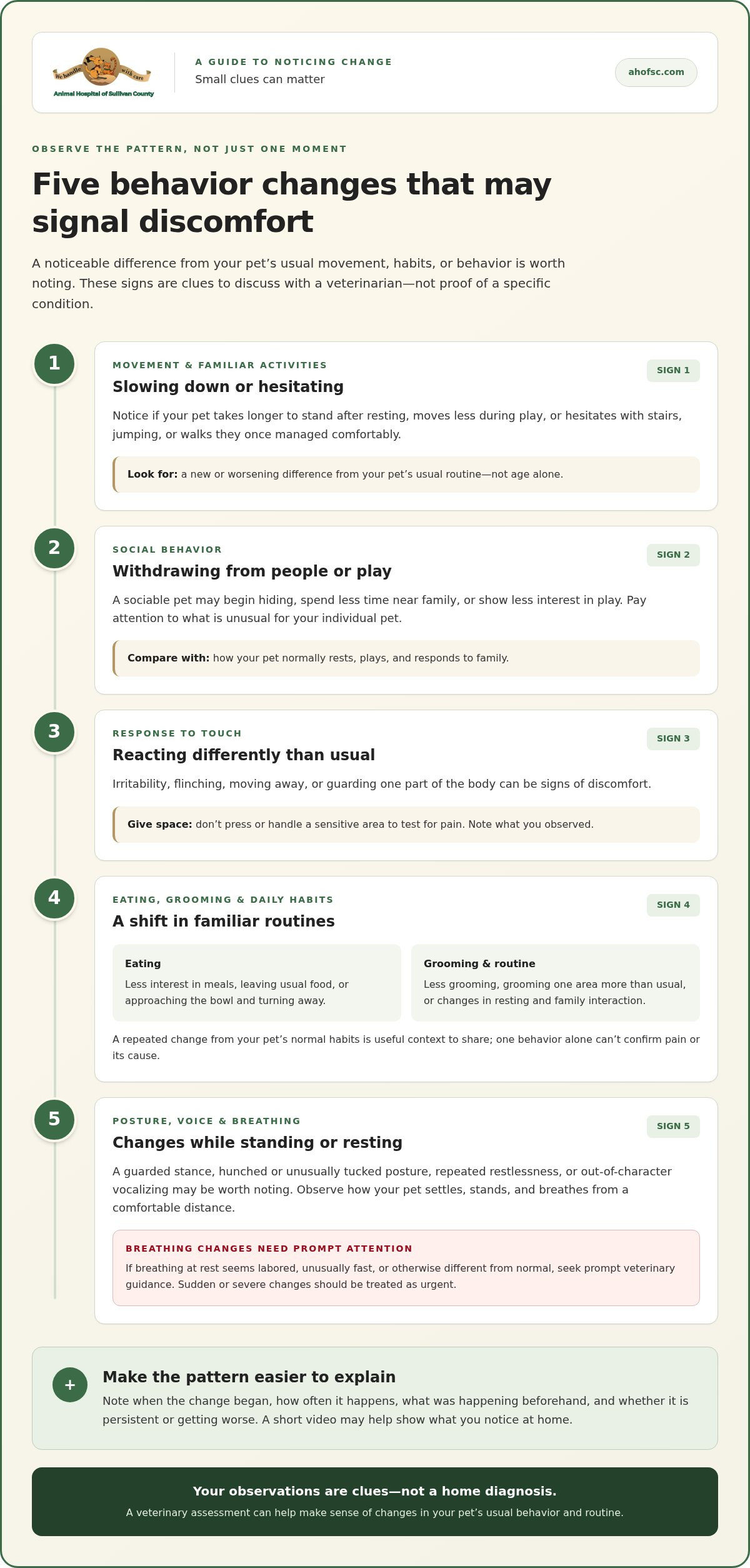
Notice whether your pet takes longer to stand after resting, moves less during play, or hesitates before using stairs they once managed comfortably. They may also pause before jumping onto a favorite spot or need more encouragement to go for a walk. These shifts can be easy to overlook when they happen gradually. What matters is a new or worsening difference, not age alone. Slower movement has many possible causes, so don’t assume it means a specific condition.
Signs 2 and 3: Withdrawing or reacting differently to touch
A sociable pet who starts hiding, spending less time near the family, or showing less interest in play may be signaling that something has changed. Some pets respond differently to touch, too. Irritability, flinching, moving away, or guarding one part of the body can be signs of discomfort. Think about what’s unusual for your pet, rather than comparing them with another animal. Don’t press or handle a sensitive area to test for pain. Give your pet space and note what you observed.
Small clues are most useful when described in context. Consider what your pet used to do, what has changed, and whether the change is persistent or getting worse. Sharing those observations with a veterinary team can help them assess your pet without relying on a home diagnosis.
Subtle signs of pet pain: appetite, grooming, posture, and breathing
Changes in eating, grooming, posture, or breathing can be easy to miss because they may develop gradually or appear on their own. Each can have several possible explanations, so one behavior by itself can’t confirm pain or identify its cause. Compare what you’re seeing with your pet’s usual habits, and pay attention to whether the difference continues, becomes more noticeable, or occurs alongside other changes.
Subtle changes in behavior can accompany physical discomfort, even when a pet isn’t limping or crying out. The AAHA Pain Management Guidelines for Dogs and Cats recognize the value of observing a pet’s behavior as part of assessing pain. Your everyday observations can help a veterinary team understand what’s different, without requiring you to diagnose the problem at home.
Sign 4: Changes in eating, grooming, or everyday habits
Notice whether your pet is less interested in meals, leaves food they normally finish, or approaches the bowl and then turns away. A single skipped meal may not tell you much on its own, but a repeated change from your pet’s normal eating pattern is worth sharing with a veterinarian. Make a note of when it began and whether your pet’s appetite seems to be changing further.
Grooming can offer another clue. A cat who stops keeping their coat tidy, grooms one area much more than usual, or becomes less visible around the home may be acting differently from their baseline. Dogs may also change how often or how thoroughly they groom themselves. Consider the whole routine: where your pet rests, how they interact with family, and whether familiar daily activities are happening as usual. These observations are useful context, not a diagnosis.
Sign 5: Unusual posture, vocalizing, or breathing at rest
A guarded stance, a hunched or unusually tucked posture, repeated restlessness, or vocalizing that’s out of character may be worth noting. Cats and dogs can show these changes differently, so focus on what is unusual for your own pet. Look from a comfortable distance and observe how they settle, stand, and breathe. Don’t press on their body or try to move a limb to see how they respond.
Breathing changes deserve particular attention, especially if they’re happening while your pet is resting. If your pet’s breathing seems labored, unusually fast, or otherwise different from normal, seek prompt veterinary guidance rather than waiting to see whether it passes. Sudden or severe changes should be treated as urgent.
A brief variation can happen, but a persistent or worsening change is more meaningful and should be discussed with a veterinary team. Keep the details simple: what you noticed, when it happens, and whether other routines have changed too. If these signs concern you, an in-person veterinary assessment can help determine what care may be appropriate.
When signs of pain need prompt veterinary attention
Not every unusual behavior calls for the same response. A new, mild change that settles may be less urgent than a symptom that appears suddenly, worsens quickly, or affects breathing. Still, visible signs can’t tell you the cause or severity of pain. The five signs your pet is in pain are reasons to pay attention, not a way to determine what’s wrong. If you’re concerned, a veterinary professional can help you decide what attention is needed.
Guidance from the International Veterinary Academy of Pain Management supports a thoughtful approach to recognizing and addressing animal pain. Trust what you’re seeing at home, and don’t wait for your pet to show every possible sign before seeking advice.
Changes that should not wait for a routine appointment
Collapse, severe distress, or difficulty breathing needs immediate veterinary help. Sudden symptoms or changes that are rapidly getting worse also call for urgent veterinary guidance. Stay calm, keep your pet as comfortable as you safely can, and contact a veterinary professional promptly for direction. Don’t wait to see whether severe signs pass, and don’t try home treatments in place of urgent assessment.
- Difficulty breathing, especially while resting
- Collapse or inability to stay upright
- Severe distress or a sudden, dramatic decline
These examples aren’t a complete checklist. If your pet’s condition feels alarming or is changing quickly, seek urgent veterinary help.
Persistent discomfort deserves professional assessment
A recurring limp, ongoing withdrawal, or a steady drop in activity deserves veterinary evaluation, even if your pet still eats and walks. Pets can continue familiar activities while uncomfortable, and the ability to move doesn’t establish that all is well. A pattern that persists, returns, or worsens is useful information to share with a veterinary team.
During regular clinic hours, call Animal Hospital of Sullivan County to discuss a concerning change and arrange veterinary assessment as appropriate. The team provides urgent care during regular office hours. For urgent concerns outside regular clinic hours, seek immediate veterinary guidance.
When you call, describe what changed and when you first noticed it. Mention whether the symptom is constant or comes and goes, whether it’s worsening, and if anything else seems different. These details help the veterinary team understand the concern and guide the next step. You don’t need to be certain your pet is in pain before asking for professional advice. A timely conversation is a sensible response to a change that worries you.
How to record possible pain signs before your pet’s appointment
A clear record can help your veterinary team understand what you’re seeing at home, especially if your pet acts differently during an appointment. You don’t need to decide whether a behavior proves pain or try to examine a sensitive area. Simply describe the change and how it compares with your pet’s usual routine. Even a few brief notes can make the pattern easier to explain.
Useful symptom notes capture timing, frequency, behavior, and how it differs from your pet’s baseline. Try this simple method:
- Write down when you first noticed the change. If you’re unsure of the exact day, give your best estimate.
- Record how often it happens. Note whether you’ve seen it once, several times a day, or on and off over multiple days.
- Describe what was happening beforehand. For example, note whether it occurred after resting, during a walk, around mealtime, or when your pet was grooming.
- Track what you observe and how it changes. Include whether the behavior improves, recurs, or becomes more pronounced.
What to note about your pet’s usual routine
Compare the change with your own pet’s normal habits. Jot down differences in movement, appetite, sleep, grooming, social behavior, or vocalizing. Note if they happen at a particular time or during an everyday activity, such as getting up from bed or approaching a food bowl. Use plain descriptions, such as “hesitated at the stairs,” rather than guessing at a cause or naming a condition.
Keep entries short and specific. “Ate half of breakfast, then walked away” gives the veterinary team more useful context than “seems unwell.” If you take a video, do so only when it’s safe and won’t delay urgent care. Film from a comfortable distance without coaxing your pet into a movement or handling an area that seems sensitive. A video is optional; your pet’s safety comes first.
What to share with the veterinary team
Bring your notes or have them ready to refer to. Share when the change started, what tends to happen beforehand, and whether the signs are improving, recurring, or worsening. Mention relevant routine changes or known incidents that may provide context. You don’t need a perfect log. Honest observations, even if incomplete, can help guide the conversation and assessment.
Don’t give your pet human pain medication unless a veterinarian specifically directs you to. Some medications intended for people can be unsafe for pets, and the right response depends on the individual animal and situation. If the signs are severe, rapidly worsening, or involve breathing difficulty, seek urgent veterinary guidance rather than spending time documenting them.
If you’ve noticed a concerning change, contact Animal Hospital of Sullivan County to discuss your observations and arrange veterinary care.
Pet Pain Help in Ferndale and Sullivan County
Noticing a possible pain sign can leave you unsure what to do next. A veterinary assessment can help put changes in context, whether you’ve observed a new limp, a shift in appetite, or a behavior that simply doesn’t feel like your pet. The team can consider your observations and your pet’s history, then decide whether diagnostic testing may help. At Animal Hospital of Sullivan County, on-site diagnostics include blood, urine, and fecal testing. The goal is to understand what care may be appropriate, not to jump to a conclusion based on one symptom.
What a veterinary assessment can help clarify
Animal Hospital of Sullivan County provides on-site medical care and diagnostic testing in Ferndale, New York. Depending on the assessment, testing may include blood, urine, or fecal tests. Which steps are appropriate depends on your pet’s individual situation, so no particular test, diagnosis, or outcome can be assumed in advance. Your notes about what changed and when can help the team understand what you’ve been seeing at home.
If the signs are sudden or severe, or your pet is having difficulty breathing, seek urgent veterinary guidance. Animal Hospital of Sullivan County provides urgent care and rapid-response emergency surgery during regular office hours.
Local veterinary care for Sullivan County pets
Animal Hospital of Sullivan County is the only AAHA-accredited animal hospital in Sullivan County and has been accredited since 1983. AAHA accreditation requires adherence to over 900 rigorous standards. The practice is veteran-owned and woman-owned. Dr. Barbara Bodolosky is a U.S. Army veteran with over 30 years of veterinary experience, bringing an established local practice and a compassionate approach to the care of pets and their families. The hospital is located in Ferndale and serves pet families in Sullivan County, including nearby communities such as Monticello and Liberty. It is also relevant to pet owners looking for veterinary care in New York, Connecticut, New Jersey, and Pennsylvania.
The clinic is located at 667 Harris Rd, Ferndale, NY 12734. Regular hours are:
- Mon to Thu 7:30 AM to 6:00 PM
- Fri 8:00 AM to 1:00 PM
- Saturday by appointment
- Sunday closed
When you call, sharing what you’ve noticed and how long it’s been happening can help the team understand your concern. If you’re worried about a change in your pet’s comfort or routine, call Animal Hospital of Sullivan County at (845) 292-6711 or visit the clinic website for care information. Reaching out for guidance is a thoughtful step for a beloved companion.
Take the Next Step Toward Your Pet’s Comfort
Noticing a change is a caring first step. You don’t need to be certain that pain is the cause or wait until your pet’s behavior becomes unmistakable before asking for help. The five signs your pet is in pain can be subtle, and your knowledge of what’s normal for your companion is valuable when deciding what to do next.
If something seems different, trust that concern enough to share it with a veterinary professional. A conversation can help you explain what you’ve observed and understand an appropriate next step for your pet. Seeking guidance isn’t overreacting; it’s one way you look out for a family member who can’t tell you what hurts.
Contact Animal Hospital of Sullivan County for compassionate veterinary care and take a thoughtful step toward supporting your pet’s comfort.
Frequently Asked Questions
Can a pet be in pain without limping?
Yes. Limping is only one possible clue, and a pet may show discomfort through changes such as avoiding a favorite resting spot, seeming unusually irritable, or losing interest in play. The five signs your pet is in pain can look different from one animal to another. Pay attention to what’s unusual for your companion, even if they still walk normally, and share persistent or concerning changes with a veterinarian.
Do cats hide signs of pain?
Yes, cats may show discomfort in quiet ways that are easy to miss. A cat who usually greets you but begins staying under the bed, skips a familiar perch, or changes their usual litter-box routine may be acting differently. None of these changes proves pain, but they’re worth noticing. If the shift continues or worries you, describe it to a veterinarian rather than waiting for your cat to cry out.
Can stress cause behavior changes that look like pain?
Yes. Stress and physical discomfort can both be associated with changes such as hiding, restlessness, or irritability, and you can’t reliably tell the cause from behavior alone. Think about recent changes, such as visitors, a move, or a different household routine, and share that context with your veterinarian. If the behavior persists, worsens, or comes with other changes, professional advice can help clarify what your pet needs.
Should I give my pet human pain medicine?
No. Don’t give your pet human pain medicine unless a veterinarian specifically directs you to do so. A medication intended for people may not be safe or suitable for your individual pet, and choosing a dose yourself can put their health at risk. If your pet seems uncomfortable, call a veterinary team for guidance. If they’ve already swallowed medication, contact a veterinarian promptly and share the product name and, if known, how much they took.
Can a veterinarian tell what is causing my pet’s pain from symptoms alone?
Not always. Symptoms help guide an assessment, but similar signs can have different explanations, so a veterinarian may need more information before determining what’s going on. They’ll consider your pet’s history and what you’ve observed, and may recommend diagnostic testing when appropriate. Be ready to describe when the change began and how it affects daily activities. The assessment helps the veterinary team decide what next steps fit your pet.
Can older pets have pain that looks like normal aging?
Yes. A senior pet may slow down, sleep differently, or become less eager to join familiar activities, but it’s best not to assume every change is simply age. Compare their current habits with what’s typical for them, and note changes that are new, recurring, or getting more noticeable. Sharing those details with a veterinarian can help determine whether an assessment is appropriate and how to support your pet’s comfort.
Does a change in appetite always mean my pet is in pain?
No. A pet may eat less or show a different interest in food for several reasons, and appetite change alone can’t identify the cause. Consider whether the change is unusual for your pet and whether it continues across meals or occurs with other shifts in behavior. If reduced appetite persists, worsens, or concerns you, contact a veterinarian for advice. Note what your pet ate and when the change started.


