

The payment option that covers a veterinary bill fastest isn’t always the one that costs least in the end. When an unexpected illness or injury affects your cherished companion, it’s understandable to worry about both their care and your household budget. Learning about flexible payment options for vet bills ahead of time can make a stressful decision feel more manageable.
You may already know that savings, pet insurance, and financing can help with veterinary expenses. The challenge is understanding how each option works, what it may cover, and what repayment terms could mean for your finances. A little preparation can help you feel more confident discussing care choices with your veterinary team.
This guide compares common ways to plan for veterinary expenses, including insurance, savings, financing, and charitable assistance. You’ll learn key terms such as deductibles, reimbursement, and deferred interest, so you can weigh the trade-offs with fewer surprises. For pet owners in New York, Connecticut, New Jersey, and Pennsylvania, the specific policy or financing agreement sets the terms. At Animal Hospital of Sullivan County, compassionate care and clear communication go hand in hand, because your pet’s well-being matters.
Key Takeaways
- Compare flexible payment options for vet bills by timing, repayment responsibility, and restrictions.
- Use a checklist to review financing terms and repayment schedules before committing.
- Ask what each recommended service addresses and which steps are time-sensitive.
- Build a practical veterinary expense plan around your pet’s needs and household budget.
- Clear communication with a veterinary team can help you make informed care decisions.
Why flexible payment options for vet bills matter when care cannot wait
A pet’s health concern can surface before a household has had time to prepare financially. In that moment, worry about a beloved family member can quickly become tangled with questions about the budget. Knowing what kinds of payment approaches exist can help you focus on understanding your pet’s needs and making thoughtful decisions.
Flexible payment options for vet bills are different ways to manage when veterinary expenses are paid and who is responsible for paying them. They can include setting aside savings, using pet insurance, paying with a credit card, or taking out financing. Each works differently: savings depend on what you’ve put aside, insurance follows the policy’s coverage and claims process, and borrowed funds must be repaid under their terms.
Why veterinary bills can be difficult to predict
Preventive visits, such as routine examinations, differ from care prompted by new symptoms. A veterinarian may recommend diagnostics to investigate a concern, medical treatment to address it, or surgery based on examination findings. Urgent-care needs can also arise unexpectedly. The right plan depends on the individual pet, not a standard checklist.
The scope of care may not be clear until a veterinary team has assessed your pet. Symptoms, examination findings, and diagnostic results all help shape recommendations. Even pets in the same household may need different care. Pet insurance is one possible planning tool, but policies vary in what they cover and how reimbursement works. For a general overview, see Understanding Pet Insurance.
Planning without letting money concerns silence questions
If you’re worried about affordability, you don’t have to keep that concern to yourself. Ask the veterinary team to explain what each recommended service is intended to assess or treat, what the next step involves, and which parts of the plan are time-sensitive. Clear information can help you understand the choices in front of you and compare payment approaches without assuming that every option fits every situation.
Organization can make these conversations easier. Keep your pet’s medical records, insurance policy details, and notes about your household budget in one place. Write down questions as they come up, including what you’d like clarified about coverage or repayment. Building an ongoing relationship with a veterinary team can also support these conversations. Learn more about compassionate lifelong pet care in Sullivan County.
Planning doesn’t mean predicting every health need. It means knowing where important information is, understanding the broad differences between ways to pay, and feeling comfortable asking for an explanation when a recommendation is unclear. That preparation can make money concerns part of an informed discussion, rather than a reason to stay silent about your pet’s care.
Four flexible ways to prepare for veterinary bills
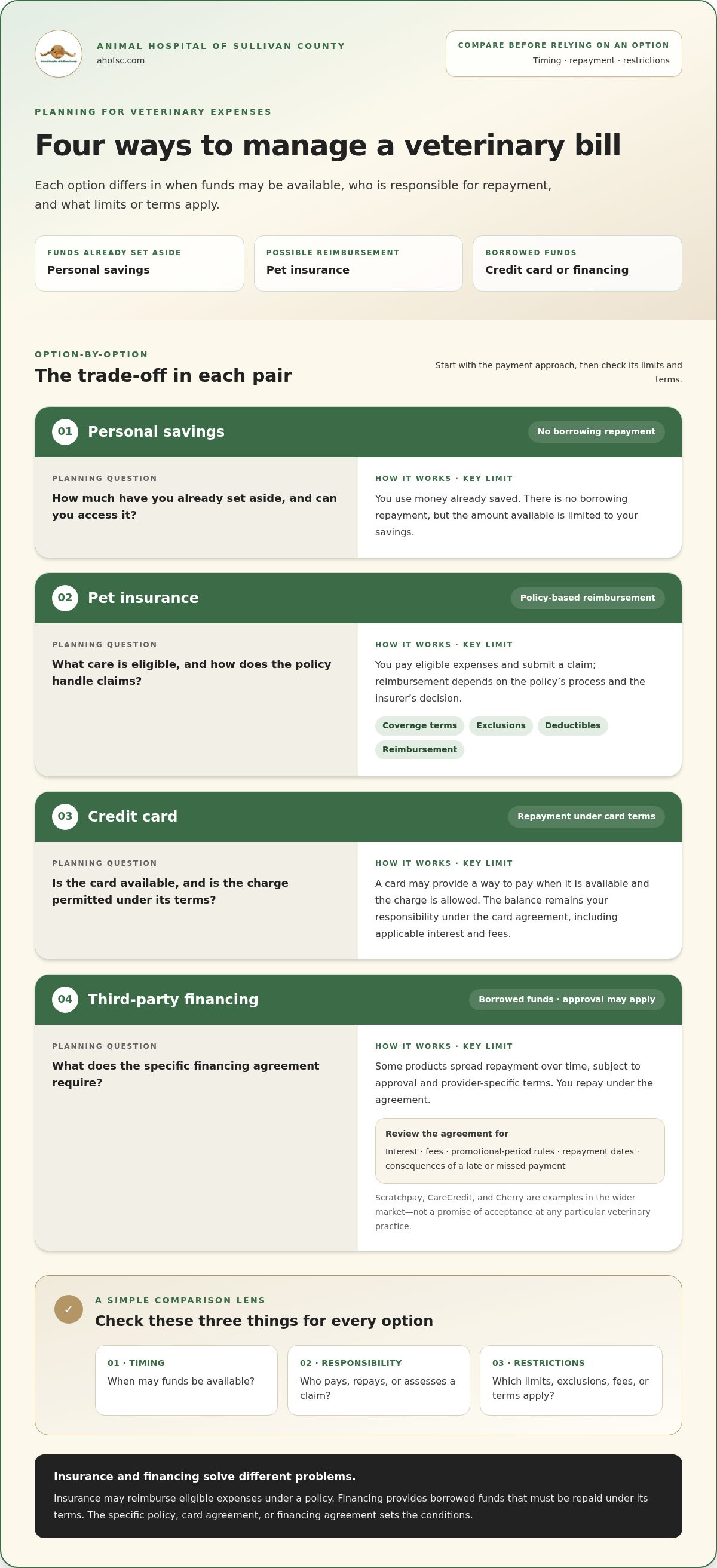
The best fit depends on more than how quickly money is available. Consider whether you’ll use funds already set aside, submit a claim for possible reimbursement, or take on a repayment obligation. Flexible payment options for vet bills differ in timing, restrictions, and financial responsibility, so compare the terms rather than assuming one approach suits every household.
Pet insurance and financing solve different problems, so they shouldn’t be treated as interchangeable. Insurance may reimburse eligible expenses under a policy, while financing provides borrowed funds that must be repaid. Availability, eligibility, and terms vary by policy, card issuer, or financing provider.
| Option | When funds may be available | Repayment responsibility and restrictions |
|---|---|---|
| Personal savings | Once you’ve set money aside and can access it. | No borrowing repayment, but the amount available is limited to your savings. |
| Pet insurance | After you pay eligible expenses and submit a claim, depending on the policy’s process. | Reimbursement depends on policy terms, exclusions, and the insurer’s claim decision. |
| Credit card | Potentially when the card is available and the charge is permitted under its terms. | You’re responsible for repayment under the card agreement, including applicable interest and fees. |
| Third-party financing | If approved and the financing provider’s process allows funds to be used for the expense. | You repay under the specific agreement, which may include interest, fees, or promotional conditions. |
Savings, pet insurance, and credit cards
Savings provide access to money you’ve already set aside, but they can cover only what you’ve accumulated. Insurance works differently: the policy defines eligible care, exclusions, deductibles, and reimbursement, and the insurer must assess a claim. A credit card can provide another way to pay, but the balance remains your responsibility under the card’s terms. Before relying on any of these options, compare when funds are available and what limits apply.
Third-party veterinary financing
Some financing products spread repayment over time, subject to approval and product-specific terms. Scratchpay, CareCredit, and Cherry are examples in the wider market, not promises of acceptance at any particular veterinary practice. Review the agreement for interest, fees, promotional-period rules, repayment dates, and what happens if a payment is late or missed. CareCredit explains its offering in CareCredit for Pet Healthcare.
Compare the agreement and payment schedule, not just a headline offer. A promotional period may have conditions, and a missed payment can affect the cost or terms of borrowing. When discussing recommended care, Animal Hospital of Sullivan County’s veterinary team can explain the purpose of treatment and the information involved in your care decisions.
How to compare vet-bill financing without overlooking repayment risks
A quick approval message or appealing promotion can make financing seem straightforward, but it doesn’t tell you the full cost or repayment responsibility. Before accepting an offer, compare the written agreement with your budget and the timing of your pet’s care. Use the same checklist for each offer so you can weigh flexible payment options for vet bills on their actual terms.
Review each offer in this order:
- Separate eligibility from the agreement. An application result or advertised approval claim doesn’t explain the final terms. Read the contract issued to you and confirm what you’re agreeing to.
- Find the full repayment schedule. Note the payment amount, due dates, repayment period, and whether payments are fixed or can change.
- Identify interest and fees. Check when interest applies, how it’s calculated, and whether account, late-payment, or other fees may be charged.
- Understand promotional conditions. If an offer includes a promotional period, find out what you must do to qualify and what happens to any remaining balance when it ends.
- Check late or missed-payment consequences. Review whether a late payment can trigger fees, added interest, or other changes under the agreement.
- Save the documents. Keep a copy of the contract, payment schedule, and written terms, then add due dates to a calendar or budget reminder.
Read the repayment terms before applying
Focus on the written terms, not only the application page or a representative’s summary. Promotional financing can carry conditions, and the consequences of not paying the balance as required depend on the specific offer. Don’t assume every plan treats missed payments or unpaid promotional balances the same way. If a term is unclear, get an explanation before you accept, and make sure it matches the contract you’ll keep.
Match the option to the care timeline
Compare the bill’s due date with when financing funds may be available or an insurance reimbursement may arrive. A claim decision and payout can take time, so don’t treat expected reimbursement as money already in hand. Consider whether you could manage the required payment alongside regular household expenses, even if other costs arise. Choose based on the complete schedule and your ability to repay, not an advertised approval, quick application, or promotional headline alone.
Credit-check practices, eligibility criteria, and promotional terms vary among issuers and financing providers. Don’t assume a claim about one company or offer applies to another, or to the final agreement you receive. Read the specific disclosure and contract for the option you’re considering. If the terms don’t fit your budget or the care timeline, pause and compare alternatives where possible. Understanding the obligation before signing can bring greater clarity to a stressful decision.
A practical checklist for preparing to discuss a veterinary bill
A clear conversation can help you understand the care plan and financial details, especially when you’re worried about your pet. You don’t need to arrive with every answer. Bringing relevant records and a few questions can make it easier to follow what’s recommended, understand what each step is for, and keep important paperwork organized.
Questions that help clarify a care estimate
Ask the veterinary team to walk you through the estimate in plain language. Find out what each diagnostic test, treatment, or follow-up visit is intended to address. If examination or test results could change the recommendations, ask which parts of the estimate might change and why. Also ask which steps are time-sensitive so you understand the care timeline.
Before the conversation ends, repeat the main points in your own words. For example, summarize the next recommended step, what it addresses, and what the team wants you to watch for. This gives everyone a chance to clarify misunderstandings. If your pet is scheduled for a procedure, understanding the care plan is part of preparing; learn about veterinary surgery care standards in Sullivan County as you consider planned surgical care.
Keep financial and care records organized
Create one place, such as a folder or secure digital file, for your pet’s records and financial documents. Keep the estimate, receipts, insurance paperwork, and any financing agreement together. Record payment due dates separately from claim submission dates or anticipated reimbursement. That separation helps prevent an expected insurance payment from being mistaken for money already available to meet a bill.
Use this step-by-step checklist before or during the discussion:
- Gather the basics. Bring relevant medical records, a current list of medications, and notes about symptoms or recent changes that may help explain your pet’s needs.
- Clarify each recommendation. Write down what the proposed diagnostic, treatment, or follow-up step is meant to do, and ask which parts are time-sensitive.
- Review the estimate together. Ask what is included and which items could change if examination findings or test results lead to a revised plan.
- Record the financial details. Note the estimate and any payment due dates. Keep insurance claim timelines and financing terms in separate notes so you can compare them accurately.
- Confirm your understanding. Summarize the care plan and next steps in your own words, then ask about anything that still feels unclear.
Good notes can help you make a thoughtful decision about care and compare financial choices without relying on memory during a stressful moment. If you’d like a veterinary team to explain recommended care clearly, discuss your pet’s care with Animal Hospital of Sullivan County.
Plan your pet’s care with a trusted Sullivan County veterinary team
Understanding payment choices is one part of planning for veterinary care. Just as important is having a veterinary team that explains what your pet needs, why a service is recommended, and what questions you can ask before deciding on next steps. A clear conversation can help families consider care and household finances together, while keeping their companion’s well-being at the center.
Animal Hospital of Sullivan County has cared for pets since 1953 and is based in Ferndale, New York. The practice provides preventive, medical, surgical, diagnostic, and urgent care during regular office hours. Its team offers compassionate communication and can explain veterinary recommendations to help families make informed care decisions. That context can support your planning as you consider flexible payment options for vet bills, though each family’s financial choices remain their own.
What compassionate, clear veterinary communication looks like
A heart-first approach pairs professional veterinary care with respect for the bond you share with your pet. That means making space for questions and explaining the purpose of recommended care in terms you can understand. Client testimonials describe transparent pricing and thorough communication, reflecting the value of clear discussions when families are considering a care plan.
Animal Hospital of Sullivan County is veteran-owned and woman-owned. Dr. Barbara Bodolosky is a U.S. Army veteran with over 30 years of veterinary experience. The practice is also the only AAHA-accredited animal hospital in Sullivan County, accredited since 1983 and adhering to over 900 rigorous standards.
Trust grows through the details of each conversation. Ask what a recommendation addresses, what the next step involves, and which parts of a plan need attention first. If you’re weighing financial decisions alongside care, sharing that concern can help keep the discussion clear and focused on your pet’s needs.
A simple next step for Sullivan County pet owners
Before you speak with the veterinary team, bring your questions and any notes about your pet’s health. Write down what you’d like explained, which recommendations feel unclear, and what you need to understand about timing. Then take the discussion one step at a time. A clear explanation can help you understand the care plan before you make decisions about how to manage the bill.
For families in Sullivan County, building a relationship with a local veterinary team can make future care discussions feel more familiar. Whether you’re planning preventive care or seeking guidance about a medical, diagnostic, or surgical recommendation, start with your pet’s health and your questions. Connect with Animal Hospital of Sullivan County to discuss your pet’s care plan with the Ferndale practice.
Take the Next Step Toward Confident Care Planning
Planning for your pet’s care doesn’t have to be a one-time task. As your companion’s needs change, revisit your household plan and adjust it to fit what matters now. The goal isn’t to predict every possibility. It’s to feel prepared to ask questions, understand the choices before you, and make decisions with your pet’s well-being at the center.
Give yourself permission to raise money concerns in a veterinary conversation. Clear, compassionate communication can help you understand recommended care and consider how it fits your circumstances. You deserve to feel informed, not alone, as you weigh flexible payment options for vet bills and plan for your cherished companion.
For a supportive conversation about your pet’s care, connect with Animal Hospital of Sullivan County. One thoughtful discussion can help you take the next step with greater confidence and care.
Frequently Asked Questions
Can pet insurance reimburse me for a veterinary bill I already paid?
Yes, a policy may reimburse you for an eligible bill you’ve already paid, but reimbursement isn’t guaranteed. The insurer reviews the treatment, policy exclusions, deductible, and claim requirements before making a decision. Check your policy documents for the records needed, such as an itemized invoice or medical notes, and submit them through the insurer’s stated claims process. Keep copies of what you send in case the insurer requests more information.
Does pet insurance usually pay the veterinary clinic directly?
Payment arrangements vary by insurer and policy. Some policies generally reimburse the pet owner after the bill is paid, while some insurers may have a direct-pay process under specific rules or participating arrangements. Don’t assume a clinic will receive funds from your insurer or that direct payment is available for your claim. Review your policy or contact the insurer to understand how payment is handled before planning around those funds.
Can applying for veterinary financing affect my credit?
It can, depending on the financing product and the stage of the application. A preliminary eligibility check may be handled differently from a full application, and credit-check practices vary by provider. Before entering personal information, read the lender’s current disclosures and consent language to learn what kind of check may occur and whether it could affect your credit. Don’t rely on another applicant’s experience as a guarantee of what will happen to you.
What happens if I miss a payment on veterinary financing?
The outcome depends on the agreement you signed and the financing product. Depending on its terms, a missed payment may lead to fees, additional interest, collection activity, or credit consequences. If you think you may miss a due date, contact the financing company promptly and keep a record of the conversation and any follow-up. Review the written agreement for the steps that apply to your account, rather than assuming every lender handles late payments the same way.
Is a veterinary payment plan the same as deferred interest?
No. A payment plan describes how an amount is repaid over time; deferred interest is a condition that may apply to some promotional credit offers. The terms aren’t interchangeable. Read the offer to see whether interest is postponed, what conditions apply during the promotional period, and what happens if a balance remains when it ends. The agreement should explain how interest is handled, so check those details before accepting the offer.
What should I bring when discussing a veterinary estimate?
Bring current information about your pet’s health and medications, relevant records, and insurance documents if you have a policy. Prepare questions about what each recommended item addresses and when payment is due. If you’re comparing flexible payment options for vet bills, having the estimate beside your policy or financing documents can help you keep the details straight. Save copies of estimates and agreements, and note payment dates separately from insurance claim deadlines.


