

An emergency doesn’t come with a predictable bill: the pet emergency treatment cost in Sullivan County depends on your pet’s condition and the diagnostics and treatment needed. The fee is based on the individual case and is given after a quote request, with the care required shaping the total. When a beloved pet is suddenly unwell, uncertainty about both their health and the cost can feel overwhelming.
This guide explains how to arrange urgent veterinary care in Sullivan County and what to consider. You’ll learn which details help the veterinary team understand the situation, how assessment and treatment needs affect an estimate, and what to expect when arranging care. Clear information can make the next step feel more manageable, so you can focus on getting support for your pet.
Key Takeaways
- Learn what can affect an urgent-care estimate, including your pet’s condition and the assessment or treatment needed.
- Find out what to discuss when arranging an appointment so the veterinary team can understand your pet’s immediate needs.
- See how to clarify payment expectations and possible deposits before care begins.
- Explore what to consider when looking for lower-cost care or financial assistance in Sullivan County.
- Understand when emergency treatment during business hours may be a helpful next step for your pet.
Urgent veterinary care
Urgent veterinary care addresses sudden health concerns through professional assessment and treatment. Start by describing the change you’ve noticed, such as a new injury, sudden weakness, or an abrupt change in behavior.
When arranging an appointment, explain what happened, when it began, and how your pet has changed since. For example, say whether an injury followed a fall or a symptom appeared without an obvious cause. These details help the veterinary team understand the concern and prepare for the visit. Include your pet’s age, known medical conditions, and any medication information you have.
Be direct about changes that seem severe or are worsening. A pet that becomes less responsive after an injury needs prompt attention. Describe what you observed rather than guessing at a diagnosis. Tell the team what your pet was doing beforehand and whether anything has changed while arranging care.
Ask how the appointment will proceed and what information to bring. If another clinic has examined your pet, mention the visit and share any available records. A medication list or previous test results, for example, may give the veterinary team useful context. Share what you have, even if it feels incomplete.
Pet emergency treatment cost in Sullivan County depends on your pet’s condition, the assessment needed, and the recommended treatment. The estimate is specific to your pet’s needs.
Urgent care does not always involve the same level of treatment. A veterinary assessment helps determine whether a concern needs immediate intervention or can be managed through a scheduled appointment. Describe the change rather than deciding on treatment yourself. For example, explain whether limping began suddenly or followed a known injury.
Upfront Payments and Deposits
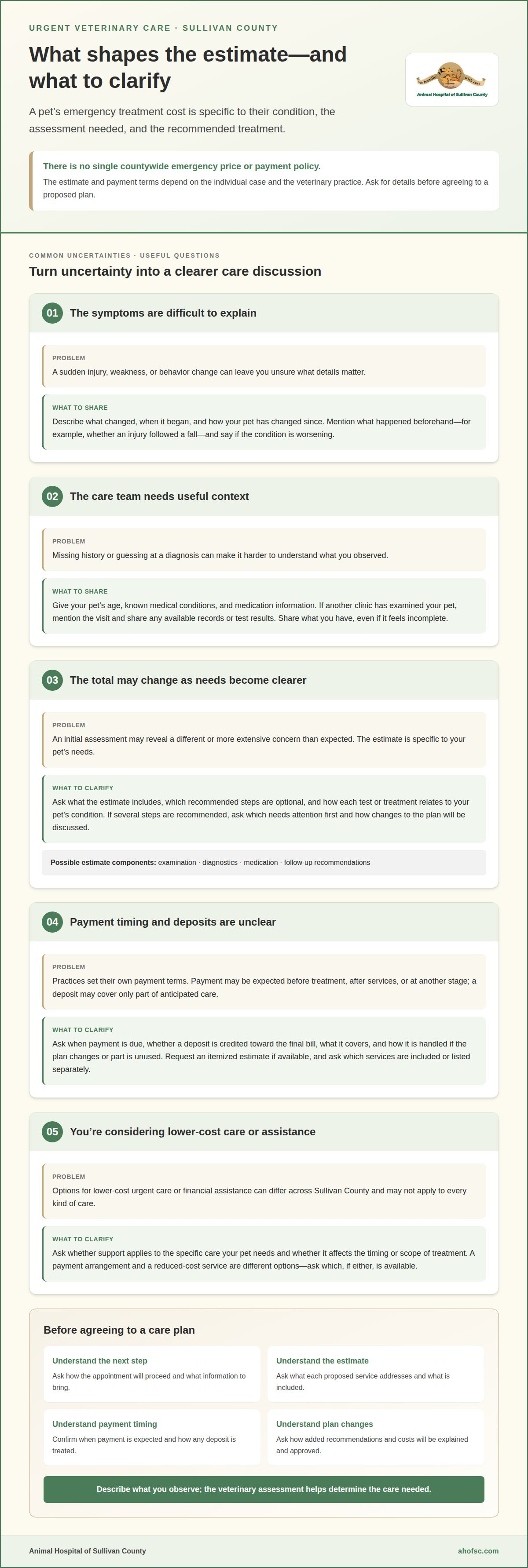
Payment arrangements can vary between veterinary practices and according to the care being considered. Before treatment proceeds, clarify what the estimate includes, which recommended steps are optional, and whether payment is expected before care begins. For example, ask how the estimate may change if an examination points to further diagnostics or treatment.
Low-Cost Care and Financial Assistance
Options for lower-cost urgent care or financial assistance can differ across Sullivan County. Ask what support, if any, applies to the specific care your pet needs, and whether it affects the timing or scope of treatment. For example, distinguish a payment arrangement from a reduced-cost service, since they address different parts of the expense.
When reviewing an estimate, focus on the proposed care rather than a single total. An examination, diagnostics, medication, and follow-up recommendations may each contribute to the plan. Ask how each item relates to your pet’s condition. If the veterinary team recommends several steps, discuss which needs attention first.
Costs can change if an initial assessment reveals a different problem than expected. For example, a visible wound may need further examination to understand its extent. Ask how each recommended test or treatment relates to your pet’s needs. This can help you make an informed decision and understand that an estimate may change as care progresses.
Before settling on a care plan, make sure you understand the next step, the expected payment timing, and any follow-up instructions. If you’re considering assistance, ask how it applies to the proposed treatment. Keep the discussion focused on your pet’s immediate needs and the choices available for addressing them.
Do Sullivan County emergency vets require upfront payment or deposits?
Payment timing is set by each veterinary practice, not by one countywide policy. A practice may request payment before treatment, a deposit toward planned care, or payment after services. Those terms can differ with the proposed treatment and the practice’s billing process. For example, an examination alone may involve a different estimate than a plan including diagnostics or surgery. Ask about payment timing while arranging care, so you understand the process before making decisions.
A deposit is an advance payment connected to an estimate or treatment plan. It may be applied to the final bill, but the practice’s terms determine how it is handled. Ask whether the amount covers a specific part of care, whether it changes if the plan changes, and how any unused portion is treated. These details matter if the initial assessment leads to a revised estimate.
Upfront payment means payment is expected before some or all services begin. A deposit, by contrast, may cover only part of anticipated care. For example, a practice might request an initial payment before diagnostics, then discuss additional costs if results lead to further treatment. Ask for a clear explanation before agreeing to the proposed plan.
During a call, describe your pet’s condition and ask which payment steps apply to the visit. Then request an itemized estimate, if one is available, and ask what each proposed service addresses. The estimate should help connect the treatment plan with the expected charges. For instance, ask whether a diagnostic test is included or listed separately. Clear itemization helps you understand what you are being asked to authorize.
Before treatment, clarify how changes to the estimate will be discussed. If an examination reveals a need for additional care, ask how the team will explain the recommendation and its cost, and whether you’ll be asked to approve it first. This is especially useful if the initial estimate covers an examination but later findings point to diagnostics or medication.
- Ask whether payment is due before treatment, after treatment, or at another stage.
- Clarify whether a deposit is credited toward the final bill.
- Ask how changes to the treatment plan affect the estimate.
- Find out which services the estimate includes and which are separate.
- Keep a record of the estimate and any payment terms discussed.
Payment options and financial assistance are separate questions. If paying the full amount at once is difficult, explain that concern early and ask what arrangements apply. Don’t assume a payment plan, credit option, or outside assistance is available. A payment method may handle a bill differently from a reduced-cost program, so clarify which options are actually offered.
For an urgent visit during business hours, arrange an emergency appointment and discuss the payment process alongside your pet’s immediate needs. Share the symptoms, ask what the first assessment involves, and request an explanation of payment timing before authorizing additional care. A focused conversation can clarify both the next medical step and the financial commitment.
Are there low-cost emergency veterinary services or financial assistance programs in Sullivan County?
Lower-cost care and financial assistance are different forms of support. A reduced-cost service changes the amount charged for eligible care. Assistance may help cover an expense without changing the treatment plan. First understand what care is recommended, then consider which kind of support fits the specific need.
There is no single assistance option for every pet or situation. Programs can have eligibility rules, limits, and application steps. The type of care may also matter: an emergency examination, diagnostic testing, medication, and surgery are distinct needs, and support for one expense might not cover another.
Start with an estimate that separates the proposed services. Ask which items address the immediate concern and which relate to later care. An examination, for example, may clarify whether further diagnostics are recommended. A clear breakdown gives you a practical basis for discussing payment choices and seeking help for a specific expense.
Ask about payment arrangements separately from reduced-cost care. A payment arrangement changes when or how you pay, but does not necessarily reduce the total. Financial assistance may have different terms, eligibility criteria, and timing. Keeping these categories distinct helps prevent confusion as you consider care for your pet.
If you’re looking into charitable assistance, identify the expense and the amount you can contribute. A fund may require an estimate, medical records, or proof of eligibility. Prepare the requested details, such as the proposed treatment and the clinic’s estimate. The application process can affect how quickly support becomes available.
If a veterinarian recommends diagnostics before treatment, ask whether assistance applies to testing, treatment, or both. If the plan changes after results arrive, the original estimate may no longer reflect the full need. A revised estimate can help you explain the situation accurately when discussing eligibility or payment options.
- Request an itemized estimate for the recommended care.
- Separate payment timing from reduced-cost or charitable assistance.
- Ask which specific services an assistance option can cover.
- Clarify application requirements and decision timing.
- Keep estimates and program communications together.
Timing matters during an urgent situation. An application may take time, while your pet may need prompt assessment. Explain the urgency when discussing financial support and ask what care can proceed while an application is considered. This helps distinguish immediate medical needs from later financial steps.
Don’t assume a lower initial charge includes every recommended treatment. It may cover an examination, while diagnostics or medication are separate. Compare the services described, not just the headline amount. Ask what the estimate includes and what could change after the veterinarian assesses your pet.
For a pet with an urgent health concern, arrange emergency veterinary care and discuss the treatment plan and payment questions together. Sharing the estimate and the assistance you’re exploring can help keep the conversation focused on your pet’s immediate needs and the practical choices available.
Animal Hospital of Sullivan County: Emergency Treatment
Animal Hospital of Sullivan County provides emergency treatment for urgent pet health needs during regular office hours. If your pet develops a sudden concern during those hours, call to discuss the situation and arrange an appointment. Share what changed and when it began so the veterinary team can understand why your pet needs care.
Depending on your pet’s condition, care may include medical treatment, diagnostics, or surgery. The veterinary team can explain the recommended next steps and how they relate to the findings. An examination, for example, may help determine whether further diagnostics or treatment are appropriate. Ask about the estimate and payment terms as you discuss the care plan.
If your pet needs urgent veterinary attention, contact Animal Hospital of Sullivan County to discuss an appointment.
Take the Next Step for Your Pet’s Care
Understanding pet emergency treatment cost in Sullivan County starts with a clear next step: discuss your pet’s health and your questions with a veterinary team. You can work through the decisions one at a time, keeping your pet’s comfort and needs at the center.
Animal Hospital of Sullivan County provides medical, surgical, and preventive care for pets. If an urgent concern arises during regular office hours, call to discuss whether an appointment is appropriate and what information will help the team understand your pet’s situation. You don’t need every answer before starting that conversation.
Contact Animal Hospital of Sullivan County to discuss your pet’s care. Taking that step can help you move forward with a clearer plan and compassionate support for a cherished family member.
Frequently Asked Questions
What emergency veterinary clinics serve Sullivan County, and where are they located?
Animal Hospital of Sullivan County is located at 667 Harris Rd, Ferndale, NY 12734. The hospital provides emergency treatment during regular office hours. For pet owners in Sullivan County, New York, this offers a local place to discuss an urgent concern. If you’re coming from elsewhere in the region, consider travel time and the clinic’s hours when planning how to arrange care.
What is the typical emergency exam fee at Sullivan County veterinary clinics?
There isn’t one typical exam fee that applies to every Sullivan County clinic. The amount can vary by practice and by the care required for the visit. An examination may be followed by additional recommendations based on your pet’s condition, so distinguish the exam charge from any proposed diagnostics or treatment. For a useful estimate, describe the concern and ask what the initial examination covers.
How much do common pet emergency treatments cost, such as X-rays, bloodwork, and IV fluids?
The cost of X-rays, bloodwork, or IV fluids depends on which services the veterinary team recommends and how they fit your pet’s treatment plan. A visit involving one diagnostic test differs from a plan combining several tests and supportive care. Ask which items are included in the estimate and what each is intended to address. A clear breakdown helps you understand how the proposed care affects the total.
What does emergency surgery for a dog or cat cost in Sullivan County?
Emergency surgery costs vary with the procedure and the care required for the individual dog or cat. The treatment plan may also include diagnostics or care after the operation, which can affect the overall estimate. Ask for the proposed surgical steps and related services to be explained separately. This makes it easier to understand what the estimate covers and which parts depend on your pet’s specific needs.


