

A seizure isn’t always a dramatic collapse. If you’re asking yourself, “Is my dog having a seizure?”, sudden uncontrolled movements or a noticeable change in awareness can be signs. Most dog seizures last 1-2 minutes, but a seizure lasting five minutes or more is a veterinary emergency.
It’s frightening to see a beloved dog act this way, and it can be hard to tell what’s happening. Knowing the difference between focal and generalized signs can help you describe what you observed and recognize when urgent care is needed.
This article explains possible causes, including epilepsy and toxin exposure, and what may happen during veterinary evaluation and treatment. It also explores potential triggers and alternative approaches, so you can better understand the options and support your dog with clear, informed care.
Key Takeaways
- Seizures may be linked to idiopathic epilepsy, toxins such as xylitol, or other medical conditions, so identifying the cause matters.
- Generalized seizures affect the whole body, while focal seizures may show up as unusual movements or behavior in one area.
- During an episode, keep your dog away from nearby hazards and don’t put anything in their mouth.
- A seizure lasting five minutes or more, or multiple seizures within 24 hours, calls for emergency veterinary care.
- Recording what happened and how your dog acts afterward can help a veterinarian assess the episode and discuss next steps.
What Causes Seizures in Dogs?
A seizure can have several possible causes, from idiopathic epilepsy to toxin exposure. Identifying the likely cause helps clarify what may happen next and what information matters during a veterinary assessment.
Toxins and Medical Conditions
Toxins and underlying medical problems can cause seizures in dogs. Xylitol, a sweetener found in some products, is one example of a toxin that can provoke a seizure. If exposure may have occurred, keep the packaging or note the product name. That information can help the veterinary team understand what your dog may have encountered.
Some seizures occur alongside an underlying disease, while others have no identifiable cause. A veterinarian may use blood and urine tests, and possibly an EKG, to assess your dog after a seizure. CT or MRI imaging, often conducted using specialized veterinary imaging systems from companies like Animage, may help look for brain lesions. The test results and your dog’s history provide context for investigating possible causes.
Seizure Causes and Triggers
A cause is the underlying reason a seizure occurs; a trigger is an event associated with an episode. In dogs with recurring seizures and no identified underlying cause, idiopathic epilepsy is the most common diagnosis. It usually affects dogs between 6 months and 6 years of age. Knowing that age range can help frame the discussion, but it doesn’t establish a diagnosis on its own.
Dogs and cats can both have seizure-like episodes, but a suspected cause in a dog should not automatically be assumed in a cat. Share your pet’s history and any possible exposure with a veterinary professional. For example, mention possible access to a product containing xylitol, rather than describing the event only as sudden shaking.
When no cause is found, “idiopathic” describes that uncertainty; it doesn’t mean the episode wasn’t real. A healthy-looking dog may still have recurring seizures associated with idiopathic epilepsy. A seizure can also signal an underlying problem that needs attention. The episode’s appearance alone can’t tell you which explanation applies.
Document possible triggers, but don’t treat a coincidence as proof. Note what happened beforehand, such as a change in routine or access to a substance, and whether your dog seemed disoriented afterward. A few clear details can help identify a possible pattern or an isolated event. Don’t deliberately recreate a suspected exposure to test the connection.
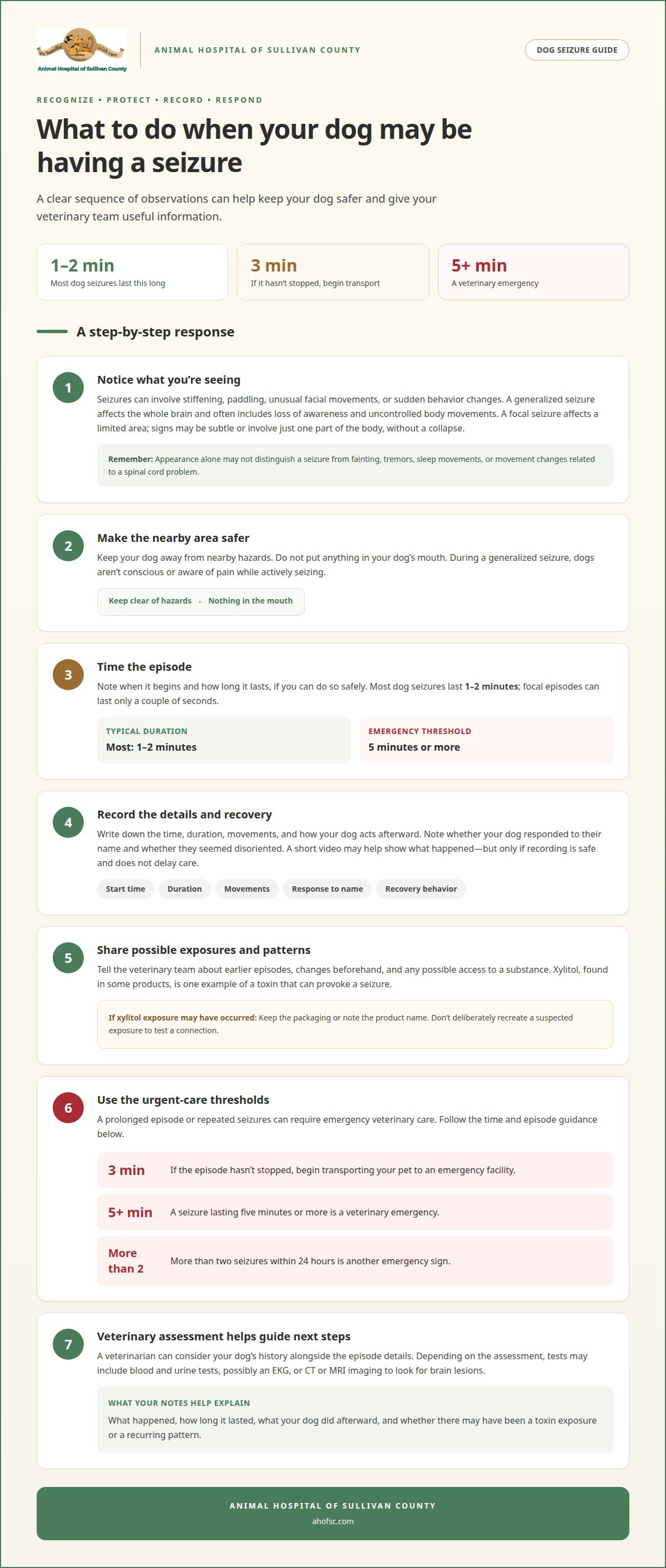
Write down the time, duration, movements, and recovery behavior you observed. A short video can also help show what happened, if you can record safely without delaying care. After a first seizure or when episodes recur, a veterinary assessment can consider your dog’s history alongside tests such as bloodwork or imaging. The evaluation helps guide the next steps.
Recognizing generalized and focal seizure signs
Seizures can look different from one dog to another. The movements, awareness, duration, and recovery help describe what you witnessed.
Physical and Behavioral Symptoms
A generalized seizure affects the whole brain and often involves loss of awareness and uncontrolled body movements. A focal seizure involves activity in a limited area, so signs may be subtle or affect one part of the body. A dog may not collapse during a focal episode, so the distinction matters.
Possible signs include stiffening, paddling movements, unusual facial motions, or sudden behavior changes. Your dog may also seem disoriented afterward. During a generalized seizure, dogs aren’t conscious or aware of pain while actively seizing. Signs vary, so describe exactly what you saw rather than relying only on a label.
Generalized seizures usually last from a few seconds to a few minutes. Most dog seizures last 1-2 minutes, while focal seizures can last only a couple of seconds. A short episode can still be significant, especially if it is new or happens again.
Seizures Versus Fainting, Tremors, and Sleep Movements
Fainting, tremors, and movements during sleep can resemble seizure activity, but appearance alone may not distinguish them. Rhythmic movement during sleep, for example, can be mistaken for a focal seizure, while a brief collapse may look like a generalized event. A spinal cord problem can also affect movement, so don’t use one symptom alone to identify the cause.
Note whether your dog responded to their name, how their body moved, and how they acted afterward. These details help a veterinarian consider possible explanations. A video can help show the movements, as long as recording doesn’t delay care or put you at risk.
Time the episode if you can do so safely. A seizure lasting longer than five minutes is a veterinary emergency, and more than two seizures in 24 hours is another emergency sign. If the episode hasn’t stopped after three minutes, begin transporting your pet to an emergency facility. Don’t wait for a second episode when urgent signs are present.
Tell the veterinarian when the event began, how long it lasted, what movements or behavior you observed, and how your dog recovered. Include earlier episodes and possible toxin exposure, such as access to a product containing xylitol. Clear details support assessment and help distinguish a one-time event from a pattern.
If urgent veterinary care is needed during business hours, emergency veterinary treatment can be an appropriate next step.
Is idiopathic epilepsy in dogs dangerous?
Idiopathic epilepsy describes recurring seizures when no underlying cause is identified. The diagnosis follows an assessment, not appearance alone. A veterinarian may consider your dog’s history and diagnostic test results together. An unusual seizure pattern, a prolonged episode, or other health changes may point to different concerns. Idiopathic epilepsy can often be managed, but seizures still need attention, especially when they cluster or continue without recovery.
After a seizure, possible checks for your dog include blood and urine tests, and sometimes an EKG. A CT scan or MRI may help look for brain lesions. These results help assess possible underlying causes; normal results don’t mean the observed episode wasn’t real. A dog between six months and six years old with normal test results may be monitored after a first seizure. The history and pattern help guide that decision.
Cluster seizures are two or more seizures within 24 hours. A dog can seem to recover between episodes, but repeated seizures still warrant emergency veterinary care. Keep a record of each start time, duration, and recovery interval. That timeline helps show whether episodes are becoming more frequent or closer together. Several seizures in a row while your dog remains unconscious call for veterinary attention as soon as possible.
Status epilepticus refers to a prolonged seizure or repeated seizures without regaining consciousness. A single seizure lasting longer than five minutes is a veterinary emergency. Don’t wait for the episode to end before seeking urgent care. A longer seizure can put your dog at serious risk, while repeated episodes without awareness leave little time to recover. Tell the veterinary team how long the seizure has continued and whether your dog regained awareness.
Long-term medication may be considered for cluster seizures, more than two seizures in six months, or a single seizure lasting longer than five minutes. A dog with more than one seizure a month or very violent episodes may also need medication. Treatment depends on your dog’s seizure history and response. Anti-seizure drugs may be needed for the rest of your dog’s life, so consistent dosing and follow-up matter.
Success is often measured by fewer episodes, with a 50% reduction in seizures used as a treatment-response measure. Some dogs seizure-free for 12 or more months may be candidates for gradual medication tapering under veterinary supervision. Never change or stop a prescribed drug on your own. Tracking episodes, missed doses, and recovery gives the veterinarian useful information when reviewing the plan.
Potential seizure triggers and alternative treatments
A trigger is an event or exposure that appears before a seizure; a cause is the underlying reason it happens. A diary may reveal a pattern, but timing alone doesn’t prove that an event caused the seizure. Record the time, activity, and circumstances around each episode. Include changes in routine, possible toxin exposure, missed medication, and how your dog behaved afterward.
Keep your notes specific. “Seizure after a walk” gives less context than recording what your dog encountered and when symptoms began. Include whether your dog was resting, eating, or moving, and whether the episode followed a change in prescribed treatment. A veterinarian can compare these details with your dog’s medical history and diagnostic findings. Don’t deliberately recreate a suspected trigger to see whether it causes another episode.
Some preventable exposures may trigger seizures, so secure household products and keep packaging if your dog may have accessed something concerning. Tell the veterinary team what the product was and when contact may have occurred. Even when a trigger seems obvious, a broader assessment matters: seizures can have different causes, and an apparent pattern doesn’t rule out disease or another medical issue.
Alternative approaches should be discussed as part of a treatment plan, not used in place of prescribed anti-seizure medication or urgent care. Vagal nerve stimulation is one approach described for seizure management. A technique involving gentle pressure on a dog’s closed eyes for 10-20 seconds, repeated every 5 minutes, has been described. Because this involves the eyes, don’t try it without direct veterinary instruction. It isn’t a reason to delay emergency treatment.
During an episode, protect your dog from nearby hazards. Move furniture or other objects, block access to stairs, and keep your hands away from the mouth. Don’t restrain your dog’s limbs. Focus on making the surroundings safe and note the seizure’s start and end times. If your dog loses consciousness or has repeated episodes, prioritize veterinary care over trying an alternative technique.
Imaging and other diagnostic tests may help investigate an underlying cause, while a seizure record can show how episodes relate to daily activity and treatment. A veterinarian may also consider whether another condition, including a spinal problem, better explains unusual movement. Share changes in awareness, recovery, or behavior rather than assuming every movement is a seizure.
The practical takeaway is to track possible patterns without treating them as proof. Keep product details, note medication changes, and describe what happened before and after each event. This record can help guide testing and treatment decisions while keeping your dog’s safety at the center.
How can you tell a seizure from fainting, tremors, or sleep movements in dogs?
A brief collapse, shaking, or twitching during sleep can look alarming, but one movement alone can’t identify its cause. Compare what happened before, during, and after the episode, then share your observations with a veterinarian.
Consider awareness and the full pattern. During a generalized seizure, a dog isn’t conscious or aware of pain. Fainting can also involve a sudden loss of awareness, so the collapse alone may not distinguish it. Note whether your dog stiffened, paddled, made repeated facial movements, or seemed disoriented afterward. These details describe the event without assuming a diagnosis.
Tremors may look like shaking while a dog remains aware of its surroundings. Note whether your dog responds to their name, maintains posture, and returns to normal behavior. These observations can help describe the episode, but they can’t prove whether it was a tremor or seizure activity. A veterinarian needs the full history, not just a description of visible shaking.
Sleep movements occur while a dog is resting. You might notice a paw twitch or a brief body movement during sleep. Record whether your dog was asleep beforehand and what happened after waking. If unusual movements occur while your dog is awake, continue, or leave them disoriented, describe that clearly rather than deciding it was ordinary sleep behavior.
Use a simple event record to preserve the details:
- Write down whether your dog was sleeping, standing, eating, or active beforehand.
- Describe the movement, including which body parts moved and whether it repeated.
- Note whether your dog responded to their name or appeared aware during the event.
- Record how your dog acted afterward, including confusion or a return to normal behavior.
- Time the episode and note whether another event followed.
A safe video can help show a veterinarian the movement and context. Keep your dog away from hazards while recording, and don’t delay urgent care to capture footage. A generalized seizure lasting longer than five minutes is an emergency; multiple seizures within 24 hours also require emergency veterinary care. Fainting, tremors, and sleep movements may need assessment too, particularly when the event is new or recurring.
If you’re unsure what you saw, share your notes and seek veterinary evaluation for seizure-like episodes. Describe the sequence in plain language, such as “collapsed after standing, then responded when called.” That account is more useful than labeling every episode a seizure.
Animal Hospital of Sullivan County: Preventive Care
Animal Hospital of Sullivan County provides Medical Care and Diagnostics to assess seizure-like episodes and guide your pet’s next steps. Share when the episode occurred, what movements you noticed, how long it lasted, and how your dog behaved afterward. These details support an evaluation and help the veterinary team consider appropriate testing.
For a prolonged seizure or repeated episodes, seek emergency veterinary care. For ongoing health support, Preventive Care gives you an opportunity to discuss your dog’s health history and concerns. Surgical Care is also available when your pet’s medical needs call for it.
If you’re concerned about an episode or want to discuss your dog’s care, contact Animal Hospital of Sullivan County.
Make a thoughtful plan for your dog’s care
If you’re still asking, “Is my dog having a seizure?”, remember that you don’t have to interpret every movement on your own. Your observations can help start a focused conversation about your dog’s health and possible support. A clear account of your concerns can make that conversation easier, especially when an episode has left you worried or uncertain.
Animal Hospital of Sullivan County offers Medical Care, Preventive Care, and Surgical Care for pets. The right next step can depend on your dog’s needs and the questions you want to discuss. Reach out to talk about your pet’s care and take the next step with support from a veterinary team. Contact Animal Hospital of Sullivan County when you’re ready. You’re acting with care by seeking answers for a member of your family.
Frequently Asked Questions
What does a seizure look like in a dog?
A dog’s seizure may involve sudden stiffening, paddling, or repeated facial movements. Some episodes affect only a small area and may appear as unusual behavior rather than a collapse. If you’re asking, “Is my dog having a seizure?”, note what happened before and after the movement, and whether your dog responded to you. These details help distinguish patterns, though a veterinarian must assess the cause.
What Is a Dog Seizure Disorder?
A seizure disorder describes recurring seizure episodes; idiopathic epilepsy is diagnosed when recurring seizures have no identified underlying cause. “Idiopathic” describes the unexplained cause, not whether the episodes occurred. Keep a record of each event, including its timing and your dog’s recovery, because the pattern can help characterize the condition. Depending on your dog’s history and episode pattern, a seizure disorder may call for monitoring or ongoing medication.
Do seizures shorten a dog's life?
A seizure diagnosis alone cannot determine how long a dog will live. The underlying cause, seizure pattern, and response to treatment all matter. The urgent concern is an episode lasting longer than five minutes or repeated seizures within 24 hours, which require emergency veterinary care. For longer-term planning, discuss whether episodes are becoming more frequent and how your dog responds to the current care plan.
How Are Pet Seizures Diagnosed?
Veterinarians diagnose seizures by combining a pet’s history with an examination and diagnostic testing. Share a video if you captured one safely, and report changes in awareness, movement, and recovery. Testing may include blood and urine analysis, sometimes an EKG, or CT or MRI imaging to look for brain lesions. A dog between six months and six years old with normal test results may be monitored after a first seizure.
How Are Pet Seizures Treated?
Treatment may involve anti-seizure medication, with the choice shaped by episode frequency, severity, and your dog’s health. Extended-release levetiracetam can be given twice daily to pets; zonisamide may be given twice daily to dogs. Potassium bromide takes several months to reach stable blood levels. These medicines have different schedules, so give prescribed medication as directed and don’t adjust it without veterinary supervision.
How long does it take for a dog to recover from a seizure?
Recovery may take a few minutes to several hours, and some dogs remain confused or disoriented for up to 24 hours. Your dog may need a quiet, safe space while returning to normal behavior. Track when awareness and coordination improve, and note any worsening signs or another episode. A prolonged seizure or repeated seizures require emergency care rather than waiting to see how recovery progresses.
What Is the Prognosis for Pets with Seizures?
Prognosis depends on the cause, seizure pattern, and your pet’s response to treatment. A dog with idiopathic epilepsy has no identified underlying cause, while seizures linked to another condition require attention to that cause. Keep follow-up records of episodes and medication changes. If your dog’s seizures become more frequent, more severe, or harder to recover from, promptly share that change with the veterinarian.
What are the common signs of a seizure in a dog?
Common signs include stiffening, paddling movements, repeated facial motions, and changes in awareness. A focal seizure may affect one area or appear as a brief behavior change, while a generalized seizure can involve the whole body. Afterward, your dog may seem confused or disoriented. Describe the specific movements and behavior you observed, since a written account can be more useful than simply calling it shaking.


