

A pain quiz can reveal clues, but it can’t tell you the whole story. An “Is my cat in pain?” quiz can help you notice changes in activity, appetite, behavior, breathing, and response to touch. Cats may hide discomfort, so even a subtle change from your cat’s usual habits is worth noting.
It’s natural to wonder whether a quieter day or a missed meal means something is wrong. This guide will help you observe changes and understand how a pain score can support, but not replace, a veterinary exam. An “Is my cat in pain?” quiz is a starting point, and the right assessment tool depends on the type of pain. A checklist for chronic joint problems isn’t interchangeable with a tool for acute pain. Careful observations, a suitable questionnaire, and a veterinary examination can give a clearer picture of your cat’s comfort and help guide the next step.
Key Takeaways
- Compare your cat’s activity and appetite with their usual routine, and note changes to share during a veterinary exam.
- Watch for shifts in personality, hiding, snapping, or distress when picked up; subtle behavior changes can be important clues.
- Include breathing, posture, and response to touch in your observations, not just obvious signs such as limping.
- Use pain scores as a structured way to describe what you notice, alongside your cat’s history and a thorough veterinary examination.
- Choose an assessment tool that matches the concern: a tool for chronic joint pain may not suit sudden pain or another condition.
Using pain scores alongside a veterinary exam
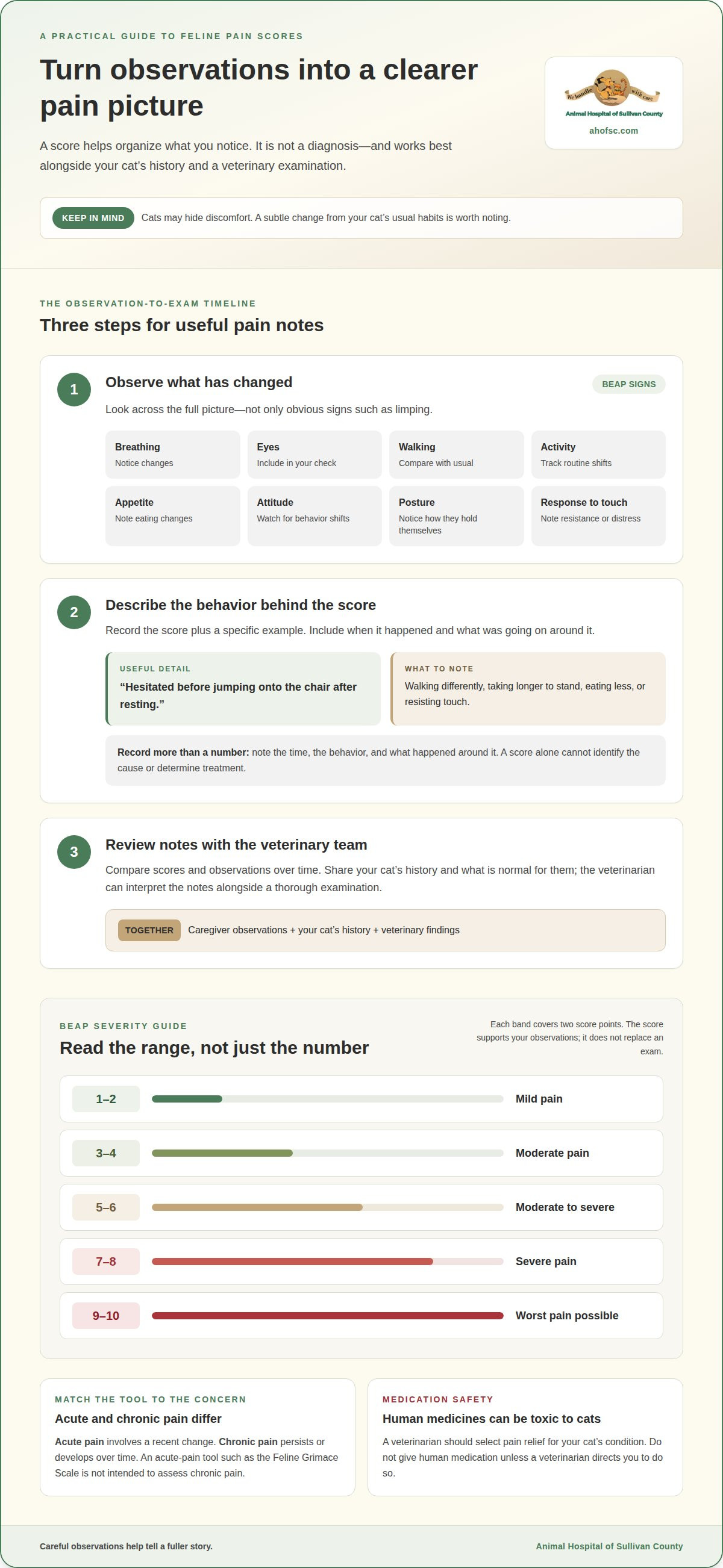
A pain score gives you a structured way to describe changes, not a diagnosis. The BEAP scale assesses breathing, eyes, walking, activity, appetite, attitude, posture, and response to touch. Pair those observations with your cat’s history and a thorough veterinary examination. A score alone can’t identify the cause or determine treatment.
The BEAP scale groups scores by severity: 1-2 indicates mild pain, 3-4 moderate pain, 5-6 moderate to severe pain, 7-8 severe pain, and 9-10 the worst pain possible. Record the score and the specific behaviors behind it. For example, note whether your cat walks differently or resists being touched, rather than recording only a number.
- 1-2: Mild pain.
- 3-4: Moderate pain.
- 5-6: Moderate to severe pain.
- 7-8: Severe pain.
- 9-10: The worst pain possible.
What are signs of acute versus chronic pain in cats? Acute pain involves a recent change, while chronic pain persists or develops over time. If you suspect chronic pain, track patterns such as altered activity or posture. An acute-pain tool, such as the Feline Grimace Scale, isn’t intended to assess chronic pain.
When should I take a cat showing pain signs to a veterinarian? Arrange a veterinary exam when you notice a change that may suggest pain, including a concerning BEAP score or new difficulty walking. Share when the change began and how it affects eating, movement, and handling.
What pain relief is safe for cats, and which human medications are toxic? A veterinarian should select pain relief for your cat’s condition. Human medicines can be toxic to cats, so don’t give your cat any human medication unless a veterinarian directs you to do so.
Caregiver observations and veterinary findings work best together. A cat’s pain can change during the day, so one quiet moment may not show the whole picture. Note the time, the behavior, and what happened around it. A record such as “hesitated before jumping onto the chair after resting” gives the veterinary team more context than “seems sore.”
Use this simple three-step routine before an appointment:
- Observe: Record BEAP signs, including breathing, appetite, and response to touch.
- Describe: Give a concrete example, such as taking longer to stand.
- Review: Compare scores and notes over time with the veterinary team.
For chronic pain, caregiver questionnaires and veterinary assessment should accompany a physical examination. Tracking the same questionnaire over time helps the team evaluate changes and treatment interventions. Bring your notes to the exam and explain what is normal for your cat. That history can help the veterinarian interpret a score and decide what further assessment is appropriate.
Activity and appetite
Compare your cat’s movement and eating with their usual routine. A change matters more than whether they match another cat’s habits. Cats may adjust how they move when an activity feels uncomfortable, while eating less can signal an underlying problem that needs attention. Note what changed and when you first noticed it.
Look at ordinary moments: getting up after resting, walking across a room, climbing to a familiar perch, or approaching the food bowl. A cat in pain may take a second or two to get up when called, even if they used to rise quickly. One observation isn’t a diagnosis, but a repeated difference gives the veterinary team useful detail.
Appetite changes deserve the same careful attention as movement. Record whether your cat finishes a meal, eats less than usual, or approaches food and then leaves. Don’t assume a missed meal is simply pickiness; a cat that stops eating may be unable to eat because of an underlying problem. Share appetite changes with a veterinarian.
- Compare one familiar activity each day. Note whether your cat gets up, walks, or jumps differently from their established routine.
- Describe the change rather than guessing at its cause. “Hesitates before standing” gives a clearer example than “seems stiff.”
- Track each meal against your cat’s normal pattern. Record whether they eat their usual amount or leave food behind.
- Notice how movement and eating change together. For example, note if your cat moves less and also visits the bowl less often.
- Discuss changes in usual day-to-day activities with a veterinarian. A concise record helps connect your home observations with the examination.
Use a simple note for each observation: the activity or meal, what your cat did, and when it happened. For example, write “ate less at breakfast” or “paused before getting up after resting.” If the pattern varies during the day, record that too. These concrete details help distinguish a brief change from a repeated shift in your cat’s routine.
If eating or movement has changed, a veterinary assessment can help put those observations in context.
Pay attention to the transition from rest to movement, not just how your cat moves once they are up. When called, a pet with pain may take a second or two to get up, unlike a pet that previously stood quickly. Record the setting and what you observed: whether your cat had been resting, how they responded to being called, and whether they moved as usual afterward. Keep the description factual, even if you’re concerned about what it might mean. A clear account of the moment is more useful than a guess about the cause.
If the difference appears again, note that it has recurred and whether it was similar each time. If it doesn’t happen every time, record that variation rather than treating it as proof that the routine is unchanged. Include these details with your notes about meals and familiar activities, so the veterinarian can consider the observations together. Focus on your cat’s own previous behaviour, not comparisons with another pet. Describe what changed, when you noticed it, and how it differs from the routine you know. A veterinarian can assess those observations in context.
Attitude and behavior
A change in your cat’s personality can be a clue to discomfort. A usually social cat who starts hiding, or a calm cat who snaps when approached, is behaving differently from their own baseline. These changes don’t identify a cause, but they give you specific observations to discuss during an examination.
A behavior-and-mobility quiz should ask whether your cat hides more, reacts differently to touch, or vocalizes in distress when picked up. It should also ask what movement has changed, such as whether your cat avoids a familiar route or seems less willing to move around.
Use these prompts to describe what you see:
- Has your cat started hiding constantly? A new pattern of staying out of sight differs from occasional time spent alone.
- Does your cat snap or pull away when approached or touched? A changed response can help identify which interactions cause concern.
- Does your cat vocalize in distress when picked up? Record the situation and response rather than repeatedly handling your cat to test it.
- Has your cat’s usual personality changed drastically? Compare current behavior with familiar routines, such as greeting household members.
- Has your cat changed how they move around familiar spaces? Note an example, such as avoiding a route they previously used.
Answer each prompt with an example and its context. “Hid under the bed during a normal evening” is more useful than “acting strange.” Include whether the behavior happened once or keeps recurring, and whether it occurs during a particular interaction. That detail helps separate an observable pattern from a general impression.
Gradual changes can be easy to miss. It may take months for a cat owner to recognize a problem, especially when the shift happens slowly. Compare today’s behavior with a familiar routine rather than relying only on your memory of how your cat acted long ago. A dated note can make a gradual change easier to explain.
Don’t force contact to get an answer. If your cat hides, snaps, or vocalizes in distress when picked up, arrange an evaluation for a serious problem. Veterinary technicians and other veterinary team members should be able to detect subtle signs of pain in cats, so share the exact behavior you observed.
Bring a short behavior record to the appointment: the change, the setting, and whether it recurred. For example, write “hid during the evening and resisted being picked up.” That concrete description gives the veterinary team a clearer starting point than a quiz result alone.
Breathing changes
Breathing is one of the observations included in the BEAP pain scale. Compare what you see with your cat’s usual breathing while resting, rather than relying on a single impression. A clear change, such as breathing that looks harder than usual, is worth reporting alongside other signs.
What cat pain symptoms require emergency veterinary care? Breathing that appears difficult, including open-mouth breathing at rest, calls for prompt emergency veterinary care. Don’t wait to complete a pain quiz when your cat is struggling to breathe.
Observe quietly from a comfortable distance. Stress from handling can make it harder to judge your cat’s normal pattern, so don’t restrain them to inspect their breathing. Note whether the change occurs while resting, after activity, or during a particular interaction. Those details help a veterinary team understand what you witnessed.
Use this short breathing checklist:
- Look at your cat while resting. A calm resting moment gives you a clearer comparison than immediately after play.
- Notice visible effort. Record if the chest or abdomen appears to work harder than usual.
- Note open-mouth breathing. Record when it occurs and whether your cat was resting or active.
- Watch for a repeated change. Note whether the breathing looks different again during another quiet moment.
- Include other BEAP observations. Record any simultaneous change in activity, posture, or attitude.
These are observations, not a home diagnosis. Pain is only one possible reason for altered breathing, and the BEAP score cannot identify the underlying cause. A veterinary examination considers breathing alongside your cat’s history and other physical signs. Describe what you saw instead of deciding that pain explains every change.
Keep the record factual. For example, write “breathing looked harder while resting” rather than “my cat is definitely in pain.” Include the setting, what your cat was doing, and whether the change stopped or continued. If you have a short video taken without disturbing your cat, it may help show the behavior you observed.
Don’t delay emergency care to gather more evidence if breathing looks difficult. Avoid forcing your cat into a position or repeatedly handling them for a better view. Keep the surroundings calm while arranging veterinary attention, and share any other changes you noticed, such as reduced activity or a different response to touch.
For a less urgent but persistent change, contact a veterinarian and describe the specific breathing pattern. Mention whether it appears at rest, after movement, or alongside other BEAP signs. A clear timeline and careful observations can support the veterinary assessment without treating a quiz score as a diagnosis.
Condition-specific pain assessment tools
A pain questionnaire works best when its purpose matches your concern. A tool designed for chronic osteoarthritis won’t automatically assess every cause of discomfort. Match the tool to the suspected condition, then interpret its results with a veterinary examination. This distinction matters: a limp may signal more pain than the limp alone suggests, while a cat taking longer to stand may have arthritis or joint pain.
For chronic joint concerns, the Musculoskeletal Pain Screening Checklist screens for chronic osteoarthritis or degenerative joint disease in cats. The Montreal Instrument for Cat Arthritis Testing - Caretaker monitors those conditions over time. Client-specific outcome measures can also track chronic osteoarthritis or degenerative joint disease. These tools have different purposes: screening helps identify a concern, while monitoring follows it.
- Possible chronic osteoarthritis: The Musculoskeletal Pain Screening Checklist is a screening tool for this concern and degenerative joint disease.
- Ongoing arthritis monitoring: The Montreal Instrument for Cat Arthritis Testing - Caretaker monitors chronic osteoarthritis or degenerative joint disease.
- Tracking an individual cat’s progress: Client-specific outcome measures monitor chronic osteoarthritis or degenerative joint disease.
- Sudden pain signs: The Feline Grimace Scale is an acute-pain assessment tool, not a chronic-pain tool.
That distinction prevents a common mismatch. Feline acute-pain tools, including the Feline Grimace Scale, shouldn’t be used to assess chronic pain. Caregiver questionnaires for chronic pain are also condition-specific. A questionnaire developed for arthritis may not suit another condition, so interpret its result in the context of what it was designed to assess.
Use observations to identify the question, not to assign a diagnosis. For example, a cat that limps may be experiencing more pain than the visible limp suggests. A cat that takes longer to stand than usual may have arthritis or joint pain. Describe the change and discuss it with a veterinarian, who can connect the relevant questionnaire with a physical examination.
For chronic concerns, caregivers and veterinary teams should track the same suitable questionnaire over time. Comparing entries helps evaluate treatment interventions and changes in daily function. Note the tool’s name, the condition it assesses, and the behaviors recorded. If a score changes, share the observations behind it rather than treating the number as a diagnosis.
The practical takeaway is simple: choose a tool by purpose. Use a screening tool to flag a possible joint problem, a monitoring tool to follow that condition, and an acute-pain tool only for acute assessment. A condition-specific questionnaire can make a cat’s changes easier to describe, but it belongs alongside veterinary assessment.
Animal Hospital of Sullivan County
Animal Hospital of Sullivan County can turn your notes and pain-score observations into a veterinary assessment. If your cat’s activity, appetite, behavior, or breathing has changed, share what you noticed and when it began. Medical Care and Diagnostics can help evaluate your cat’s health and guide appropriate next steps. A quiz can organize observations, but it can’t identify the cause of pain or replace an examination. Contact Animal Hospital of Sullivan County to discuss your concerns about your cat.
Turn your observations into a thoughtful next step
A quiz can help organize what you’ve noticed, but your cat’s comfort deserves attention beyond a score. An “Is My Cat in Pain?” quiz can give you a starting point for describing changes and deciding what to discuss with a veterinarian. Your observations, paired with a professional assessment, can help guide care suited to your cat.
Animal Hospital of Sullivan County offers Medical Care and Diagnostics to help assess health concerns, along with Preventive Care and Surgical Care when appropriate. Treat an “Is My Cat in Pain?” quiz as a prompt for a conversation, not a diagnosis. Share what has changed and what concerns you, so the discussion can focus on your cat’s wellbeing and possible next steps.
Contact Animal Hospital of Sullivan County to discuss your cat’s health. Your care and attention matter, and taking that next step is a kind way to support your beloved companion.
Frequently Asked Questions
Is My Cat In Pain?
Your cat may be in pain, but a quiz can’t confirm it or reveal the cause. Treat an unusual change as a reason to observe closely, especially if your cat avoids a familiar movement or reacts differently to ordinary handling. Don’t press or manipulate a sore area to test it. Note what you noticed and share those details with a veterinarian, who can assess your cat directly.
What are common signs that a cat is in pain?
Common clues include changes in walking, posture, appetite, activity, breathing, or response to touch. The BEAP scale organizes observations across these areas, including eyes and attitude. Look for a combination of changes rather than waiting for one dramatic sign. For example, a cat that moves differently and resists a familiar interaction gives you several useful details to mention during an appointment.
How can I tell whether a cat is in pain or just acting differently?
You can’t reliably distinguish pain from another cause by behavior alone. Consider what changed, the setting, and whether the behavior affects your cat’s usual routines. A new hiding place after household changes differs from unexplained withdrawal alongside reduced movement. Write down relevant changes at home, then share both the behavior and its context with your veterinarian instead of trying to diagnose the cause yourself.
How do veterinarians diagnose pain in cats?
Veterinarians assess pain by combining your observations and your cat’s history with a physical examination. They may consider movement, posture, and responses during the exam, then use diagnostic testing when appropriate to investigate possible causes. A questionnaire can organize observations, but its score doesn’t diagnose a condition. Bring notes about when changes began and which ordinary activities now seem different; those specifics add context to the exam.


