
If your pet seems healthy, why consider blood work every year? The importance of annual pet blood work isn’t that one screening can rule out every problem. It’s that results can provide a useful health baseline and may reveal changes that aren’t obvious at home.
It’s understandable to have questions about what a test measures or what an unexpected result might mean. Routine blood work can offer helpful clues, but it has limits, and screening isn’t a one-size-fits-all checklist. Your pet’s age, medical history, medications, examination, and any new symptoms all help shape the decision.
This guide explains what common blood tests can assess, when screening may be useful, and what results can’t tell you on their own. You’ll also find practical ways to prepare for a conversation with your veterinarian and understand possible next steps.
Key Takeaways
- The importance of annual pet blood work lies in building context for your pet’s health, not in guaranteeing that every problem will be found.
- Common test categories offer different clues, but results need to be considered alongside an exam and your pet’s overall history.
- Age, previous results, medications, medical history, and current concerns can all shape whether and when screening makes sense.
- Before testing, share relevant changes and follow your veterinary team’s specific instructions about food or medications.
- Preventive care and diagnostic support can help guide a screening plan tailored to your pet.
Why annual pet blood work matters even when your pet seems healthy
Your dog still races to the door, or your cat hasn’t missed a meal. Those routines are reassuring, but a pet’s behavior can’t answer every question about what’s happening inside the body. The importance of annual pet blood work is that it may give a veterinarian more information during preventive care, even when a pet appears well.
Annual blood work means laboratory testing considered as part of a pet’s preventive-care plan. It doesn’t mean every pet needs the same tests or an identical panel every year. Some health changes may not cause obvious signs at first, but screening can’t guarantee early detection or rule out illness. It adds information to a veterinary assessment that also considers an exam, medical history, and any changes you’ve noticed.
For a visual overview of why veterinarians may discuss routine screening, watch this video:
What does a healthy-looking pet have to do with blood work?
Pets can’t tell us that they feel a little different, and subtle changes can be easy to miss in familiar routines. A veterinarian might discuss screening for a cheerful dog at a preventive visit, not because the dog appears sick, but to decide whether laboratory information would add useful context. That discussion should reflect the individual pet, not an assumption that every healthy-looking animal needs the same tests. Blood work can be relevant to conditions such as those diagnosed or monitored via blood work, but it cannot identify every condition or confirm a diagnosis by itself.
How can routine results become a useful baseline?
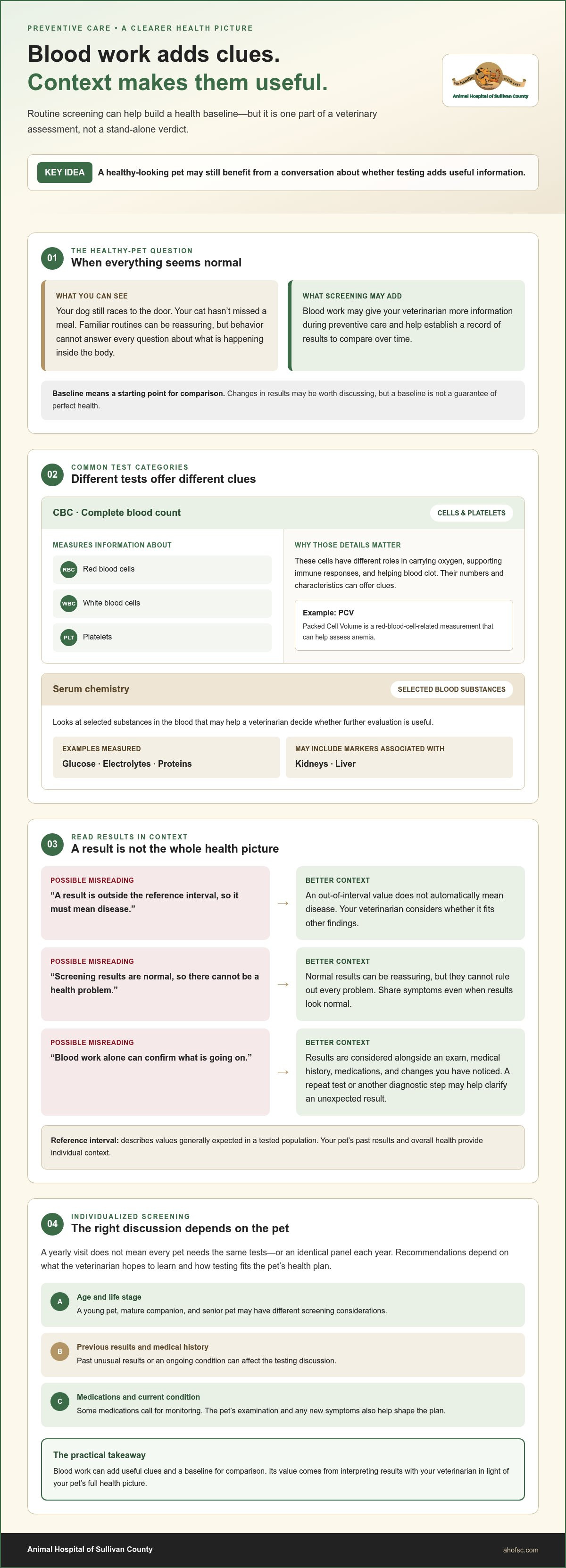
A health baseline is a record of your pet’s results that the veterinarian can consider in light of the pet’s overall health. Comparing results over time may help identify changes worth discussing. A laboratory’s reference interval describes values generally expected in a tested population, while your pet’s past results, exam, and medical history provide individual context. A value within an interval isn’t the whole story, and a result outside it doesn’t automatically mean disease.
A baseline is a starting point for comparison, not a guarantee of perfect health. Reviewing changes over time can help your veterinarian decide whether they matter for your pet. No result should be interpreted in isolation. Your veterinarian can explain what it may mean, whether it fits the overall clinical picture, and whether a next step is appropriate.
What annual pet blood work can reveal and what it cannot
Blood test results can offer useful clues, but they’re only one part of understanding your pet’s health. Common laboratory categories include a complete blood count (CBC) and serum chemistry. A veterinarian may consider these or other tests depending on the pet and the reason for screening.
What can a CBC and chemistry panel tell a veterinarian?
A CBC measures information about red blood cells, white blood cells, and platelets. These cells play different roles in carrying oxygen, supporting immune responses, and helping blood clot. Their numbers and characteristics may give a veterinarian clues to consider alongside other findings. For example, a Packed Cell Volume (PCV) is one measurement related to red blood cells that can help assess anemia.
Serum chemistry testing looks at selected substances in the blood, such as glucose, electrolytes, proteins, and markers associated with organs including the kidneys and liver. Those results may help a veterinarian decide whether further evaluation is useful. Symptoms, medical history, or examination findings may also lead the veterinarian to consider other types of tests.
Why blood work is only one part of the health picture
Results make the most sense alongside the full picture: your pet’s examination, changes you’ve noticed, current medications, and past health concerns. A value outside a reference interval doesn’t automatically mean serious disease. The veterinarian can consider whether it fits with other findings and whether repeating a test or taking another diagnostic step would help clarify it.
Normal screening results can be reassuring, but they cannot rule out every health problem. Some conditions may not change the specific values measured, and blood work alone may not provide a diagnosis. Share any symptoms even if the results look normal. If a result is unexpected, ask what it could mean for your pet and whether follow-up is appropriate.
The importance of annual pet blood work is best understood as one part of a thoughtful veterinary assessment, not a stand-alone verdict. Animal Hospital of Sullivan County provides preventive and medical care supported by onsite diagnostics. Learn more about the hospital’s preventive and diagnostic care as part of your pet’s ongoing health plan.
Does every pet need blood work every year? Age and health matter
No. Annual blood work isn’t automatically the same requirement for every pet, and a yearly visit doesn’t necessarily mean the same tests are right each time. The importance of annual pet blood work depends on what the veterinarian hopes to learn and how testing fits your pet’s health plan. Recommendations are individualized, not a universal schedule.
How age and life stage may change the conversation
A young pet, a mature companion, and a senior pet may have different screening considerations. Age can shape the discussion, but it doesn’t tell the whole story. A veterinarian also considers previous results, health history, and current condition. For more on care as pets grow older, see this guide to senior pet care in Sullivan County.
When history or health concerns may affect testing
Testing discussions may change if your pet has had an unusual result before, lives with an ongoing condition, or takes medication that calls for monitoring. New concerns matter, too. A change in thirst, appetite, energy, or everyday habits is worth mentioning, even if it seems small. These details help the veterinarian decide whether routine screening is appropriate or whether a different diagnostic approach may better answer the question.
Before an appointment, consider noting:
- Changes in eating, drinking, weight, energy, or bathroom habits.
- Current medications and supplements, including any recent changes.
- Past test results or health issues you want to discuss.
Symptoms may call for testing beyond routine screening. The right next step depends on the examination and the concern being investigated. Share what you’ve noticed rather than trying to decide which test your pet needs. Your veterinarian can explain the options, how timing fits your companion’s circumstances, and what the results may mean. That conversation helps make a screening plan purposeful and tailored, rather than a yearly checkbox.
How to prepare for annual pet blood work and understand next steps
A little preparation can make a blood-work appointment more useful and help you feel ready to discuss the results. The importance of annual pet blood work isn’t just the sample itself. Sharing relevant context and understanding what happens afterward are part of the process, too.
What should you tell the veterinary team before testing?
Before the visit, make a brief list of your pet’s current medications and supplements, known conditions, previous test concerns, and any changes in appetite, thirst, energy, weight, or behavior. These details can help the veterinary team interpret findings in context.
Ask whether your pet needs any preparation for the specific tests planned. Follow the instructions provided for your pet, including any guidance about food or medications. Don’t assume fasting is needed, and don’t change or skip a medication unless the veterinary team tells you to.
What happens after the results are reviewed?
Once the veterinarian has reviewed the findings alongside your pet’s examination and history, next steps will depend on the full picture. Results may be reassuring, suggest monitoring over time, or prompt repeat testing or another diagnostic step. An unusual value doesn’t automatically mean serious disease, and no single result should be treated as a diagnosis without veterinary interpretation.
Use the review as a chance to ask questions and make sure you understand the plan. You might ask:
- What does this result mean for my pet, given their history and exam?
- Is any follow-up testing or monitoring recommended? If so, why and when?
- Are there changes at home that I should watch for or report?
- Should I continue my pet’s medications as usual?
If your pet develops urgent or rapidly worsening symptoms, seek timely veterinary advice rather than waiting for routine screening or results. Blood work is one part of care, and concerning changes deserve attention in their own right.
Animal Hospital of Sullivan County provides preventive and medical care supported by onsite diagnostics. Learn about preventive-care and diagnostic needs as part of a thoughtful plan for your pet’s health.
Annual pet blood work in Sullivan County: a thoughtful preventive-care plan
Blood work is most helpful when considered as part of your pet’s overall care, not as a promise to find every health problem. The right conversation may look different for each companion. Age, health history, medications, examination findings, and your observations can all help shape whether screening is appropriate and what questions it may help answer.
How blood work fits into a broader wellness visit
A preventive-care visit can bring together a physical examination, your pet’s history, preventive health needs, and diagnostic testing when appropriate. Blood work is one tool in that process, not a substitute for the veterinarian’s assessment. Bring your questions and share changes you’ve noticed at home so the veterinary team can understand your concerns and explain its recommendations.
Animal Hospital of Sullivan County has served local families since 1953, providing preventive and medical care supported by onsite diagnostics. Those diagnostic capabilities support veterinary evaluation, while the specific approach depends on the individual pet and the reason for testing. A useful discussion can cover what a proposed test may help assess, how its findings fit with the examination, and whether follow-up makes sense.
A reassuring next step for Sullivan County pet families
You don’t need to arrive with a testing plan already decided. Bring your pet’s medical history, a list of medications, and any questions or observations you’d like to discuss. If you’re unsure whether a change is relevant, mention it. Your veterinary team can put the details in context and talk through options clearly.
For a broader look at preventive care and long-term companionship, explore this guide to compassionate lifelong pet care in Sullivan County. For pet families across New York, Connecticut, New Jersey, and Pennsylvania, the importance of annual pet blood work is best understood through an individualized conversation, not a blanket rule. Discuss a preventive-care plan with your veterinary team that reflects your pet’s needs and clarifies any recommended next steps.
Make your pet’s next wellness conversation count
The importance of annual pet blood work is best understood as part of an individualized care plan, not a rule that every pet needs identical tests each year. Blood work can offer helpful information, but results need to be considered alongside your pet’s examination, history, medications, and any changes you’ve noticed.
Bring your questions and observations to a preventive-care visit. Ask what testing may help clarify, how results will be interpreted, and whether follow-up is recommended. Clear guidance can make the process feel more manageable and help you make informed choices for your companion.
Animal Hospital of Sullivan County provides preventive care supported by onsite diagnostics. Discuss a preventive-care plan for your pet with the veterinary team and take the next step with confidence and care.
Frequently Asked Questions
Is annual blood work necessary for every healthy pet?
No. Annual blood work isn’t an automatic requirement for every healthy pet, and the same screening plan may not suit every dog or cat. A veterinarian considers age, previous results, medical history, medications, and current concerns when discussing whether testing may be useful. For pet parents in New York, Connecticut, New Jersey, and Pennsylvania, a preventive-care visit is a good opportunity to talk through what fits your companion.
What does annual blood work check for in dogs and cats?
It depends on which tests the veterinarian recommends. Common examples include a complete blood count, which looks at red and white blood cells and platelets, and a chemistry panel, which measures selected substances and organ-related markers. These tests may offer clues about blood cell levels, glucose, electrolytes, and kidney or liver function. They don’t assess every condition or replace an examination.
Can blood work detect illness before a pet shows symptoms?
Sometimes blood work can show changes that prompt further evaluation before clear signs are noticed at home, but it can’t promise early detection. Whether a finding is meaningful depends on the particular test and your pet’s health history, examination, and other information. If you notice changes in appetite, thirst, energy, or behavior, tell your veterinarian even if screening results seem reassuring.
How often should senior pets have blood work?
Senior pets may benefit from blood work every six to twelve months, but the right timing depends on the individual animal. A veterinarian may consider previous results, ongoing conditions, medications, and any new changes when recommending a schedule. Some pets need closer monitoring, while others may have a different plan. Discuss the reason for the recommended timing and what the results will help your veterinary team assess.
Does my pet need to fast before blood work?
Not always. Preparation depends on the specific tests planned and your pet’s circumstances, so follow the instructions provided by your veterinary team. Ask whether your pet should eat or take regular medications as usual before the appointment. Don’t assume fasting is needed, and don’t withhold food or change medication without specific guidance. Clear instructions can help ensure the sample is collected under appropriate conditions.
What happens if my pet’s blood work results are abnormal?
An abnormal result doesn’t automatically mean your pet has a serious disease. The veterinarian will interpret it alongside the physical examination, symptoms, medications, and medical history. Depending on the finding, next steps might include monitoring, repeating a test, or considering additional diagnostics. Ask what the result may mean for your pet, why any follow-up is recommended, and when to seek advice if you notice changes at home.
Can normal blood work guarantee that my pet is healthy?
No. Normal blood work can be reassuring, but it can’t rule out every health problem or guarantee that a pet is completely healthy. Tests measure specific information, and some conditions may not affect the values checked. Your veterinarian considers results together with an examination and your pet’s history. If you’re concerned about a symptom, mention it even if recent screening results were within expected ranges.


