
To learn how to find a good vet in rural PA, consider AAHA accreditation alongside client reviews, looking for evidence of thoughtful communication, follow-through, and respectful care. Pennsylvania has 48 rural counties, so distance and the options nearby can shape your search.
It’s natural to want more than a convenient location when your pet needs care. You want a veterinary team you can trust with a beloved family member, and accreditation or online reviews alone can’t tell the whole story.
This guide explains how to assess AAHA accreditation and read reviews for useful details about client experiences. You’ll also find practical ways to compare rural Pennsylvania options and decide what matters most for your pet’s ongoing care.
Key Takeaways
- Use AAHA accreditation as one useful point of comparison, alongside the care and communication that matter to your pet.
- Look for specific, repeated details in client reviews rather than relying on star ratings alone.
- Compare emergency hospitals by practical factors that can shape your next steps when urgent care is needed.
- Understand the difference between emergency treatment during business hours and after-hours care as you plan ahead.
- Learn how preventive care can support your pet’s ongoing health and help you build a relationship with a veterinary team.
Client reviews
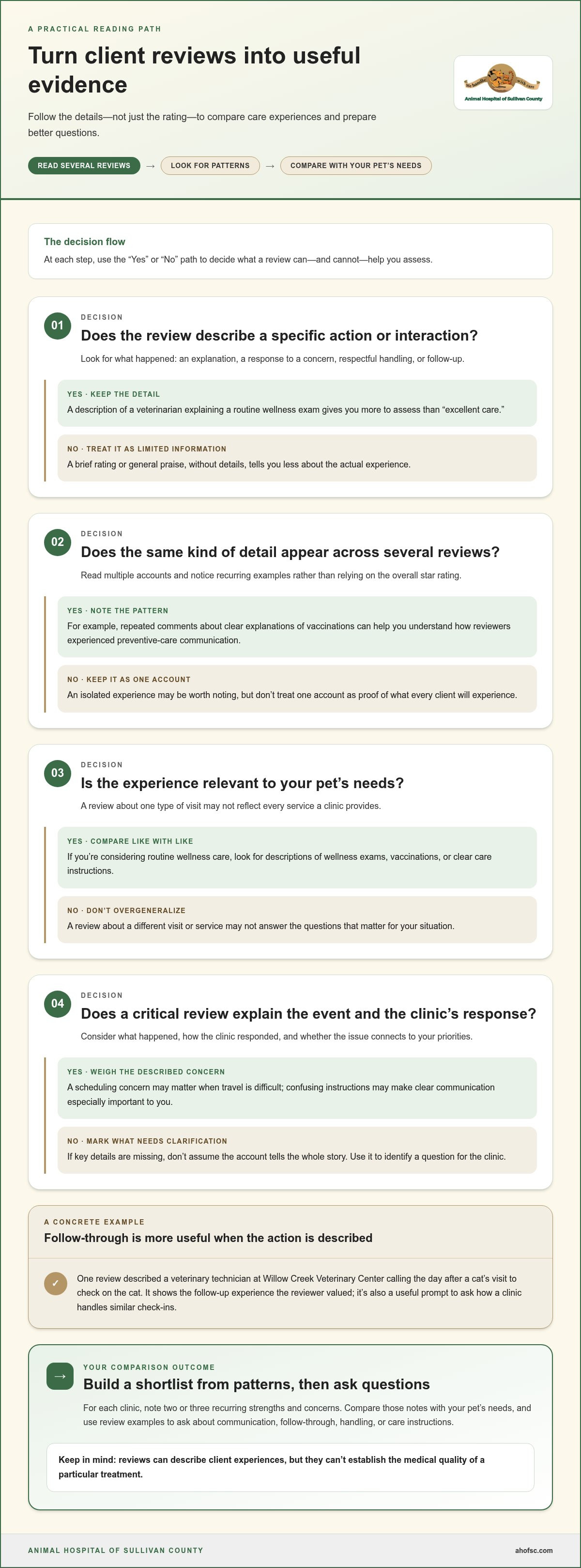
Client reviews can reveal how a clinic treats people and pets beyond the exam room. Use them as one source of information, not a final verdict. A review describing how a veterinarian explains a routine wellness exam gives you more to assess than “excellent care.” Look for specific actions, such as listening to a concern, explaining next steps, or following up after a visit. If you’re deciding how to find a good vet in rural PA, these details can help you compare care experiences thoughtfully.
Read several reviews instead of relying on the overall star rating. A rating compresses different experiences into one figure, while written details help you judge what matters for your pet. Look for recurring examples across reviews. If several owners mention clear explanations about vaccinations, that pattern can help you understand how the clinic communicates about preventive care.
Pay attention to communication. Useful examples include whether staff explained a diagnosis in plain language, answered questions, and clarified the next step. Compassionate interactions matter when a pet is uncomfortable or a family feels worried. Reviews can describe how people felt in those moments, but they can’t establish the medical quality of a particular treatment.
Look for follow-through, too. One review describes a veterinary technician calling a client the day after a cat’s visit to check on the cat. That detail shows what the reviewer valued: a check-in after an appointment. As you consider how to find a good vet in rural PA, notice whether reviewers mention follow-up instead of relying on general praise alone.
- Mark comments about explanations, such as a doctor reviewing test findings or care instructions.
- Notice whether reviewers describe respectful handling of a nervous animal.
- Compare comments about routine visits, including wellness exams and vaccinations.
- Look for examples of how the clinic responds when a client raises a concern.
- Separate firsthand experiences from brief ratings without details.
Reviews can also help you assess whether a clinic’s veterinary services fit your needs. A pet with ongoing health concerns may need a different conversation than a healthy puppy coming in for a routine visit. Look for descriptions relevant to your situation, such as clear explanations during wellness care or attentive communication after a procedure. A review about one kind of visit may not reflect every service.
Read critical reviews as carefully as positive ones. Focus on the event described, the clinic’s response, and whether the issue matters to your priorities. A complaint about scheduling may matter if travel is difficult; confusing instructions may make clear communication especially important to you. Don’t treat one account as proof of what every client will experience.
Use a simple comparison method: note two or three recurring strengths and concerns for each clinic. Then compare your notes with what your pet needs, such as routine wellness care or help understanding vaccinations. This turns online comments into a practical shortlist without asking reviews to answer medical questions they can’t settle.
Look for examples behind the language reviewers use. “Compassionate” is more useful when paired with a specific action, such as staff taking time to calm a frightened animal. “Excellent” is more informative when the writer explains what happened. These details can help you decide which clinic to consider and what questions to ask at a first visit.
Use reviews to form questions for a clinic, rather than treating praise or criticism as proof. Ask whether the examples reflect the communication, follow-through, or handling that matters for your pet. A Willow Creek Veterinary Center technician called a client the day after their cat’s visit to check on the cat. This is a concrete example of a follow-up experience, while leaving you to ask the clinic how it handles similar check-ins. Reviews may reflect individual circumstances, so consider whether the writer clearly describes the visit and interaction. If details are missing, ask the clinic about its approach to questions, follow-up, and care instructions. Look for patterns across detailed accounts, but keep your pet’s needs in view. Use reviewers’ descriptions to prepare for a conversation with the veterinary team and identify what you want clarified before choosing care.
How to compare emergency veterinary hospitals near rural Pennsylvania towns
Choosing an emergency hospital before a crisis gives you a clearer plan for your pet. In rural Pennsylvania, compare practical details such as travel routes, posted hours, and instructions for urgent calls. A hospital that seems close on a map may take longer to reach from home, especially when roads or weather affect your route. Save the names and directions for the options you consider.
Start with location and access. Enter your home address and each hospital’s address into a mapping tool, then compare routes you could realistically take. Consider familiar roads and whether you have an alternate route. For example, a family outside a small town might compare a direct route with one that avoids a road they find difficult to travel. The goal is a usable plan, not simply a short-looking distance.
Next, review each hospital’s published hours and instructions for urgent visits. Emergency care and routine appointments serve different needs, so don’t assume a regular veterinary clinic handles emergencies at every hour. Note the hospital’s stated process for incoming cases. If the instructions say to call first, save the number and follow that direction when seeking care.
- Access: Record the address, route, and directions you can follow under stress.
- Hours: Note the stated schedule and any instructions for urgent visits.
- Communication: Look for clear guidance about calling, arrival, and what information to bring.
- Care fit: Compare the hospital’s described emergency services with your pet’s needs.
- Continuity: Plan how visit notes can be shared with your regular veterinarian.
Communication matters before the trip begins. Look for clear instructions on what to do when an animal needs urgent attention. Compare whether the hospital explains how to make contact, what details to provide, and what to bring. Keep your pet’s current medications and relevant medical information together. Those details can help you communicate clearly when time feels pressured.
Consider how the emergency hospital fits with your pet’s regular clinic. Your usual veterinarian may know your animal’s history, while an emergency team may see your pet for a separate urgent concern. Keep relevant records, such as medication details and previous test information, so you can share them with the emergency team. Ask your regular clinic how records are handled during routine care.
Don’t compare hospitals by a single feature. A convenient route may not be the only deciding factor; clear arrival instructions, appropriate emergency services, and a workable records plan matter, too. If two options seem similar, note what each one explains about urgent visits. Specific directions are easier to act on than a general claim that a hospital provides emergency care.
Before an urgent situation, make a short plan with your household. Decide who will find directions, gather your pet’s records, and call if the hospital’s instructions require it. Keep the plan with your pet’s routine information. A written note with the chosen hospital, route, and contact details can reduce confusion when family members need to act quickly.
Use your comparison to identify an emergency option and understand its stated process, not to replace your pet’s regular care. If an emergency happens after hours, contact a local emergency veterinary provider right away. Having a route and your pet’s essential information ready can help you focus on getting appropriate help.
Geographic convenience is not the only measure; consider how local veterinary capacity may affect the options available. In Pennsylvania, 25 rural counties have fewer than 15 licensed veterinarians per 100,000 residents. The Pennsylvania rural counties described have fewer than 15 licensed veterinarians per 100,000 residents. That context makes it especially useful to identify a realistic route, understand each hospital’s urgent-visit process, and keep your pet’s information ready to share.
For those interested in the longer-term rural veterinary workforce, the Pathway to Rural Veterinary Practice program offers structured rural practice externships for immersive, hands-on experience in Pennsylvania communities. Students may enter the Pathway program at matriculation or by the end of their first year in veterinary school. The Pathway to Rural Veterinary Practice program's Fall 2027 application deadline is September 15, 2026 at 11:59 p.m.; its Fall 2028 application deadline is Mid-September, 2027. For pet owners comparing emergency options, the practical step remains to save the contact details and directions for the hospitals that fit their needs.
Which rural Pennsylvania vets offer after-hours or emergency care
After-hours care and emergency treatment during regular business hours are different arrangements. A veterinary clinic may provide urgent treatment while open, while an after-hours emergency requires a local emergency veterinary provider. Don’t assume your regular clinic handles both. Make a plan that identifies where to go when the clinic is closed and how to contact that provider.
Start with your regular veterinarian’s posted hours and instructions for urgent concerns. Save the information where household members can find it, such as beside your pet’s medical records. Then identify a local emergency veterinary provider for after-hours emergencies. Contact that provider right away if an after-hours emergency arises. Knowing this step in advance can prevent confusion when your pet suddenly needs help.
Use this checklist to distinguish the care arrangements that matter:
- During business hours: Note whether your regular veterinary clinic provides emergency treatment while open.
- After closing: Identify the local emergency veterinary provider you would contact.
- Instructions: Keep the provider’s directions for calling or arriving with your pet.
- Records: Gather medication details and relevant medical history for the visit.
- Travel: Save a route you can follow from home, including an alternate route.
Distinguish “urgent care” language from explicit after-hours instructions. A clinic describing emergency treatment doesn’t, by itself, explain what happens after closing. Read the hours and instructions together. For example, if a clinic closes before your household is usually home, plan around its listed hours rather than assuming someone will be available later.
Prepare a short call note for an urgent situation. Write your pet’s name, age, current medications, known health concerns, and a concise description of what changed. Include when you first noticed the problem, if you know. These details help you explain the situation clearly over the phone. Keep the note with vaccination and medical records, where another household member can find it.
Plan practical details before an emergency occurs. Save the emergency provider’s contact information in household phones and write it on the printed plan. Map the route from home, then identify a backup driver in case the usual driver is unavailable. If you live outside a town, consider where you can safely pull over to make a call. These steps make the plan usable beyond one person’s memory.
Ask your regular veterinary clinic how it shares medical records with an emergency provider. A current medication list and previous test information can help the emergency team understand your pet’s history. Keep copies accessible and update them when a prescription changes. For example, replace an outdated medication note after a routine appointment rather than searching through old paperwork during a stressful trip.
When an after-hours emergency arises, contact a local emergency veterinary provider right away. Follow its instructions for the next step and bring your pet’s available records. Don’t delay urgent contact while trying to resolve routine scheduling questions with a clinic that’s closed. A prepared plan should make the distinction clear: your regular veterinarian supports ongoing care, and the emergency provider is your after-hours contact.
For care during regular business hours, a veterinary clinic may provide emergency treatment alongside other medical needs. Keep the clinic’s hours and urgent-care instructions with your household plan, so you know which option applies. Review your pet’s veterinary care options as you prepare a clear plan for routine visits and urgent needs.
Animal Hospital of Sullivan County: Preventive Care
Animal Hospital of Sullivan County offers Preventive Care for families seeking ongoing support for their pet’s health. The hospital also provides Medical Care, Diagnostics, and Surgical Care for needs beyond routine wellness visits. Preventive care is a natural starting point for building a care plan and discussing your pet’s health over time. If a new concern arises, medical care and diagnostics can help assess it; surgical care addresses needs requiring surgery. Choosing a veterinary team also means finding a place where you feel comfortable discussing your animal’s needs and asking questions. To discuss care for your pet, contact Animal Hospital of Sullivan County or visit ahofsc.com.
Take the Next Step Toward Ongoing Care
You now have a practical starting point for deciding how to find a good vet in rural PA. The next step is personal: consider what will help your household feel prepared to discuss your pet’s health and build continuity over time. A brief note about your pet’s history, current concerns, and care priorities can make that first conversation more focused.
Animal Hospital of Sullivan County offers Preventive Care, Medical Care, and Surgical Care. These services support pets at different stages, from ongoing wellness needs to concerns requiring treatment. Choosing a veterinary team is also about feeling heard and understanding the care being discussed. Bring your questions, share what you’ve noticed at home, and take the time you need to understand the next steps for your companion.
If you’re ready to discuss care for your pet, contact Animal Hospital of Sullivan County. A thoughtful first conversation can help you move forward with greater confidence and care for the family member who depends on you.
Frequently Asked Questions
How to find a licensed veterinarian in rural Pennsylvania?
To find a licensed veterinarian in rural Pennsylvania, use the Pennsylvania State Board of Veterinary Medicine’s license-verification resources to confirm the clinician’s name and active status. Then call the practice to verify it is accepting patients and treats your animal’s species. Ask how far the clinic is from home and where patients go after hours. If you're deciding how to find a good vet in rural PA, plan a routine visit before an urgent need arises.
How to check reviews and references for rural vets in Pennsylvania?
Look beyond star ratings by reading written reviews for specific details about communication, follow-up, and how staff handle worried pets. Check several sources and pay attention to recurring comments rather than a single unusually positive or negative account. You can also ask the practice whether a current client is willing to share their experience. Notice how clearly the clinic answers your questions when you call; that interaction offers a useful preview of communication.
What questions should I ask when choosing a veterinarian in rural Pennsylvania?
Ask whether the veterinarian regularly treats your pet’s species, how preventive visits and follow-up are handled, which diagnostics are available onsite, and how referrals or after-hours emergencies are coordinated. Request an estimate before recommended tests or procedures, and ask how the clinic shares results. For households whose options include Sullivan County, New York, Animal Hospital of Sullivan County offers urgent treatment during regular office hours, but not 24/7 emergency care. Consider travel distance alongside your answers.


