Imagine watching your senior dog struggle to get comfortable, knowing something is wrong but dreading the thought of invasive tests or scary procedures. It's a heavy burden for any pet parent to carry. You want answers, but you also want your best friend to feel safe and secure during their visit. When you're looking for a pet ultrasound Sullivan County families have trusted since 1953, you're looking for more than just a diagnostic tool. You're looking for a "heart-first" team that treats your pet like a cherished family member.
It's natural to feel confused about the difference between an X-ray and an ultrasound, or to feel anxious about hidden health issues that aren't easily seen. This technology provides a clear window into your pet's health right here in our community. We'll show you how non-invasive imaging offers a stress-free experience and a clear diagnosis without the need for surgery. As the only AAHA-accredited hospital in the area, we provide the expert interpretation you need to ensure your best friend's comfort, happiness, and longevity.
Key Takeaways
- Learn how non-invasive sound waves create a clear picture of your pet's internal health without the discomfort or stress of surgery.
- Understand the vital differences between X-rays and ultrasounds so you can feel confident in the diagnostic path chosen for your best friend.
- Discover why a pet ultrasound Sullivan County families trust is the preferred tool for examining soft organs and detecting hidden health concerns.
- Follow our simple preparation checklist to help your pet stay calm and ensure the clearest possible images during their appointment.
- Explore how our onsite diagnostic technology and 70-year legacy of care mean you don't have to travel far for expert medical answers.
Understanding Pet Ultrasound in Sullivan County: Why It Is Recommended
When your pet isn't feeling their best, the most important goal is getting a clear answer without adding to their stress. At our clinic in Ferndale, we use veterinary ultrasound to see exactly what's happening inside your pet's body. This advanced technology uses high-frequency sound waves to create detailed, moving images of internal structures. It's completely non-invasive and painless! Choosing a pet ultrasound Sullivan County residents can rely on means you're giving your companion the benefit of modern science paired with a gentle, "heart-first" touch. We believe every animal deserves a diagnostic experience that feels like a helping hand rather than a clinical procedure.
When a Physical Exam Isn’t Enough
A thorough physical exam is always the first step in our journey of care. Our doctors use their hands to feel for abnormalities, but even the most experienced touch has its limits. Palpation can sometimes miss very small masses or subtle changes in the texture of an organ. Ultrasound goes much deeper by providing a real-time view of how organs are actually functioning in the moment. We can watch the heart beat, see blood flow through vessels, and inspect the intricate layers of the stomach or intestinal walls. It's a window into their well-being that we simply can't get any other way.
For our senior pets living throughout the Catskills, these scans are a vital part of proactive preventive care. They help us catch age-related changes in the liver or kidneys long before your pet shows outward signs of illness. It's about staying one step ahead to ensure their golden years are full of comfort. By seeing the "unseen," we can create a tailored health plan that addresses your pet's specific needs before a small issue becomes a big worry. We want to ensure your best friend stays by your side for as long as possible!
Common Conditions Diagnosed via Ultrasound
We frequently recommend ultrasound when we suspect specific internal issues that aren't visible on the surface or through blood work alone. It is an exceptional tool for identifying bladder stones or kidney irregularities that might be causing your pet hidden discomfort. Because the images are so detailed, we can also use them to detect abdominal masses or tumors early. This early detection is crucial. It often leads to much more successful outcomes and a higher quality of life for your furry family member.
Beyond illness, we use this technology to celebrate and protect new life. Monitoring pregnancies in breeding animals with ultrasound allows us to check on the health and heartbeats of the puppies or kittens with incredible precision. Whether we're looking for the cause of tummy trouble or confirming a healthy litter, our goal is to provide you with the peace of mind that comes from expert, compassionate diagnostics right here in your own neighborhood.
How Veterinary Ultrasound Works: A Stress-Free Diagnostic Tool
Understanding the technology behind your pet's care can help ease any lingering anxiety. Unlike other diagnostic methods that might seem intimidating, ultrasound is a gentle process that prioritizes your pet's comfort. It's an incredible tool that allows us to provide a high level of medical care right here in Ferndale! We believe that the best medicine is delivered with a soft touch and a clear explanation.
The Science of Sound Waves and Imaging
The process begins with a small handheld device called a transducer. This probe sends high-frequency sound waves into the body, which then bounce off internal organs and return to the machine. To understand how veterinary ultrasound works, imagine a sonar system on a ship. The machine calculates the time it takes for these "echoes" to return, creating a detailed map of the internal architecture.
Different tissues reflect sound differently based on their density. Fluids appear black because sound waves pass through them easily, while solid organs like the liver or spleen appear in various shades of gray. Echogenicity is the ability of a structure to bounce back sound waves. This variation allows our experts to spot even the smallest changes in organ texture or identify unwanted masses that shouldn't be there.
Why Ultrasound is Non-Invasive and Safe
One of the biggest reliefs for pet parents is knowing that ultrasound involves zero radiation. While X-rays are essential for looking at bones, they use small amounts of radiation that require special safety protocols. Ultrasound is purely based on the safety of sound. This makes it incredibly safe for repeated use, which is helpful when we need to monitor a chronic condition or a developing pregnancy.
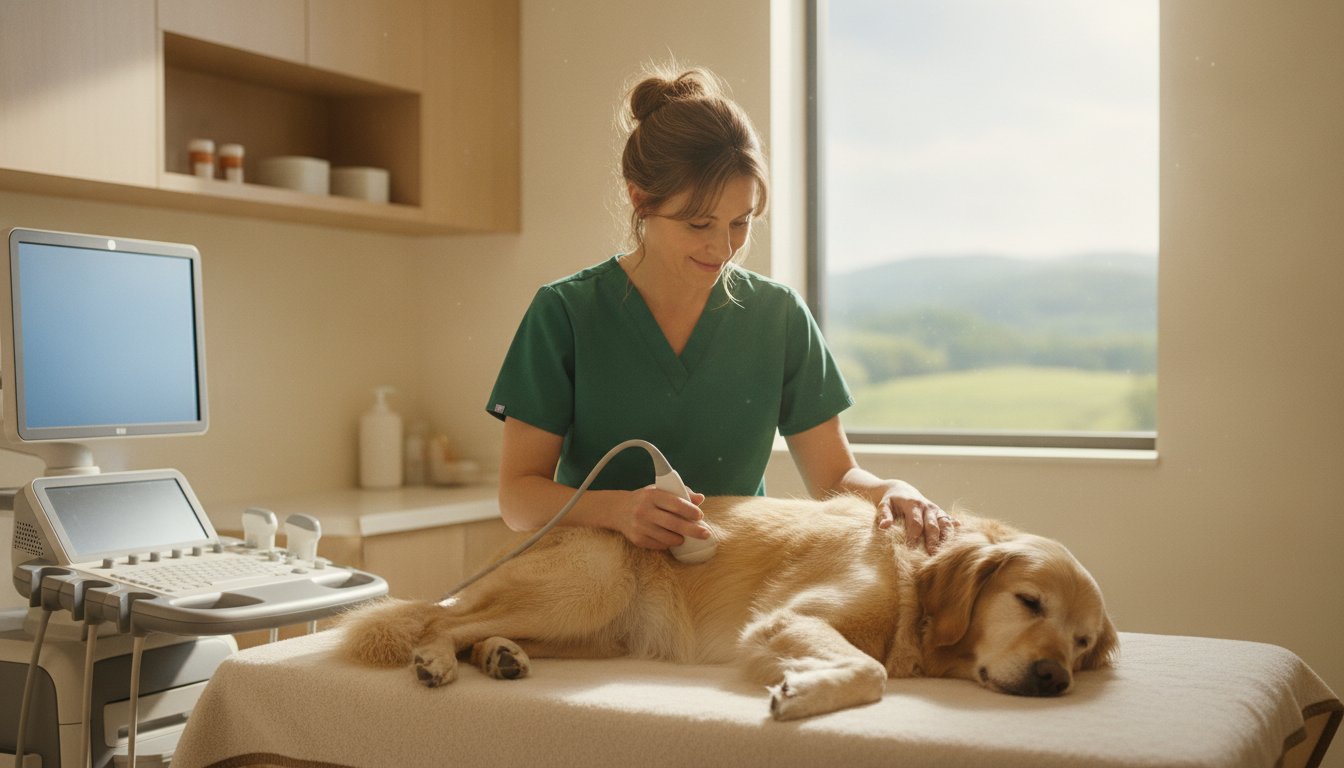
Most pets remain completely awake and relaxed during the procedure. We often perform the scan in a quiet, dimly lit room to help your best friend feel at ease. The process usually takes between 20 and 60 minutes. During this time, your pet simply lies on a soft, padded table while we apply a soothing gel to the skin to ensure the best possible image quality. Because it's so gentle, sedation is rarely needed unless a pet is exceptionally wiggly or anxious.
Speed is another major advantage of a pet ultrasound Sullivan County residents appreciate. We see the images on the monitor in real-time. This means we can often discuss preliminary findings with you immediately. There's no waiting days for a lab to send back results. We can start a treatment plan or suggest next steps before you even leave the clinic. This efficiency is part of our commitment to providing thorough, compassionate diagnostics that respect both your time and your pet's well-being.
Ultrasound vs. X-Rays: Choosing the Right Imaging for Your Pet
It's completely normal to feel a little confused when your veterinarian mentions different types of imaging for your pet. You might wonder why one is better than the other, or why your pet might even need both. While we have many tools at our disposal, choosing between an X-ray and a pet ultrasound Sullivan County is about finding the most effective way to help your best friend. Our goal is always to get the most accurate answers as quickly as possible so we can start the right treatment plan.
Seeing Soft Tissue vs. Bone
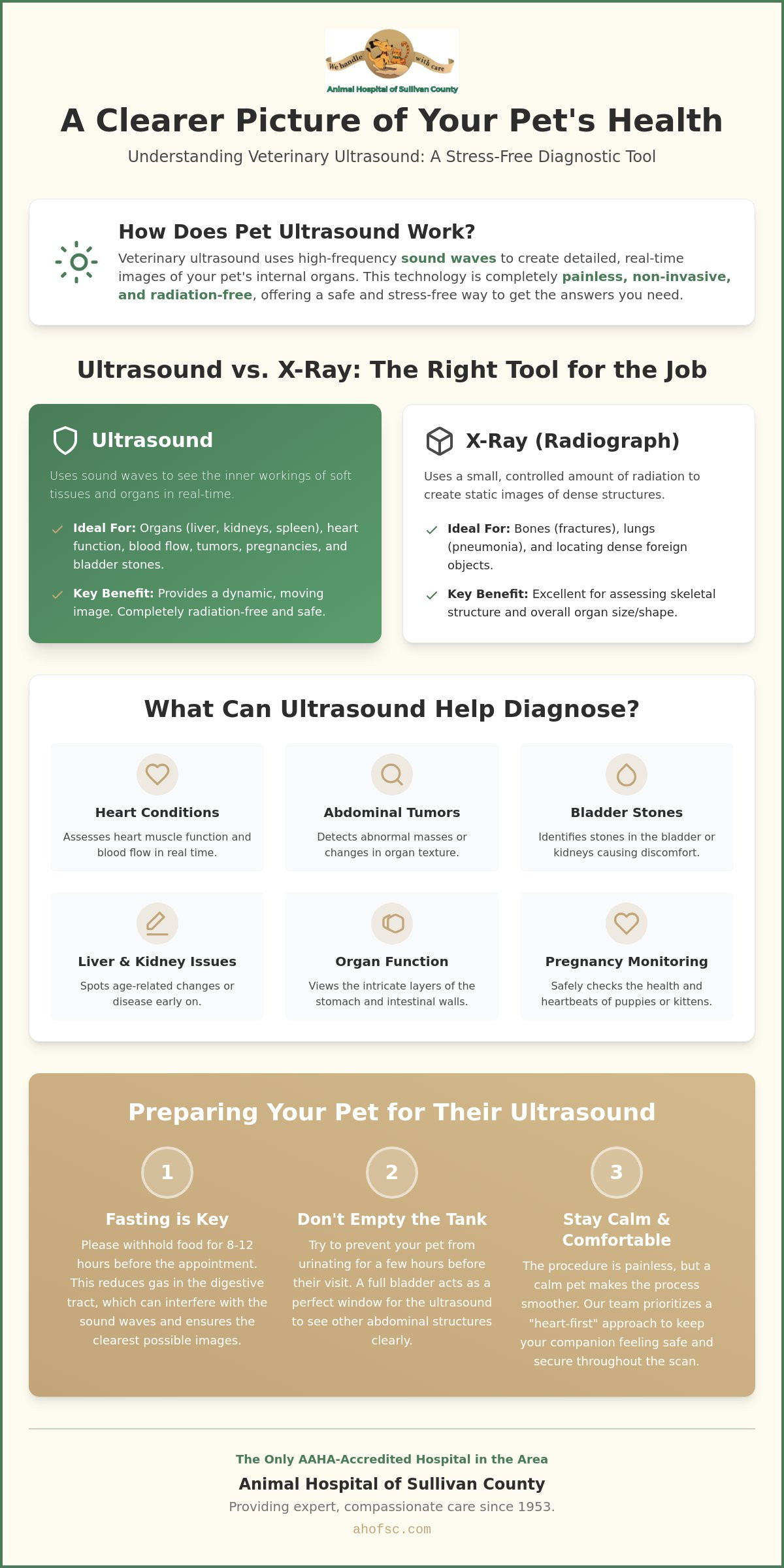
X-rays are a foundational tool in veterinary medicine. They are excellent for looking at dense structures like bones, joints, and even foreign objects your pet might have accidentally swallowed! An X-ray also helps us see air-filled spaces like the lungs. However, an X-ray essentially provides a "silhouette" or a shadow of the internal organs. It can show us the size and shape of the liver or heart, but it can't show us what's happening inside those organs.
This is where ultrasound truly shines. It allows us to see the internal architecture of soft organs with incredible detail. For example, while an X-ray might show an enlarged heart, an echocardiogram (a specialized heart ultrasound) lets us see the thickness of the heart walls and the health of the chambers. Our approach to pet diagnostics Sullivan County families have relied on for decades often integrates both technologies. By combining the "big picture" of an X-ray with the "internal view" of an ultrasound, we get a complete map of your pet's health.
Real-Time Imaging: The Benefit of Motion
The most exciting benefit of a pet ultrasound Sullivan County is the ability to see the body in motion. An X-ray is a static snapshot, but an ultrasound is like a live-action movie! This real-time imaging is vital for several reasons:
- Heart Health: We can watch heart valves open and close and monitor the direction of blood flow.
- Digestion: We can observe peristalsis, which is the wave-like movement of the intestines that moves food along.
- Precision: If your pet needs a needle biopsy, we use the ultrasound to guide the needle exactly where it needs to go, making the procedure much safer and more accurate.
Choosing the right imaging isn't just about technology; it's about the cost-benefit of getting the right diagnosis the first time. We know that medical costs can be a concern for many families. Investing in the most appropriate diagnostic tool early on often saves you money and stress in the long run. It prevents the need for "guesswork" treatments and ensures your pet gets exactly what they need to feel better. We're here to guide you through these choices with honesty, expertise, and a heart-first approach to your pet's care!
Preparing Your Pet for an Ultrasound Appointment in Ferndale
We understand that any medical visit can stir up a little "vet-xiety" for both you and your furry companion. Our goal at the Animal Hospital of Sullivan County is to make this process as gentle and predictable as possible. Taking a few simple steps at home can ensure your pet stays relaxed while helping us capture the clearest possible images. When you're scheduled for a pet ultrasound Sullivan County families can trust, preparation is the key to a stress-free experience and an accurate diagnosis.
Pre-Visit Instructions: Fasting and Shaving
If your pet is coming in for an abdominal scan, we will typically ask you to withhold food for about 12 hours before the appointment. We know those "puppy dog eyes" at breakfast time are hard to resist! However, a 12-hour fast is essential because food particles and excess gas in the stomach can create shadows on the monitor. These shadows can block our view of important organs like the liver or kidneys. You can usually keep their water bowl full unless we've given you specific instructions otherwise.
To get a high-quality image, the ultrasound probe needs direct contact with the skin. This means your pet will need a minor "haircut" in the area being scanned. Sound waves simply cannot travel through the air pockets trapped in fur. We use professional, quiet clippers to minimize any startle, and we promise the hair will grow back before you know it! Most pets don't mind the breeze on their belly one bit. If your pet is particularly sensitive to the car ride to Ferndale, try using calming pheromone sprays or playing soft, rhythmic music to help them settle into a peaceful state of mind before they arrive.
What Happens During the Procedure
When it's time for the scan, we'll guide you and your pet into a quiet, dimly lit room. This soothing environment is designed to keep sensory input low and comfort levels high. We use a clear, water-based cooling gel on the shaved area. This gel acts as a bridge for the sound waves to travel from the probe into the body. While the gel might feel a little cold at first, most pets find the gentle, rhythmic pressure of the probe quite relaxing. Many of our patients even start to doze off during the procedure!
We know that you are your pet's ultimate source of comfort. In many cases, we're happy to have you stay close by to offer a reassuring word or a gentle scratch behind the ears. This "heart-first" approach is a fundamental part of our diagnostics services. By working together as a team, we ensure your best friend feels safe and loved while we gather the vital information needed to protect their health. Most appointments are wrapped up within an hour, and your pet can go right back to their normal routine immediately afterward.
Compassionate Diagnostic Care at Animal Hospital of Sullivan County
Choosing where to take your best friend for medical care is a deeply personal decision. We understand that you want the latest technology without losing that warm, neighborly touch. At the Animal Hospital of Sullivan County, Dr. B and our entire team take a "heart-first" approach to every medical case. We don't just see patients; we see cherished family members who deserve our full dedication and expertise. By offering a pet ultrasound Sullivan County families can access right in their own backyard, we ensure that high-quality diagnostics are never out of reach for our community.
Advanced Onsite Diagnostics in the Catskills
One of the biggest benefits of our Ferndale clinic is the ability to provide comprehensive answers in one single visit. There is no need to spend hours driving to the city or a distant specialist when your pet is feeling unwell. We've invested in onsite technology that allows us to combine imaging with in-house vet lab testing NY. This integrated approach means we can often get results within the same appointment!
Fast results lead to faster relief for sick animals. Whether you are coming from Monticello, Liberty, or right here in Ferndale, our goal is to provide a clear path forward as quickly as possible. Having these tools under one roof allows us to act decisively, which is especially vital during urgent situations. We believe that your peace of mind is just as important as your pet’s physical health, and we work tirelessly to provide both through our advanced diagnostic capabilities.
A Legacy of Care Since 1953
Our hospital has been a steady presence in the community since 1953, making us the oldest veterinary hospital in the county. We take great pride in our history as a woman-owned and veteran-operated clinic. Since 1983, we've maintained our AAHA accreditation, a distinction held by fewer than 15% of clinics nationwide! This legacy of excellence is reflected in how we utilize modern tools to improve the quality of life for every animal we treat.
We find that ultrasound is particularly helpful for senior pet care Sullivan County companions need as they age. It allows us to monitor chronic conditions with a gentle touch, ensuring your pet stays comfortable throughout their golden years. While we always hope for the best news, we are also here to support you through the most difficult times. If a scan reveals a terminal illness, we provide compassionate pet end of life care Sullivan County owners can rely on for dignity and support.
We invite you to schedule a wellness exam today to discuss your pet’s internal health. Whether your friend is a playful puppy or a quiet senior, we are dedicated partners in their journey of care. Let’s work together to ensure they enjoy a long, happy, and healthy life by your side!
Empowering Your Pet’s Health with Clear Answers
Your best friend's health is a journey we take together, and having the right tools makes all the difference. By choosing a pet ultrasound Sullivan County families can trust, you're opting for a "heart-first" approach that prioritizes both comfort and precision. We've seen how this non-invasive technology provides a stress-free experience while revealing vital details that physical exams or X-rays might miss. It's about getting the right diagnosis the first time so your companion can get back to their happy, tail-wagging self as quickly as possible.
Since 1953, our hospital has been a steady partner for local pet parents. As an AAHA Accredited facility, we're proud to offer compassionate, non-invasive onsite diagnostics right here in Ferndale. You don't have to travel far for expert medical authority and neighborly empathy. We're here to guide you through every stage of your pet's life with kindness and technical skill. Schedule a Diagnostic Consultation at Animal Hospital of Sullivan County today to ensure your cherished family member receives the exceptional care they deserve. We look forward to seeing you and your best friend soon!
Common Questions About Pet Ultrasounds
Does my pet need to be sedated for an ultrasound?
Most pets don't need sedation because the procedure is gentle and painless. We use a calm, quiet environment to help your best friend relax on a padded table. If a pet is very painful or highly anxious, we might suggest a mild sedative to help them stay still. This ensures we get the clear images needed for an accurate diagnosis without causing your companion any unnecessary distress. Your pet's comfort is always our top priority during a pet ultrasound Sullivan County visit.
How much does a pet ultrasound cost in Sullivan County?
The cost of a pet ultrasound Sullivan County appointment varies depending on the complexity of the diagnostic study required. Since we tailor every exam to the individual needs of your best friend, we encourage you to call our office for an accurate estimate. Our team is dedicated to transparency and will walk you through the diagnostic process. We want to ensure you have all the information needed to make the best decision for your pet's well-being and your family budget.
Will you have to shave my pet for the ultrasound?
Shaving is usually necessary to get the clearest possible view of your pet's internal organs. Fur traps air, which blocks the high-frequency sound waves from reaching the skin and returning to the probe. By removing a small patch of hair, we ensure the diagnostic gel makes perfect contact for high-definition imaging. Your pet's fur will grow back naturally in a few weeks. We take great care to keep this minor haircut quick, quiet, and stress-free for your companion.
Can I stay with my pet during the ultrasound procedure?
We frequently encourage owners to stay with their pets to provide comfort and a sense of security. Your presence can be incredibly soothing for a pet in a new environment. In certain situations where we need precise positioning or specific safety protocols, we may ask you to wait nearby to allow our team to focus. We always aim to do what's best for your pet's emotional well-being. We'll talk through the plan with you before we start the scan.
How long does it take to get the results of a pet ultrasound?
You'll often get a preliminary update right after the scan because we see the images moving in real-time. For more complex cases, we may consult with a board-certified specialist to ensure the most accurate interpretation possible. This expert review usually takes about one to two business days. Once we have the final report, we'll reach out to discuss the results and any necessary adjustments to your pet's health care plan. We value your peace of mind and your time.
What is the difference between an ultrasound and an echocardiogram?
An ultrasound is the general name for imaging that uses sound waves to look inside the body. An echocardiogram is a specific type of ultrasound that focuses exclusively on the heart. While a standard abdominal scan looks at organs like the kidneys, an echocardiogram measures heart wall thickness and valve function. Both are vital diagnostics we offer to provide a clear window into your pet's internal health. We'll recommend the specific scan that fits your pet's unique symptoms.
Can an ultrasound detect cancer in dogs and cats?
Ultrasound is an excellent tool for spotting masses, cysts, or enlarged organs that could indicate cancer. It allows us to see the internal texture of an organ, which often changes when disease is present. If we find a suspicious area, we can use the ultrasound to perform a guided fine-needle aspirate. This helps us collect cells safely to send to a pathologist. Early detection through imaging is often the key to more successful treatment outcomes and a better quality of life.
What happens if the ultrasound finds something concerning?
We will sit down with you immediately to explain the findings and what they mean for your pet's future. Our heart-first approach means we're your partners in care, providing both medical expertise and emotional support. We'll discuss all available options, from medical management to surgical care, to help you make an informed choice. You won't have to face difficult news alone. We're here to guide you toward the best possible outcome for your cherished companion and your family.


