
What if the greatest risk to your pet's wellness during a move isn't the car ride, but a missing medical chart? When you are switching clinics, getting pet medical records transferred should feel like a gentle, reassuring step, not an overwhelming administrative headache. Your animal companion is a cherished member of the family, and their complete history tells the ongoing story of their health and comfort!
It is completely natural to worry that communication delays will force your dog or cat to endure repeated blood draws, duplicate vaccines, or misunderstandings about an existing chronic condition. You deserve absolute peace of mind when stepping into a new clinic. In this guide, you will learn exactly how to transfer your pet's medical records smoothly between veterinary clinics without missing vital health histories. We'll walk through requesting comprehensive clinical notes, handling diagnostic imaging, and ensuring your new care team understands every chapter of your companion's care.
Key Takeaways
- Discover how a complete health history protects your four-legged family member from redundant bloodwork and preserves vital diagnostic baselines.
- Follow a proven timeline for getting pet medical records transferred smoothly between clinics, including proper verbal and written consent protocols.
- Understand your legal rights regarding medical file access and why requesting uncompressed diagnostic imaging matters for second opinions.
- Learn practical strategies for coordinating interstate health certificates and safeguarding continuous care for senior pets with chronic conditions.
- Find out how a dedicated veterinary team can manage clinic-to-clinic transfer logistics directly, ensuring your companion receives uninterrupted care.
Why Getting Pet Medical Records Transferred Is Vital for Your Pet's Health
At its heart, a veterinary medical record transfer is the secure exchange of your companion's clinical health journey between care providers. It bridges past treatments with future wellness. Moving to a new practice without these files leaves your clinical team working in the dark. Modern veterinary hospitals require a comprehensive chart before performing complex procedures or prescribing specialized medications. Maintaining medical continuity directly improves treatment outcomes for companion animals. It ensures your pet receives personalized, safe attention from day one!
Every clinical note matters. Much like human medical records, a pet's file preserves critical details about surgical recoveries, previous physical exams, and adverse drug reactions. For example, tracking a past negative reaction to an antibiotic prevents life-threatening allergic responses during future treatments. Prioritizing getting pet medical records transferred guarantees that your new veterinarian builds upon past successes instead of starting over.
To help you visualize the process of digitizing and managing your companion's clinical files, watch this helpful walkthrough:
Preventing Redundant Testing and Unneeded Medication Duplication
Repeated clinic visits can trigger significant stress for sensitive pets. When your new veterinarian possesses past blood chemistry profiles, they establish a baseline to monitor subtle kidney or liver changes, especially during senior wellness visits. Avoiding duplicate diagnostic imaging spares your dog or cat unnecessary sedation, while protecting your family budget. Detailed medication logs also prevent accidental drug interactions, ensuring that ongoing therapies remain steady and effective.
What a Complete Veterinary Medical History Must Contain
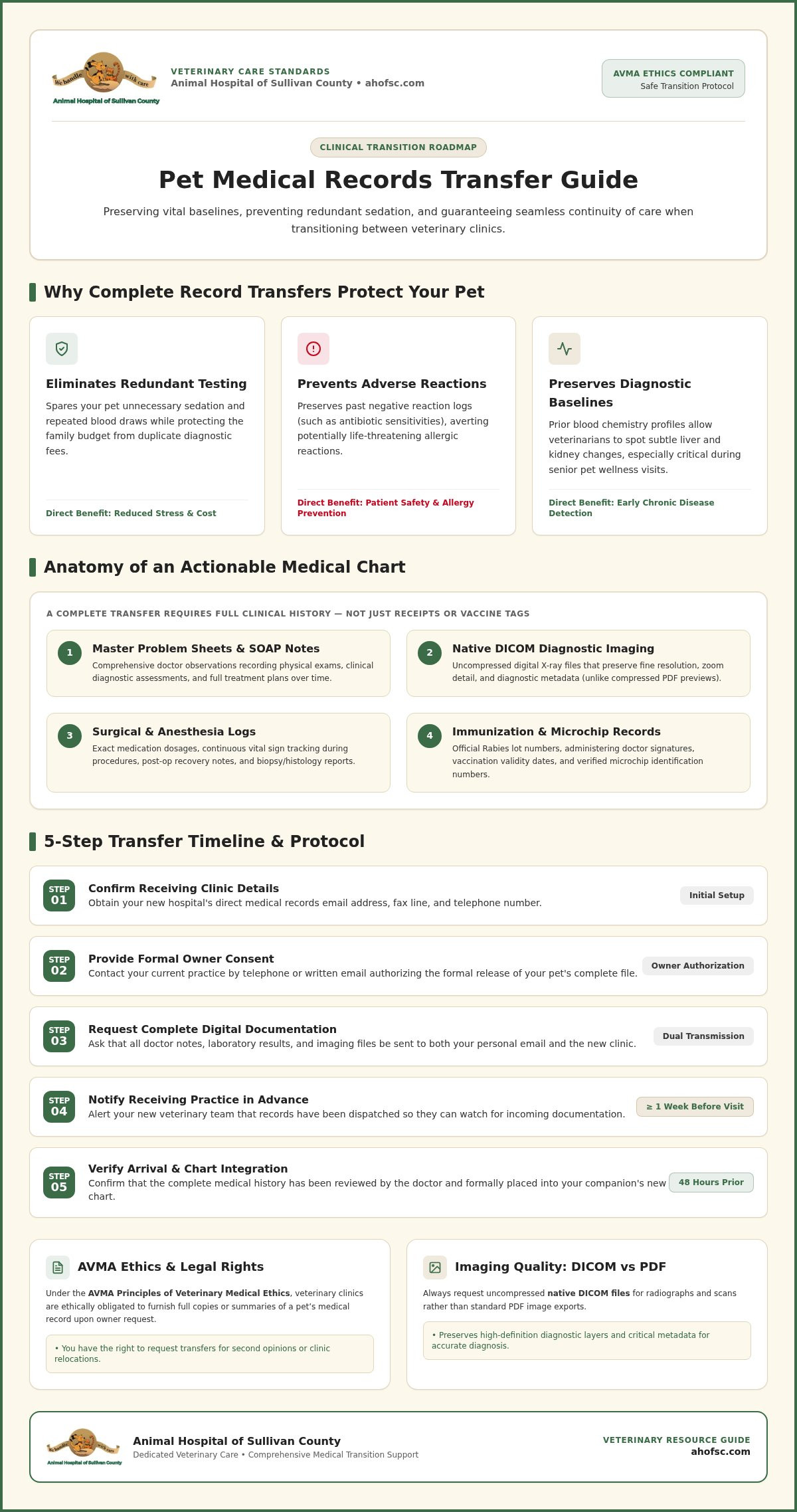
A simple invoice receipt or vaccination tag is not a clinical record. An actionable file must include:
- Master Problem Sheets and SOAP Notes: Detailed doctor observations describing physical exams, clinical assessments, and treatment plans.
- Diagnostic Imaging in Native DICOM Format: Uncompressed digital X-ray files that preserve fine resolution and metadata, rather than low-resolution PDF captures.
- Surgical and Anesthesia Logs: Specific medication dosages, vital sign tracking, and biopsy or histology reports.
- Immunization Certificates and Microchip Records: Rabies lot numbers, administering signatures, and microchip registration numbers to establish positive medical identification.
How to Transfer Pet Veterinary Records: A Step-by-Step Guide
Managing the clinical transition for your dog or cat does not have to feel chaotic. Under the AVMA Principles of Veterinary Medical Ethics, veterinary teams are ethically bound to provide copies or summaries of your pet's health history upon request. By staying organized and following a structured timeline, getting pet medical records transferred becomes a calm, empowering step in welcoming your companion to their new medical home!
Here are the five chronological steps for a smooth chart transfer:
- Confirm your new hospital's contact information: Note their direct records email address and phone number.
- Provide formal owner consent: Contact your current practice by phone or written email to release your companion's files.
- Request complete digital PDF documentation: Ask that all doctor notes, laboratory results, and imaging files be sent to both your personal email and the new clinic.
- Notify the receiving practice early: Alert your new veterinary care team at least one week before your pet's appointment.
- Verify arrival: Confirm forty-eight hours before your scheduled exam that the full history has been reviewed and placed into your pet's new chart.
Contacting Your Previous Clinic and Requesting Documentation
Call your current clinic's reception team with confidence and warmth. You can simply say, "Hello! I am transitioning my pet's ongoing care and need their complete medical file, including doctor exam notes and lab reports, emailed to me and my new clinic." State regulations and patient privacy rules often require a signed email release, so ask if they need a written form completed. Always specify that you need full diagnostic histories rather than a basic vaccine printout.
Verifying Transmission and Delivery to Your New Animal Hospital
Most clinics appreciate an industry-standard turnaround window of 3 to 5 business days to collate and review archival files. Call your new provider two days prior to your visit to confirm everything arrived safely. Maintaining your own digital folder of PDFs on a personal cloud drive gives you ultimate control during future relocations. If you are joining the Catskills community, the dedicated team at Animal Hospital of Sullivan County is always happy to guide you through coordinating these files smoothly.
Digital vs. Physical Records: PDFs, Pet Portals, and Diagnostic Discs
Paper records are easily misplaced, so direct practice-to-practice digital PDF transmission remains the gold standard for clinical handoffs. Mobile patient portals work well for showing immediate rabies verification at boarding kennels, but comprehensive evaluations require complete files. For pets with orthopedic or cardiac histories, request that your former hospital export digital X-rays as raw DICOM files on a flash drive or secure cloud link, allowing your new veterinarian to read every subtle detail.
Legal Rights, Record Ownership, and State Veterinary Regulations
Understanding the legal framework behind veterinary documentation brings immense comfort during times of transition. A common point of confusion for pet parents is knowing who actually owns these charts. Under state licensing laws across New York and neighboring tri-state areas, the physical chart and original digital files are the legal property of the veterinary facility. However, you retain a protected ethical and legal right to all the diagnostic data and clinical notes contained inside. When getting pet medical records transferred, you are requesting your companion's rightful medical story, not asking for a special favor!
Who Legally Owns Your Pet's Medical Records?
State veterinary practice acts classify physical documents, server files, and digital imaging as property of the clinic that generated them. Even so, statutes like New York State Education Law require licensed practitioners to supply copies of diagnostic charts, laboratory panels, and treatment sheets upon formal request. Practice acts also require facilities to retain patient files for several years following an animal's last visit. Some pet parents fear their records might be held hostage over an unresolved billing dispute. Under professional medical ethics standards, clinics cannot withhold vital records necessary for immediate or ongoing patient care due to an outstanding account balance.
Handling Response Delays, Practice Closures, or Reluctant Clinics
If a previous clinic is slow to respond, a calm follow-up can keep things moving:
- Submit a formal written request: Send an email specifying your pet's registered name, microchip number, and the direct contact details of your receiving veterinary hospital.
- Plan around official transit guidelines: If you are relocating across state lines, review USDA pet travel requirements well in advance, since interstate certificates of veterinary inspection demand verified vaccine logs.
- Search for successor practices: When a clinic permanently closes or merges with a larger hospital system, patient archives are usually transferred to a neighboring custodian facility or central database.
If records simply cannot be recovered because an independent practice closed without archiving, take a deep breath. Your new veterinary team will perform gentle physical triage, running fresh baseline wellness panels to establish a brand-new safety net for your four-legged family member.
Special Scenarios: Moving, Senior Pets, and Emergency Readiness
Every animal companion has a unique health journey, but certain life stages and transitions require extra care. Getting pet medical records transferred before unexpected health events occur gives your clinical team immediate clarity when your furry friend needs prompt comfort and relief!
Relocating to Sullivan County or the Greater Tri-State Region
Moving your household to the scenic Catskills introduces your pet to new environments and local pathogens. Sullivan County's lush woodlands carry significant exposure to regional tick-borne conditions like Lyme disease and Anaplasmosis. Having your companion's previous preventative history helps your new veterinarian quickly calibrate parasite prevention and local vaccination plans. If you are crossing state lines during your move, remember that state departments of agriculture require an official Certificate of Veterinary Inspection alongside an unexpired, signed rabies certificate. For families managing longer relocations or navigating complex travel logistics, professional pet transport specialists such as Relopet can help ensure transit requirements are met seamlessly. Make sure to update your pet's microchip contact information with your new address at the same time.
Transferring Histories for Senior Pets and Chronic Medical Conditions
For aging companions, continuity is everything. If your senior dog or cat lives with chronic kidney disease, feline diabetes, or advancing osteoarthritis, an isolated blood test only tells half the story. Serial lab panels spanning two or three years reveal subtle progression trends that single tests miss completely. Reviewing historical therapeutic drug monitoring also protects your companion from medication adjustments that could stress delicate organ systems. To safeguard your aging best friend's vitality, schedule a compassionate consultation for senior pet care in Sullivan County so our team can review their long-term charts in detail.
Emergency Preparedness and Critical Diagnostic Baselines
Sudden illnesses happen quickly. Preparing ahead transforms a frightening crisis into an organized, rapid medical response:
- Assemble a grab-and-go binder: Keep printed copies of your pet's latest blood chemistry profiles, surgical notes, and vaccination forms near your carrier or leash.
- Document critical health alerts: Prominently highlight confirmed drug allergies, seizure management logs, and specialized cardiac imaging summaries.
- Speed up daytime stabilization: When you arrive for daytime urgent medical care, having these historical baselines in hand saves precious minutes during triage.
Completing these steps in advance shields your four-legged family member from unnecessary pain and gives you genuine peace of mind.
Seamless Care Transitions at Animal Hospital of Sullivan County
Welcoming a new pet to your home or settling into a new neighborhood should be filled with joy, not paperwork anxiety. Since 1953, Animal Hospital of Sullivan County has served families across Ferndale, the Catskills, and the tri-state area with deeply compassionate, personalized veterinary medicine. Led by Dr. Barbara Bodolosky ("Dr. B"), our team believes that getting pet medical records transferred should be completely stress-free. We treat your companion like a cherished family member from the very moment you reach out!
How Our Ferndale Healthcare Team Manages Your Transfer Details
Pet parents often feel overwhelmed trying to coordinate files between busy practices. Our caring front-desk staff is delighted to lift that administrative burden off your shoulders. When you register with us, simply provide your previous clinic's name and contact information. We gladly contact them directly to request full chart notes, diagnostic imaging files, and previous lab panels.
Once those records arrive, Dr. B and our clinical team thoroughly review your pet's health background before you even walk through our doors. This careful preparation ensures we understand your companion's unique medical baseline. You never have to worry about missing an important allergy alert or reciting complex treatment histories from memory. We manage the paperwork so you can focus entirely on supporting your pet!
What to Expect During Your Companion's First Welcoming Visit
Your companion's initial appointment is designed to be gentle, unhurried, and low-stress. We take the time to let your dog or cat get comfortable with our team, offering soft praise and calm encouragement. During this visit, our doctors perform a thorough nose-to-tail physical assessment, listening closely to your questions and lifestyle observations.
Because we have already integrated your pet's historical lab work, our full in-house diagnostic laboratory can accurately compare previous baselines with current health markers. This cohesive view allows us to create tailored preventive care plans, whether that involves custom nutrition, dental monitoring, or specialized medical therapies.
Smooth continuity of care is the greatest gift you can offer your four-legged companion. Prioritizing getting pet medical records transferred helps us provide the exact care they deserve. Connect with our dedicated team at Animal Hospital of Sullivan County to schedule your family's initial consultation today!
Take the Next Step for Your Pet's Lifelong Wellness
Your animal companion's medical history is far more than simple paperwork; it is the essential roadmap to their ongoing comfort and vitality. Ensuring uninterrupted care spares your pet from redundant tests, protects vital diagnostic baselines, and gives your new clinical team immediate insight into their unique health needs. Prioritizing getting pet medical records transferred transforms an ordinary clinic change into a calm, reassuring transition for your entire household!
Providing compassionate veterinary care to Ferndale and Sullivan County families since 1953, our team is here to support you at every turn. Dr. B and our clinical staff perform comprehensive, personalized chart reviews to ensure your four-legged family member receives thoughtful attention backed by full preventive, medical, surgical, and diagnostic capabilities. We are always ready to welcome you with open arms and gentle hands. Schedule your pet's welcoming first visit at Animal Hospital of Sullivan County today, and let us partner with you in nurturing a lifetime of happy, healthy memories!
Frequently Asked Questions
Can a veterinary clinic refuse to release my pet's medical records?
No, veterinary clinics cannot withhold clinical records needed for ongoing care, even if you have an outstanding account balance. Under state veterinary regulations and national ethical guidelines, pet owners have a legal right to copies of their companion's health data. While practices own physical paper charts, refusing to supply copies or treatment summaries upon written request constitutes professional misconduct in states like New York.
How long does it typically take to get pet medical records transferred?
Getting pet medical records transferred typically takes three to five business days for non-emergency visits. This window gives busy administrative teams adequate time to gather doctor notes, compile lab results, and export diagnostic images safely. For urgent daytime medical situations, veterinary practices usually expedite requests immediately via secure digital file sharing or direct phone coordination between clinical teams.
Do veterinary clinics charge fees for sending medical records?
Most animal hospitals send digital PDF charts via email or practice portals at no charge. However, state laws do permit practices to assess a reasonable administrative fee to cover the physical labor, ink, and materials required for printed charts or diagnostic discs. Checking in advance with your previous clinic will ensure you know their specific administrative policies regarding record reproduction.
What specific documents are needed when switching to a new vet?
You need a complete medical file that includes comprehensive doctor exam notes, chronological vaccination certificates, and serial blood chemistry panels. Diagnostic reports, surgical and anesthesia logs, master problem summaries, and microchip documentation are equally essential. Providing this complete diagnostic history prevents duplicate tests and ensures your companion's unique medical narrative transitions seamlessly into their new care plan.
Can my new vet contact my old vet directly to get records?
Yes, your new animal hospital can coordinate directly with your prior care provider. At Animal Hospital of Sullivan County, our front-desk team routinely contacts previous clinics across New York, New Jersey, Pennsylvania, and Connecticut to request full charts. You simply need to provide the prior clinic's name, phone number, and verbal or written authorization allowing them to release your pet's confidential data.
What happens if my previous animal hospital permanently closed down?
If a previous clinic closes, patient files are often transferred to an affiliated sister practice, a local custodian hospital, or a regional archiving service. State veterinary licensing boards often maintain registry records indicating where medical charts were archived. If files remain entirely unrecoverable, your new veterinary team will conduct an initial wellness exam and baseline bloodwork to establish a fresh clinical foundation.
Do I need to transfer records if I only need updated vaccines?
Yes, getting pet medical records transferred is still vital even for routine wellness shots. Your new veterinarian must verify previous vaccine manufacturer lot numbers, administration dates, and any documented adverse reactions to select the safest immunization schedule. Having past medical notes also confirms whether your companion has underlying chronic conditions that might influence vaccine timing or preventive parasite control.
How do I transfer digital X-rays and specialized ultrasound imaging files?
Digital radiographs and ultrasounds must be transferred as uncompressed DICOM files, rather than standard JPEG images or PDF screen grabs. Ask your former clinic to email a secure cloud download link or save the raw imaging studies onto a diagnostic flash drive. This format preserves critical exposure metadata and image resolution, allowing receiving doctors and specialists to evaluate fine internal structures accurately.


