
The boxes are packed, the travel plan is set, and your pet’s records are still tucked somewhere in a drawer. A move can unsettle familiar routines, but your pet’s care doesn’t have to start from scratch. This moving to Pennsylvania with a pet vet guide helps you carry important health information, medications, and care plans with you from day one.
It’s natural to wonder which records to bring, what Pennsylvania’s vaccination and dog-licensing rules require, and how to help your companion feel at ease in a new home. A little preparation can make those first weeks feel more manageable. This practical checklist explains what to gather before you leave, which state and local requirements to verify for your destination, and how to plan for veterinary care after you arrive. You’ll also find gentle ways to protect your pet’s routine during travel and settling in, so your family can begin this next chapter with a clearer plan and greater peace of mind.
Key Takeaways
- Use this moving to Pennsylvania with a pet vet guide to organize records, medications, travel supplies, and next steps for care.
- Separate statewide pet requirements from county, municipal, and housing rules, then verify what applies at your destination.
- Choose a veterinarian with your pet’s needs, location, appointment access, and communication preferences in mind.
- Keep familiar essentials and key records accessible on moving day, and prepare a quiet space for your pet’s arrival.
- After settling in, share your pet’s records and make a preventive-care plan tailored to their needs.
Moving to Pennsylvania With a Pet: Start Your Veterinary Checklist Early
A move can feel like a lot to manage, but your pet’s care doesn’t have to get lost among the boxes. When records, medications, and familiar routines travel with your companion, you have a useful starting point for continuing care in your new home.
This moving to Pennsylvania with a pet vet guide begins with a simple sequence: gather medical information, verify requirements for your destination, plan the journey, and arrange ongoing veterinary care. Think of it as a flexible checklist, not universal legal advice. Rules can differ between state, county, and municipal levels, and housing policies may add their own conditions.
For a wider look at the state’s veterinary education landscape, the University of Pennsylvania School of Veterinary Medicine offers an overview of the school’s history, research, and educational programs.
Here’s a short video about bringing veterinary care into a community:
What to organize before packing
Request your pet’s vaccination history, medical summaries, diagnostic results, and current medication details. Include medication names, instructions, and the amount you have on hand so the next veterinary team can understand the current plan. Save copies in a travel folder you can reach easily and in a secure digital location. Record your current veterinary practice’s contact information, along with any scheduled follow-up, so pending care doesn’t disappear during the move.
Start early enough to request missing records and resolve gaps before departure. If your pet has an ongoing health concern or upcoming follow-up, note it clearly for the new veterinary team. A complete file helps them understand your companion’s history rather than relying on memory during a busy transition.
Build a realistic move timeline
Give each task a place on the calendar, then adjust the timing to your pet’s age, health, temperament, and travel arrangements. The move may call for extra planning if your companion takes regular medication or finds travel stressful.
- Before departure: Gather records and medication details, check current state and destination rules through relevant government sources, and identify veterinary care options near your new home.
- On travel day: Keep essential records, medication, food, water, and identification accessible rather than buried in packed boxes.
- After arrival: Share your pet’s records with the new veterinary team and discuss preventive-care timing suited to their individual needs.
Save this pre-move checklist:
- Medical records, vaccination history, and diagnostic results
- Current medication details and scheduled follow-up information
- Veterinary contact details and a secure digital copy of the records
- Destination requirements verified with the appropriate authorities
- A travel plan and next steps for ongoing care
Records, verified requirements, and a care plan are the three essentials that help carry your pet’s veterinary care across state lines. With those in hand, you can focus on helping your companion feel safe as your family settles into its new home.
Pennsylvania Pet Requirements: Verify Licenses, Rabies Records, and Local Rules
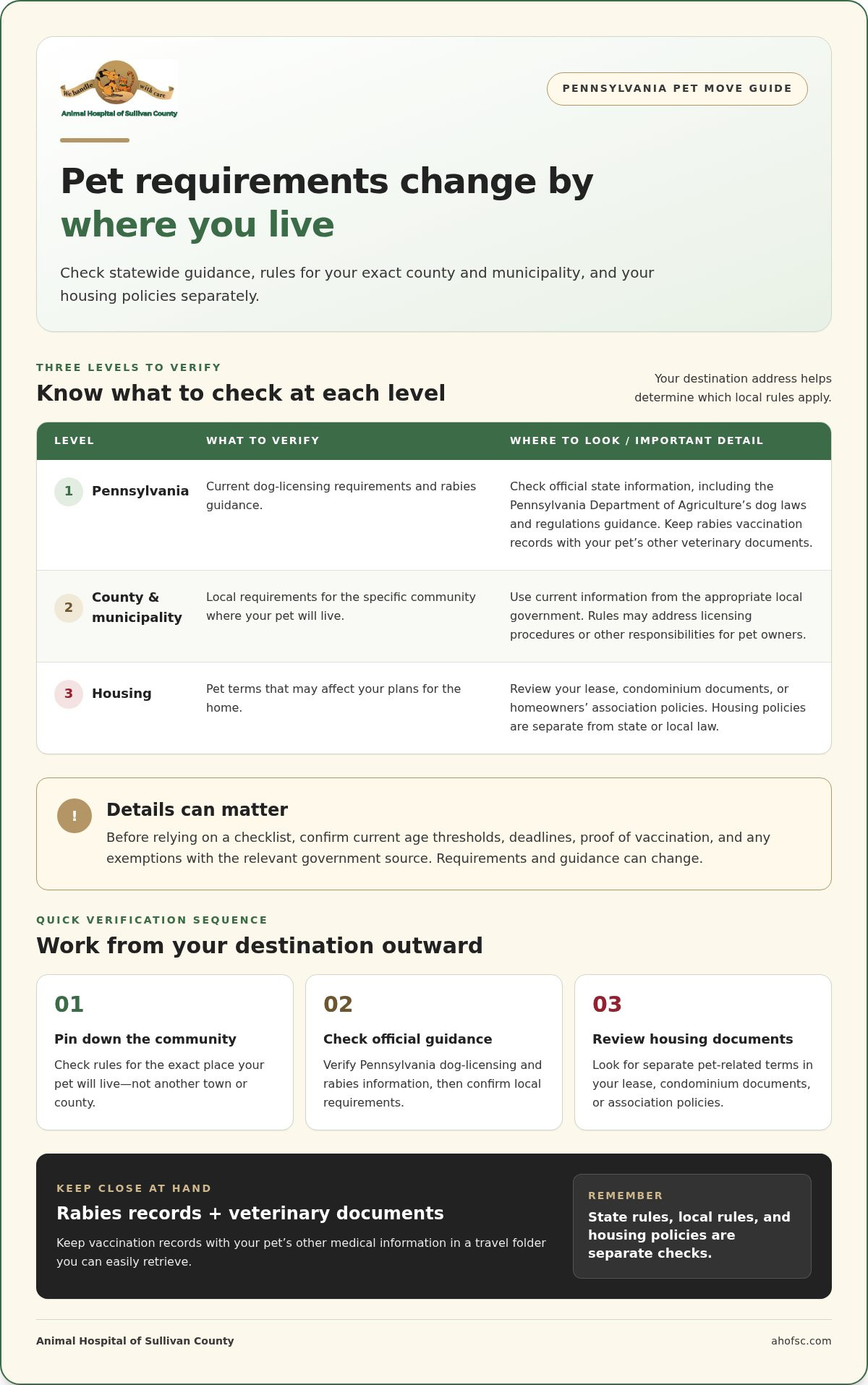
Pet rules can come from more than one level of government, so don’t assume a requirement that applies in one Pennsylvania community automatically applies in another. As part of your moving to Pennsylvania with a pet vet guide, check statewide rules first, then confirm any county or municipal requirements for the exact place you’ll live. Your lease, condominium documents, or homeowners’ association rules may add separate conditions.
Your destination address can determine which local pet rules apply, so verify requirements for the community where your pet will actually live. This distinction helps you avoid relying on advice meant for another town or county.
Check dog licensing and rabies documentation
Use current official guidance to understand Pennsylvania dog-licensing requirements and what documentation is needed. The Pennsylvania Department of Agriculture’s Pennsylvania Dog Laws and Regulations page is a useful starting point for state dog laws, licensing, and rabies information. Keep your pet’s rabies vaccination records with their other veterinary documents, where they’re easy to retrieve.
Details can matter. Before relying on a checklist, verify current rules for age thresholds, deadlines, proof of vaccination, and any exemptions directly with the relevant government source. Requirements and guidance can change, and a general article can’t determine which details apply to every pet or circumstance.
Check county, municipal, and housing rules
Next, look for pet-related requirements from the county and municipality where you’re moving. Depending on the location, rules may address matters such as licensing procedures or other responsibilities for pet owners. Use the appropriate local government’s current information rather than assuming statewide guidance answers every local question.
Housing rules are a separate step. Review your lease, condominium documents, or homeowners’ association policies before moving day. Note any pet-related terms that affect your plans, and resolve questions with the relevant property manager or association. These policies are not the same as state or local law, but they may still affect whether and how your pet can live in the home.
- State: Verify current Pennsylvania dog-licensing and rabies guidance through official state sources.
- County and municipality: Check requirements tied to your destination community.
- Housing: Review the rules that apply to your specific lease or community.
Once you have your new address, update your pet’s identification and microchip contact details with your current phone number and other requested information. That way, an old address won’t interfere with reconnecting you if your companion gets lost during the transition.
Keep a note of where you checked each rule and when, so you can revisit the right sources if plans change. If your new home is within its service area, Animal Hospital of Sullivan County’s veterinary care can be part of your ongoing care plan as you settle in.
Choose a Pennsylvania Veterinarian Without Interrupting Your Pet’s Care
A familiar care routine can make a move feel steadier for your pet. Choosing a veterinary practice is less about finding a universal “best” and more about finding care that fits your companion’s health needs, your location, and the way your family communicates. This moving to Pennsylvania with a pet vet guide approach puts continuity first: identify what your pet needs now, then look for a practice that can support ongoing care.
Start with practical details. Consider travel time from home, how appointments are scheduled, and whether the practice’s services align with your pet’s needs. A pet who takes ongoing medication may need regular follow-up, while a healthy young animal may mainly need preventive care. For families settling near Animal Hospital of Sullivan County, the practice has served its community since 1953 and provides preventive, medical, surgical, and diagnostic care for small animals. Learn more about its approach to compassionate lifelong pet care.
Match veterinary access to your pet’s needs
Look beyond location alone. Review a practice’s stated services and business hours, and consider whether appointment access suits your schedule and your pet’s likely follow-up needs. If your companion has a chronic condition, mobility concern, or recurring symptoms, continuity with a team that can understand their history may be especially valuable.
Plan for urgent situations, too. Emergency treatment and after-hours arrangements differ between practices. Understand how urgent concerns are handled during regular business hours and what arrangements apply when the practice is closed. Animal Hospital of Sullivan County provides emergency treatment during business hours; families should keep the practice’s hours and emergency instructions accessible as part of their care plan.
Transfer records and establish a clear handoff
A smooth transition depends on more than sending a file. Ask your current veterinary practice for a concise medical summary and relevant test results, then make sure the new care team receives them. Clear information can help prevent confusion about past diagnoses, medication instructions, or recommended follow-up.
- Share medication names and prescribed doses, along with known allergies or past reactions.
- Point out ongoing concerns, recent changes in behavior or appetite, and pending follow-up needs.
- Bring forward diagnostic results that may help the new team understand your pet’s history.
Keep treatment steady while the handoff is underway. Don’t stop, change, or adjust prescribed medication without veterinary guidance, even if moving disrupts the usual schedule. If a refill or follow-up may be due around the move, raise that timing with the veterinary team before departure so you can make a plan together.
Once records are transferred, share your priorities and communication preferences with the new practice. Let the team know how you prefer to receive instructions and which questions matter most to your family. A thoughtful first conversation helps establish a partnership, so your pet’s care can continue with a clear understanding of both medical needs and everyday routines.
Moving-Day Pet Checklist: Make Travel and Arrival Less Stressful
Moving day can be noisy and unpredictable, so give your pet a safe place in the plan before the doors start opening and closing. A little preparation helps prevent misplaced essentials and gives your companion familiar comforts amid the change. This part of your moving to Pennsylvania with a pet vet guide is about keeping the journey organized and making the first moments at home gentler.
A low-stress arrival starts with familiar essentials, secure surroundings, and a return to routine. Keep your pet’s needs in mind as you arrange the travel setup, pack supplies, and prepare a calm space at your destination.
Prepare a travel kit for your pet
Pack a separate, easy-to-reach bag rather than placing pet supplies in boxes headed straight to the moving truck. Include familiar food, water, bowls, waste supplies, bedding or a favorite comfort item, identification, and any prescribed medication. Keep medical records in a separate travel folder so they’re available without unpacking. For a long journey, plan ahead for access to the essentials your pet may need along the way.
Choose a secure, appropriately sized carrier or restraint suited to your pet and the way you’re traveling. Get your pet comfortable with the carrier or restraint before moving day, if possible, so it isn’t introduced amid the rush. Keep your pet secured during travel, and avoid leaving them unattended in an unsafe situation.
Travel needs can vary. If your pet has a health condition, becomes distressed while traveling, or you’re considering medication for the trip, speak with a veterinarian beforehand. Don’t give medication that hasn’t been prescribed or recommended for your pet.
Settle your pet into the new home
Before your pet arrives, prepare a quiet, enclosed room away from the busiest moving activity. Set out familiar bedding, water, food, and other essentials. Keep doors, windows, and exterior access secure while your companion adjusts, especially as movers or family members carry belongings in and out. A calm space gives your pet somewhere familiar to rest while the home is still changing around them.
- Before departure: Pack the travel kit, prepare a secure carrier or restraint, and set aside records and medication.
- During the move: Keep your pet secured and supplies accessible. Ask household members to keep track of doors and gates.
- After arrival: Bring your pet to the prepared room, offer familiar essentials, and let them explore at a comfortable pace.
As boxes are unpacked, return to familiar feeding, rest, and activity routines as much as your new schedule allows. Keep an eye on how your pet responds, and seek veterinary guidance if you have health-related concerns during the transition.
If your new home is within its service area, connect with Animal Hospital of Sullivan County about your pet’s ongoing care as you settle in.
After the Move: Build a Steady Veterinary Care Plan in Pennsylvania
Once the boxes are unpacked, turn your move checklist into a manageable plan for your pet’s care. There’s no single appointment deadline that fits every animal. Age, health history, medications, and recent travel can all shape what should happen next. Use the first weeks to share records, learn your new practice’s routines, and agree on preventive-care timing that suits your companion.
This final step in a moving to Pennsylvania with a pet vet guide is about building continuity, not rushing through a list. Keep your pet’s veterinary details together, note any questions that came up during the journey, and update identification once your new contact information is settled.
Plan the first veterinary conversation
Bring or send your pet’s medical records, current medication details, and any recent test results. Share observations from the journey and the adjustment period, such as changes in appetite, energy, behavior, or medication routine. Even small details can help the veterinary team understand how your pet is settling in.
Use the conversation to review health history and discuss an appropriate preventive-care plan for your pet’s individual needs. Rather than assuming an old schedule still fits, ask how prior care, current health, and upcoming needs should guide the next steps. The pet wellness and lifelong-care guide offers additional perspective on supporting your companion through each stage of life.
Update identification and plan for changing needs
After your new address and phone number are settled, update the contact information on your pet’s collar identification and microchip registration. A microchip is only useful for reunification when its contact details are current. Use this pet microchipping guide as a helpful reminder to review that information after a move.
Save your regular veterinary practice’s phone number and business hours somewhere easy to find. Also understand its stated emergency-care arrangements. Animal Hospital of Sullivan County provides emergency treatment during business hours. For needs outside those hours, make a separate plan for where to seek urgent veterinary help, and keep that information accessible rather than searching for it during a stressful moment.
- Keep a digital and printed copy of key health information.
- Track medication instructions and follow-up recommendations.
- Save contact details, business hours, and emergency-care instructions.
- Review identification and microchip contact information after settling in.
Small, steady steps help make a new place feel more familiar for the whole family. If you’re settling within the hospital’s community, you’re warmly invited to learn about Animal Hospital of Sullivan County and its veterinary care as you plan your pet’s next chapter.
Make Your Pet’s Next Chapter Feel Familiar
A new home becomes familiar one small routine at a time. As your family settles in, keep your pet’s care part of that rhythm: notice how they’re adjusting, keep important information easy to find, and stay connected with a veterinary team that understands their needs. The moving to Pennsylvania with a pet vet guide is a starting point, but your companion’s individual needs can shape the plan from here.
You don’t have to make every decision at once. Take the next practical step, whether that’s updating contact details, sharing records, or arranging a conversation about ongoing care. A steady relationship with a veterinary team can help your pet feel supported through this transition and the years ahead.
If you’re settling within the hospital’s community, learn about veterinary care at Animal Hospital of Sullivan County and take a look at whether it’s a good fit for your family. Here’s to a welcoming new home and many happy, healthy days together!
Frequently Asked Questions
Do I need to change my pet’s veterinarian when I move to Pennsylvania?
No, you don’t have to change veterinarians simply because you’re moving. You can continue with your current practice if travel and appointments remain practical, or establish care closer to your new home for easier visits and follow-up. In this moving to Pennsylvania with a pet vet guide, the goal is a workable care relationship, not a change for its own sake. Ask your current practice how to share records if you decide to transfer care.
What veterinary records should I bring when moving with a pet?
Bring vaccination history, a medical summary, relevant diagnostic or laboratory results, and a current medication list. Include the prescribing instructions and note known allergies, past reactions, ongoing conditions, or pending follow-up. For example, if your pet recently had imaging or bloodwork, those results may help a new veterinarian understand the context without repeating the story from memory. Keep a copy you can access if your phone battery dies or internet access is unavailable.
Does Pennsylvania require a dog license?
Yes. Pennsylvania requires dogs three months of age or older to be licensed. Verify the current process and any applicable details through official Pennsylvania guidance and the county where you’ll live, since local licensing steps may differ. Keep the license information with your pet’s important records, and note when it needs renewal. If you’re moving with a younger puppy, check the current rules as the dog approaches the applicable licensing age.
Do I need proof of rabies vaccination when moving to Pennsylvania?
Pennsylvania requires dogs and cats three months of age or older to have a current rabies vaccination. Keep the vaccination certificate with your pet’s records, including the date and other details shown by the issuing veterinary practice. Proof may also be needed when obtaining a dog license. Confirm current documentation requirements with official state and destination-local sources, especially if your pet’s vaccination is due or the records you have are incomplete.
How soon after moving should I find a new veterinarian?
Start identifying veterinary care before you move, then arrange a first conversation or appointment based on your pet’s health and upcoming needs. There isn’t one deadline that suits every animal. A pet with a medication refill, ongoing condition, or recommended follow-up may need a more immediate plan than a healthy pet whose preventive care is current. Share the records and ask the veterinary team to help set an appropriate schedule.
Can my pet travel with its medication during a move?
Yes, bring prescribed medication with your pet rather than packing it with household belongings. Keep it in its labeled container when possible, follow the veterinarian’s instructions, and make sure you can access it during the journey. Don’t change the dose or give medication intended for another animal. If travel timing could interfere with a dose, or you’re unsure how to manage medication on the road, get individualized guidance from your veterinarian before departure.
What should I do if my pet becomes sick during the move?
If your pet seems ill, contact a veterinary practice for guidance and describe the signs, when they began, and any medication your pet takes. For severe or rapidly worsening symptoms, seek urgent veterinary attention rather than waiting until you reach your destination. Before departure, save contact details for veterinary care along your route and near your new home. If you’re unsure how serious a symptom is, call a veterinary professional for direction.


