
If you’re searching for “cat check up cost near me,” you probably want a clear estimate and a sense of what could add to it. The total depends on the purpose of the visit and the care recommended for your cat. A routine wellness appointment and a visit prompted by a new symptom may involve different discussions and services.
This guide explains what can shape a check-up estimate in Sullivan County, what a wellness visit may involve, and how to prepare for a useful cost conversation. Your cat’s age, lifestyle, health history, and current condition can all inform recommendations. Animal Hospital of Sullivan County provides preventive care and onsite diagnostics to support each cat’s individual needs. Cat owners in New York, Connecticut, New Jersey, and Pennsylvania can use these steps to plan questions and understand what a visit may include.
Key Takeaways
- A cat check-up estimate is specific to your cat. The “cat check up cost near me” may depend on their health, age, and recommended care.
- A wellness visit is a chance to discuss your cat’s behavior, appetite, activity, and health history with the veterinarian.
- Ask how the examination, recommended diagnostics, and treatment for a health concern may affect the estimate.
- Prepare for a cost discussion by bringing medication details, relevant records, and written questions about your cat’s care.
- Animal Hospital of Sullivan County provides preventive care and onsite diagnostic capabilities to support your cat’s ongoing health.
Cat check-up cost near Sullivan County: why there is no one-size-fits-all estimate
Planning preventive care means balancing your cat’s health needs with your household budget. Searching for “cat check up cost near me” can turn up figures, but an estimate is most useful when it reflects the reason for the visit and the care recommended for your cat.
A routine wellness appointment differs from a visit prompted by vomiting, a change in appetite, or another concern. The recommended care may differ, too. No single estimate fits every cat because each visit is shaped by that cat’s needs and clinical findings.
For a broad overview of preventive medicine and common health concerns, the Cat Health reference offers useful background. A veterinarian can help put your own cat’s history and current condition in context.
To see an example of a cat’s visit to the veterinarian, watch this video:
What owners mean when they search for a cat check-up
Some owners are planning routine wellness care; others are seeking help because something seems different. These may be different kinds of appointments. Your cat’s age, health history, lifestyle, and current concerns can guide the conversation and recommendations. Vaccines, tests, or treatment are not automatically part of every check-up. They depend on your cat and what the veterinarian finds or discusses.
Why nearby prices and national averages may not match
Clinic location can influence pricing, as can the reason for the visit and the services recommended. A published figure might cover an exam alone, bundle the exam with other services, or reflect another region. Third-party surveys are broad references, not dependable predictions for a Sullivan County appointment. For local context on the practice and its approach to care, explore the Sullivan County animal hospital care guide.
For a more useful planning conversation, explain whether your cat is coming in for routine prevention or because you’ve noticed a change. Share relevant history, then ask which recommendations are important now and how each would affect the estimate. This helps distinguish the planned visit from additional care that may be considered based on your cat’s circumstances.
What a cat wellness check-up may cover at a Sullivan County veterinary clinic
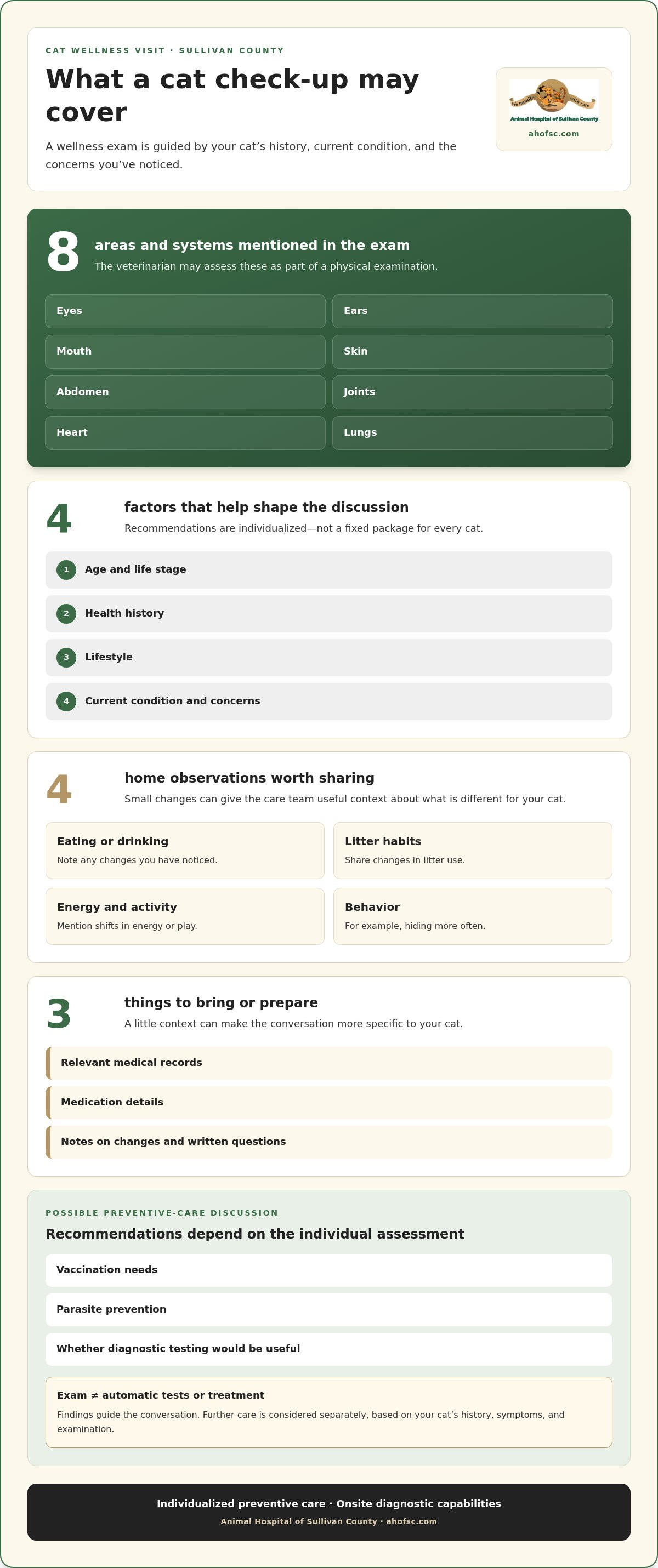
A wellness visit gives you and the veterinarian time to discuss how your cat is doing and consider their health as a whole. The appointment may include a physical examination informed by your cat’s age, history, and any concerns you’ve noticed.
During an examination, the veterinarian may assess your cat’s eyes, ears, mouth, skin, abdomen, and joints, and listen to their heart and lungs. Findings guide the discussion, but do not automatically mean your cat needs tests or treatment. Further care depends on the individual assessment.
Preventive care is individualized: the veterinarian considers your cat’s history, current condition, and needs before discussing recommendations.
What the veterinarian may discuss during a routine cat exam
Your observations at home are valuable. Be ready to describe changes in eating or drinking, litter habits, energy, and behavior. A subtle shift, such as hiding more often or playing less, can help the care team understand what has changed. Bring questions, too, so you can leave with a clearer picture of your cat’s care.
Health history adds context to the examination. Previous diagnoses, medications, and changes over time can help distinguish a new concern from a long-standing pattern. If you’re unsure whether something is relevant, mention it. Sharing what you’ve noticed makes the conversation specific to your cat rather than a generic checklist.
How a cat’s age and history shape preventive care
A kitten’s care discussion may differ from an adult cat’s, while a senior cat’s needs and history may prompt different questions. Preventive recommendations are not identical for every age group. The veterinarian can consider your cat’s life stage and circumstances when discussing what may be appropriate. For age-related context, the senior pet care guide explores considerations for older companions.
Depending on the discussion and examination, preventive care may include talking through vaccination needs, parasite prevention, or whether diagnostic testing would be useful. These are possibilities, not a fixed package for every wellness visit. Animal Hospital of Sullivan County provides preventive care supported by onsite diagnostic capabilities, so recommendations can be considered in the context of your cat’s health.
Before the appointment, note changes you’ve observed and gather relevant medical records and medication details. If the veterinarian makes a recommendation, ask what it is intended to address and how it relates to your cat’s health. Understanding the reason behind each step can help you make informed decisions. Learn more about preventive veterinary care at Animal Hospital of Sullivan County.
What can change a cat check-up estimate? Understanding possible add-on care
A wellness exam and any care recommended after it are separate parts of the visit. The examination gives the veterinarian a chance to assess your cat. Further services depend on what your cat’s history, symptoms, and exam findings suggest.
The exam is one part of the estimate; any additional care is recommended separately based on your cat’s needs.
| Part of the visit | What it may involve | Why it may affect the estimate |
|---|---|---|
| Routine examination | A wellness assessment and discussion of your cat’s health and preventive needs. | This is the planned check-up; its scope is distinct from additional services. |
| Recommended diagnostics | Testing may be considered to help investigate a concern or clarify findings. | The type of diagnostic service depends on the clinical question and your cat’s circumstances. |
| Treatment for a health concern | Care may be discussed if the veterinarian identifies a problem or your cat has symptoms. | The plan depends on the concern and the care considered appropriate for your cat. |
This breakdown is useful when comparing information about “cat check up cost near me.” A total that includes diagnostics or treatment is not necessarily describing the same visit as an estimate for an examination alone. Ask for the estimate to be explained by category, so you can tell what relates to the exam and what relates to a separate recommendation.
Routine exam versus additional diagnostic testing
Testing may be recommended when symptoms, health history, or examination findings give the veterinarian a reason to investigate further. A diagnostic test gathers information about a specific health question. It does not guarantee a particular result and is not automatically part of every check-up. Animal Hospital of Sullivan County has onsite diagnostic capabilities to support care when testing is appropriate. Those capabilities do not mean every cat needs diagnostics during a wellness visit.
If a test is recommended, ask what question it is intended to answer, how the result could inform care, and whether it is needed during this visit or can be discussed as part of a follow-up plan. A clear explanation helps you understand the recommendation without assuming every possible service is a required add-on.
When a check-up becomes a medical or urgent visit
A planned preventive appointment differs from a visit prompted by a new or worsening symptom. Changes such as reduced appetite, unusual litter habits, or a sudden shift in behavior are useful to mention when arranging care. Share when the change began and whether it has progressed. If you’re concerned that your cat needs urgent attention, describe the symptoms promptly. Emergency treatment is available during business hours.
Animal Hospital of Sullivan County provides preventive, medical, and diagnostic care for small animals. Learn about pet diagnostic care in the diagnostics guide. For individualized care planning, connect with Animal Hospital of Sullivan County.
How to plan for a cat check-up near Ferndale, NY, without skipping needed care
A little preparation can make the appointment more comfortable and the cost conversation clearer. You don’t need every answer in advance. Bring what you know about your cat, share what concerns you, and let the care team help you understand the next steps.
Before the visit, gather your cat’s records and medication list, note any changes, and write down your questions and budget concerns.
- Before the appointment: Note the reason for the visit and any symptoms or changes you’ve observed.
- Gather useful information: Bring relevant veterinary records and a current list of medications and supplements.
- Prepare questions: Write down what you’d like to understand about the exam, recommendations, and estimate.
- During the discussion: Share your priorities and ask how recommended care relates to your cat’s needs.
Questions to prepare before your cat’s appointment
Ask what the examination covers and whether additional recommendations are optional, time-sensitive, or important to address during the visit. If you have a budget in mind, say so. Cost concerns are a normal part of planning care, and sharing them helps the team explain recommendations and discuss an appropriate plan.
Make room for questions about symptoms, health history, and what you’ve noticed at home. For example, ask what a proposed test is intended to clarify, or whether a recommendation addresses an immediate concern or longer-term prevention. If several needs come up, ask which steps should be prioritized and why. Clear explanations can help you make informed decisions without feeling pressured to agree to every recommendation at once.
Records and observations that help the veterinary team
Bring prior veterinary records if you have them, along with the names or packaging details of your cat’s medications and supplements. Note when a change began and how often it happens. “Eating less since last week” gives more context than “not eating normally.” For older companions, age-related questions may be useful to discuss alongside the senior pet care guide.
If your cat’s condition seems urgent or is worsening, don’t postpone seeking veterinary guidance just to reduce an estimate. Describe the changes when arranging care so the team understands why you’re calling. Preparation can support thoughtful decisions, but it shouldn’t stand in the way of an examination or diagnostic care that may be needed for your cat’s health.
Animal Hospital of Sullivan County provides preventive, medical, and diagnostic care for small animals. If your cat is due for preventive attention, schedule a cat check-up and bring your questions so the visit can focus on your companion’s needs.
Book a caring cat check-up with Animal Hospital of Sullivan County
Your cat’s health is personal, and preventive care should make room for the questions and observations that matter to your family. Animal Hospital of Sullivan County has cared for small animals in the community since 1953, providing preventive, medical, and surgical care supported by onsite diagnostics. This gives you a foundation for discussing your cat’s wellbeing and planning around their individual needs.
A check-up is also a chance to build a fuller picture over time. Sharing changes in your cat’s appetite, activity, or behavior helps the veterinary team understand what is typical for them and what may need attention. If the discussion points to further assessment, onsite diagnostic capabilities support care when the veterinary team determines they are appropriate. Testing is not automatically part of every preventive visit.
A local team for preventive care and ongoing questions
Compassionate care includes listening to the people who know their pets best. Questions about a new behavior, a change in routine, or your cat’s preventive needs are worthwhile, even if the change seems small. Keeping your veterinary team informed about your companion’s health history makes future conversations more specific and useful.
Preventive visits offer time to discuss health and care priorities before concerns become the focus of an appointment. They can help you understand what your cat may need now and what to keep in mind as their needs change. For a broader look at the practice’s approach to supporting pets over time, the guide to compassionate, lifelong pet care shares more local context.
Take the next step toward your cat’s check-up
If you’re ready to arrange preventive care, share your cat’s age and the reason for the visit when planning the appointment. Mention symptoms or recent changes, too. A routine wellness visit and an appointment prompted by a new concern may call for different conversations, so explaining what’s happening helps the team understand your cat’s needs.
It’s also fine to raise cost concerns. If you’re searching for “cat check up cost near me,” remember that an estimate depends on the visit and recommendations for your individual cat. Discussing your questions and priorities can help you understand the proposed plan without assuming every possible test or service is needed.
Animal Hospital of Sullivan County supports cats’ preventive care with attention to their individual health. Arrange your cat’s check-up, and share any concerns when booking so the visit can begin with what matters most to you and your companion.
Make your cat’s next care decision with confidence
Planning for your cat’s health doesn’t require having every answer before you walk through the door. A thoughtful conversation can help you understand the choices and decide what makes sense for your companion now. As your cat’s needs change, that shared understanding can provide a steadier starting point for future care decisions.
If you’re searching for “cat check up cost near me,” bring questions about the estimate, your cat’s wellbeing, and the care being considered into the conversation. You deserve to feel informed, and your cat deserves care guided by their individual needs.
Schedule a caring check-up for your cat with Animal Hospital of Sullivan County. Share any concerns when arranging the visit, and take the next step knowing you can discuss your companion’s care with a team that values their wellbeing. A little clarity can help you move forward with greater confidence.
Frequently Asked Questions
How much does a cat check-up cost near me?
The cost depends on the appointment and the care recommended for your cat, so “cat check up cost near me” won’t produce one price that applies to every Sullivan County visit. Ask for an estimate based on the planned appointment and clarify which services it includes. If your cat needs additional care after assessment, ask how those recommendations affect the estimate before proceeding.
What is included in a routine cat check-up?
A routine check-up generally centers on a physical examination and a conversation about your cat’s health. The veterinarian may assess your cat’s overall condition and discuss changes you’ve noticed at home. Vaccinations, testing, or treatment are not automatically included; recommendations depend on the individual cat. If you’re unsure what an exam estimate covers, ask for the planned visit to be described separately from possible follow-up care.
Does a cat need a check-up every year?
Ask your veterinarian what schedule suits your cat rather than assuming one interval is right for every pet. Age, medical history, and changes in health can affect how often a cat should be seen. A cat managing an ongoing concern, for example, may need a different follow-up plan from a healthy adult. Your veterinarian can help set a schedule and explain when to arrange a visit sooner.
Can I ask about the cost before my cat’s appointment?
Yes, raising cost questions while planning an appointment is reasonable. Explain whether the visit is preventive or prompted by a concern, then ask what the estimate covers and how separately recommended care may affect it. You can also share a budget concern so the veterinary team can explain priorities and discuss a plan. If your cat’s symptoms worsen, don’t delay seeking veterinary guidance just to settle the estimate first.
What should I bring to my cat’s check-up?
Bring relevant veterinary records and a current list of medications and supplements, including their names and how your cat takes them. Jot down questions and specific observations, such as when a behavior began or how often it happens. If a symptom is intermittent, a short video can help illustrate what you’ve seen at home. Keep your cat safely secured in a carrier for travel to the clinic.
Is a cat wellness exam the same as a sick visit?
No. A wellness exam is planned around preventive care, while a sick visit is prompted by a symptom or change that needs attention. A sick visit may lead to diagnostic testing or treatment depending on the veterinarian’s assessment, so its scope can differ from a preventive appointment. When arranging care in Sullivan County, describe the concern and when it began, especially if it is getting worse.


