Did you know that microchipped dogs are reunited with their families over twice as often as those without one, while microchipped cats are returned home at a rate nearly twenty times higher? These statistics from the American Veterinary Medical Association highlight why microchipping pets Sullivan County is such a vital step for every local family. While a collar can slip off and a tag can become unreadable, a microchip stays with your best friend forever. It acts as a silent, permanent guardian that never fails, even in the thickest brush of the Catskills.
We understand the deep anxiety that comes with a pet wandering off during a hike or slipping out the back door. It's a heavy weight to carry, but you don't have to face that fear alone. This guide will show you how a simple microchip provides a permanent bridge home for your Sullivan County pet, even if collars and tags are lost. We'll clear up the confusion between GPS trackers and chips, explain why the procedure is as quick as a routine vaccination, and help you ensure your contact information is always ready to bring your companion back to your arms.
Key Takeaways
- Learn why a tiny RFID transponder provides a permanent form of identification that never loses power, unlike battery-dependent GPS trackers.
- Discover how the quick and safe process of microchipping pets Sullivan County is no more stressful for your companion than a routine vaccination.
- Understand the vital importance of national registry enrollment to ensure your pet's unique ID is always linked to your current contact information.
- Explore how local community networks and professional scanners in Monticello and Liberty work together to create a reliable safety net for lost pets.
- Find peace of mind by partnering with a compassionate expert who treats your pet's safety as a sacred, lifelong commitment.
What is Pet Microchipping and Why Does it Matter in Sullivan County?
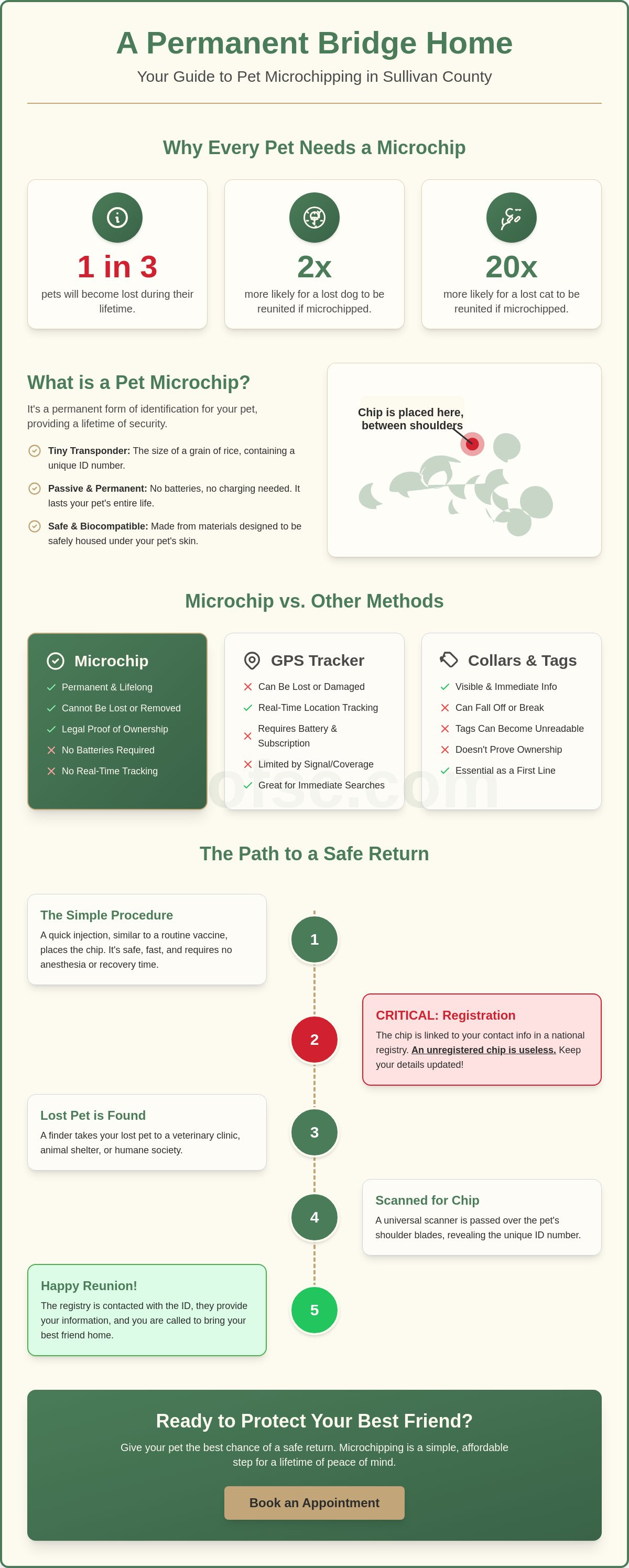
Sullivan County is a paradise for our four-legged friends, offering sprawling hiking trails and lush wooded areas to explore. However, these beautiful environments also come with unique risks. A sudden summer thunderstorm or a fast-moving deer can cause even the most well-behaved pet to bolt into the brush. Research from animal welfare organizations like the American Humane Association suggests that 1 in 3 pets will go missing during their lifetime. This is a frightening thought for any pet parent! That's why microchipping pets Sullivan County is such a vital part of our local community's safety net. It provides a level of security that travels with your pet wherever they go, even when other methods fail.
To understand how this technology works, it helps to know what a pet microchip is and how it functions. It's a tiny RFID transponder, about the size of a grain of rice, that is gently placed under the skin between the shoulder blades. Unlike other devices, a microchip isn't a GPS tracker. It doesn't broadcast a signal or track your pet's movements through the forest. Instead, it holds a unique identification number. This number is your pet's permanent ticket home, only revealing itself when scanned by a professional at a vet clinic or animal shelter. It's a simple, elegant solution for a complex problem.
Microchip vs. GPS: Understanding the Difference
Many families use GPS collars to track their pets in real time during hikes. These are fantastic tools, but they rely on batteries, cellular signals, and active subscriptions. If the battery dies or the collar falls off in the woods, the protection vanishes. A microchip is different because it lasts for your pet's entire life. It never needs a charge and works everywhere, providing a final safety net when technology fails. While GPS is great for finding a pet right now, the chip is what proves who they belong to when they're found.
Why Collars and Tags Aren't Enough
We always recommend collars and tags, but they are rarely a complete solution on their own. In the rugged Catskills, a collar can snag on a branch and break away. Tags also suffer from wear and tear, eventually becoming unreadable. Because a microchip is placed securely under the skin, it cannot be lost or removed. It also serves as legal proof of ownership in a dispute. Choosing microchipping pets Sullivan County families can rely on is the most effective way to ensure your family remains whole!
The Microchipping Procedure: Simple, Safe, and Fast
Many pet parents feel a bit of "needle nerves" when they think about their beloved companion getting a microchip. We completely understand that feeling! It's natural to worry about anything involving a needle for your furry family member. However, the actual experience is quite gentle. The injection is very similar to a routine vaccination. It's a simple, safe, and fast procedure that provides a lifetime of protection. There is no need for anesthesia or surgery. Your pet won't even need a recovery period. They can go right back to their favorite activities, like chasing squirrels or napping in the sun.
We place the tiny chip just under the skin between the shoulder blades. This specific area is chosen because the skin is loose, making the injection easy and keeping the chip secure. The chip itself is made of biocompatible materials, similar to what's used in human medical implants. This ensures it lives harmoniously inside the body without causing allergic reactions or irritation. Over time, a thin layer of connective tissue forms around the chip, which helps keep it from moving around. It's a silent, comfortable guardian that your pet will never even know is there.
When is the Best Time to Microchip?
Timing is flexible, but earlier is usually better. We often perform microchipping pets Sullivan County during a puppy or kitten's very first preventive care visit in Ferndale. Another popular option is to have the chip placed during a spay or neuter surgery while your pet is already resting comfortably under anesthesia. If you have an older pet who isn't chipped yet, don't worry! It's never too late to provide that extra layer of security for a senior companion. Every pet deserves that bridge back home.
What to Expect During Your Visit
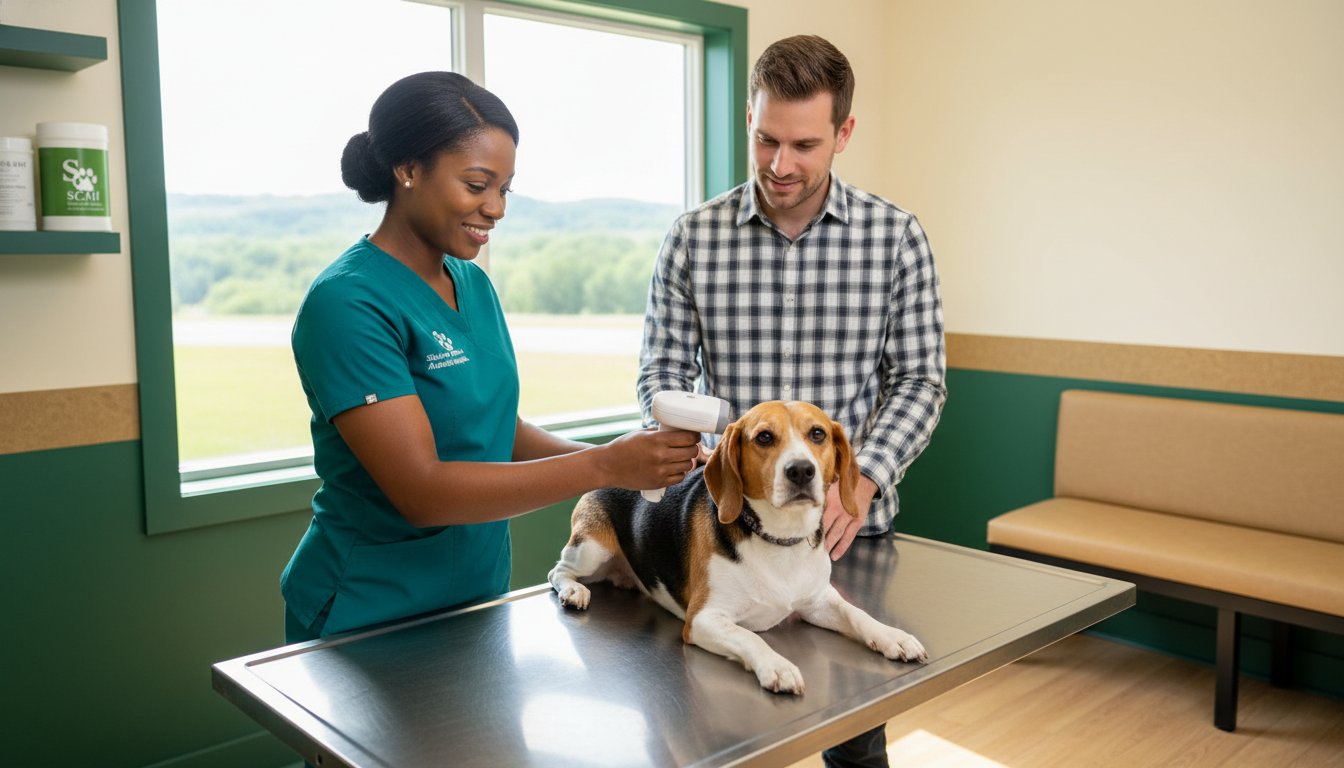
We follow a steady, methodical process to ensure every detail is perfect. First, the veterinarian uses a handheld scanner to check the new chip and ensure it's functioning correctly. Next comes the quick injection, which only takes a few seconds. Most pets barely notice it, especially if they're distracted by a tasty treat or a gentle ear rub! Finally, we scan your pet one more time to confirm the chip is correctly placed and readable. This methodical approach ensures your pet's permanent ID is ready to go before you even leave the clinic. Providing microchipping pets Sullivan County families trust means making sure every step is handled with heart and precision. We want you to walk out our doors feeling confident and secure.
Activating the Safety Net: Registration and Recovery
A microchip is a marvel of modern medicine, but it's only half of the safety equation. Without your contact information linked to that unique number, the chip is like a key with no door to open. We want to ensure that if your pet is ever lost, the journey back to your arms is as short as possible! This is why registration is the most critical step after microchipping pets Sullivan County companions. Many veterinary professionals across New York rely on the HomeAgain registry, a trusted national database that helps reunite thousands of families every year. It's a simple step that turns a piece of technology into a true lifeline.
When a lost pet is brought into a local facility, whether it's a vet clinic or a shelter in Monticello or Liberty, the very first thing staff members do is reach for a scanner. According to the American Veterinary Medical Association, microchipped dogs are reunited with their owners 52.2% of the time, compared to just 21.9% for those without. For cats, the difference is even more staggering, with return rates jumping from 1.8% to over 38%. The study found that the most common reason for a failed reunion is incorrect or missing information in the registry. We don't want that to happen to you. While social media groups are wonderful for spreading the word, they rely on someone seeing a post at the right time. A registered microchip is a direct, private line of communication that works 24/7.
How to Register Your Pet's Microchip
The process is simple and only takes a few minutes of your time. Start by locating your pet's unique 15-digit ID number, which we provide on a card during your visit. Next, visit the registry website, such as HomeAgain, to create a secure profile for your pet. Finally, add your current phone number and at least one emergency contact. This ensures that if you're traveling or unavailable, someone who loves your pet can still be reached.
Keeping Your Information Current
Life changes, and your pet's registry should change with it. We recommend making it a habit to check your contact details during your pet's annual wellness exam. If you move to a new home in Sullivan County or get a new cell phone number, updating the registry should be at the top of your to-do list. If you've recently adopted a pet that was already microchipped, you'll need to transfer the registration into your name. This ensures that microchipping pets Sullivan County owners rely on actually works when it matters most. When a shelter scans a pet and finds a current number, the relief is instantaneous!
Sullivan County Local Resources for Lost and Found Pets
Living in our beautiful corner of New York means we get to enjoy stunning landmarks like Walnut Mountain Park or the scenic trails near Liberty. While these spots offer wonderful bonding time for families and their companions, they're also places where a curious scent can lead a pet off the path. If your best friend wanders away, the community in Monticello, Liberty, and Ferndale is incredibly supportive. However, navigating the local protocol for lost animals can feel overwhelming when you're worried. This is why microchipping pets Sullivan County families choose is so essential. It works alongside our local resources to bring families back together safely.
In New York State, there is a specific protocol for finding stray animals. If you find a wandering dog or cat, the law generally requires you to notify the town's animal control officer or the local police department. Many people also turn to the SullCo Lost and Found Pets Facebook group. This is a fantastic secondary resource where neighbors help neighbors by sharing photos and sightings. While social media moves fast, it isn't always foolproof. A rainy photo or a missing collar can lead to confusion. The microchip remains the only way to provide certain identification that holds up in any situation, ensuring your pet isn't just another post on a timeline.
What to Do if Your Pet Goes Missing in Sullivan County
The moment you realize your pet is missing, your first step should be to alert your microchip registry. This flags the ID number as "lost" in the national database. Next, call the animal control officers in your specific town and reach out to nearby veterinary clinics. Even if your pet hasn't been brought in yet, having their description on file is helpful. We recommend using social media to spread the word quickly, but always rely on the chip for the final, positive identification that proves your pet belongs home with you.
Finding a Pet: The Role of Local Veterinarians
If you happen to find a stray animal, any veterinary clinic in our area can help. Most modern clinics use a "Universal Scanner." This device is designed to read all different frequencies of microchips, ensuring no pet is left unidentified. In our Ferndale clinic, we provide this scanning service for free to help lost souls find their way home. It is a moment of pure joy for our staff when a quick scan reveals a registered number and a phone call home! If you want to ensure your pet has this same protection, we invite you to schedule a preventive care visit to discuss the best options for your family. This small step creates a permanent safety net that covers every mile of our beautiful county.
Why Sullivan County Families Trust Animal Hospital of Sullivan County
Since 1953, our hospital has been a steady, comforting presence for families throughout the region. We've seen generations of pets grow up in our care; that long history is something we cherish deeply. Dr. B leads our team with a heart-first philosophy. This means every animal is treated with the same tenderness we'd give our own cherished family members. We view the relationship between you and your animal as a sacred bond that requires both technical skill and emotional sensitivity. For families seeking microchipping pets Sullivan County services, they choose us because we combine this neighborly warmth with the highest medical standards. As an AAHA-accredited facility, we hold ourselves to rigorous benchmarks that only an elite group of animal hospitals in North America achieve. This accreditation is a mark of our dedication to excellence in every stitch, scan, and checkup.
Comprehensive Care Beyond the Chip
Our commitment to your pet's happiness doesn't end with a microchip. We provide a full spectrum of medical and surgical care to keep your companion healthy for years to come. From routine vaccinations and preventive care to advanced diagnostics, we're here for every stage of their life. We understand that a visit to the vet can sometimes feel stressful, so we strive to create a welcoming environment that feels like home. Our onsite pet store is also stocked with recommended collars and safety gear. These items offer a great secondary layer of protection to complement your pet's new permanent ID. Every family member who walks through our doors in Ferndale receives personalized attention. We believe in treating the person at the other end of the leash with just as much kindness as the patient.
Schedule Your Pet's Safety Appointment Today
Securing your pet's future is a simple step that provides a lifetime of relief. You can easily combine a microchipping procedure with your pet's next wellness exam for added convenience. It only takes a few moments to create a permanent link between you and your best friend. Peace of mind is just one short visit away! Our team is ready to guide you through the registration process so you can leave our clinic feeling completely confident. Protect your pet today with a microchip at Animal Hospital of Sullivan County!
Give Your Pet a Permanent Ticket Home
Choosing a microchip is one of the most loving gifts you can provide for your companion. It's a silent guardian that stays with them through every adventure, ensuring they're never truly lost. This simple step is the heart of microchipping pets Sullivan County families trust to bridge the gap between a lost pet and a joyful reunion. By pairing this technology with an updated registry, you're creating a lifelong safety net that works even when collars and tags fail.
Our team has served the families of this county since 1953, and we take that legacy of trust seriously. Dr. Barbara Bodolosky leads our AAHA accredited facility with a "heart-first" approach, treating every animal like a member of our own household. We're here to guide you through this quick procedure with the compassion and expertise your pet deserves. Schedule a Microchipping Appointment in Ferndale Today to secure your peace of mind. We can't wait to see you and your best friend in our clinic soon!
Frequently Asked Questions
Does microchipping hurt my pet?
The procedure is very gentle and feels much like a routine vaccination. We use a sterile needle to place the tiny chip, and most pets don't even flinch, especially if they're distracted by a yummy treat! There is no lingering pain, and your pet won't even know the chip is there once the second-long pinch is over.
How much does it cost to microchip a dog in Sullivan County?
Professional fees for this service can vary depending on the facility you choose. Some local animal shelters offer low-cost clinics at specific times of the year, while private veterinary practices include the chip and registration assistance as part of their professional care. We recommend calling your trusted local provider directly to get the most accurate information for your budget.
Can a microchip track my pet's location via GPS?
No, a microchip is not a GPS tracking device. It doesn't have a battery or a way to broadcast a signal across the Catskills. Instead, it uses passive RFID technology that only "wakes up" when a scanner is passed over it. It's a permanent form of identification rather than a real-time tracking tool.
What happens if I move or change my phone number?
You'll need to log into your pet's registry account, such as HomeAgain, to update your contact details. This is a vital step for microchipping pets Sullivan County owners often overlook! If your information isn't current, the shelter won't be able to call you when they scan your pet. We suggest checking your account every year during your pet's wellness visit.
Do I have to pay a yearly fee for the microchip to work?
No, the microchip itself never "expires" and doesn't require a subscription to function as an ID. While some registries offer optional premium memberships for extra travel or medical perks, the basic service of linking your pet's ID number to your phone number is typically permanent once you've completed the initial registration.
Can a microchip wear out or need to be replaced?
Microchips are incredibly durable and are designed to last for at least 25 years. Because they have no moving parts and no internal power source, there is nothing to wear out or break down. It's a one-time procedure that provides a lifetime of protection for your furry family member.
Is my personal information safe in the microchip database?
Yes, your privacy is very well protected. The microchip itself only contains a unique 15-digit identification number; it does not store your name, address, or phone number. Only authorized personnel at animal shelters or veterinary clinics can use that ID number to access your contact information through the secure, encrypted registry.
What should I do if I find a lost pet in Sullivan County?
Your first and most helpful step is to take the animal to a local vet or shelter to be scanned for a chip. Most clinics in our area will perform this scan for free to help a lost pet get home. While you wait for results, you can also post a clear photo on the SullCo Lost and Found Pets Facebook group to alert the local community.


